
Smart Glasses Hinge Patent Seals Out Water and Dust
Folding the arms on a pair of smart glasses is a surprisingly tricky engineering problem when water is involved. Meta's latest patent tackles the weak spot where the hinge meets the frame.
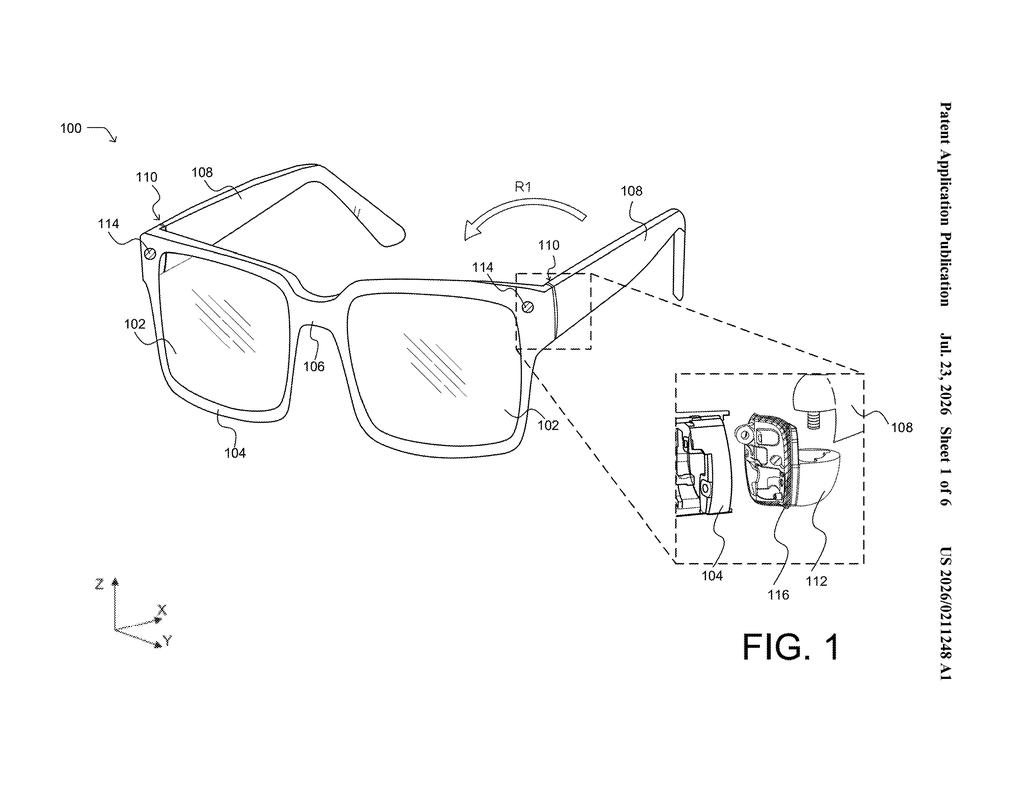
What Meta's glasses hinge water seal actually does
Imagine wearing your smart glasses on a rainy walk or a sweaty workout. Every time you fold the arms in and out, the hinge flexes, and that gap is exactly where water and dust sneak inside to damage the electronics.
Meta's patent describes a rubber-like seal called a wiper gasket that wraps around the hinge where it meets the frame. Think of it like the rubber lip around a car door, pressing firmly against a surface to block anything from getting through.
The clever part is how the frame itself is held together. Instead of the seal bearing all the mechanical stress when you bend the arm, internal mounting points inside the frame absorb that force. Your wiper gasket stays pressed tight without getting stretched or torn over time, keeping the seal working much longer.
How the wiper gasket and internal mounts share the load
The patent covers a hinge assembly for a head-mounted device, most likely smart glasses. At its core, the design solves a problem that plagues any folding wearable: keeping the junction between a moving arm (the temple) and the main frame (the front piece) watertight.
The key component is a wiper gasket, a flexible seal that wraps around the inner edge of the frame and presses against a fixed section of the hinge. The gasket sits at the boundary where the temple connects to the frame, forming a continuous barrier against water and dust.
What separates this approach from a simple rubber ring is the load-management structure behind it:
- The stationary part of the hinge is fastened to the frame through internal mounts hidden inside the frame body.
- When force is applied to the frame (say, a flex during folding or from being sat on), that force travels into the internal mounts rather than into the gasket itself.
- This means the seal is not being constantly stressed and distorted by mechanical loads, so it keeps its shape and its sealing ability over many cycles.
The design essentially decouples the structural job (holding the hinge in place) from the sealing job (blocking water), letting each component do only what it is designed to do.
What this means for future Ray-Ban Meta glasses
Smart glasses are worn in the real world, which means rain, humidity, and sweat. Today's Ray-Ban Meta glasses carry an IPX4 splash rating, which is fairly modest. A more durable hinge seal could support a higher water-resistance rating, the kind that opens up more outdoor and athletic use cases without the anxiety of a drizzle ruining a $300 pair of glasses.
For Meta's hardware roadmap, this is also a signal that the company is thinking carefully about the physical durability of folding wearables, not just the software or AI features inside them. If these glasses are going to be an everyday carry device, they need to survive everyday life, and a hinge that fails in the rain is a fast way to lose a customer.
This is solid, unglamorous engineering work. A wiper gasket with decoupled load paths is not a flashy AI feature, but it is exactly the kind of detail that separates a gadget people actually wear daily from one they leave in a drawer after the first rainy day. Meta needs to win on reliability if smart glasses are going to go mainstream, and patents like this suggest the company is paying attention to the right things.
Get our take in your Top Stories
Liked this breakdown? Add Patentlyze as a preferred source on Google, and our plain-English take shows up more often in your Top Stories the next time Meta patent news breaks.
There are more where this came from
We read every patent application Big Tech publishes and send you the ones worth knowing. Plain English, free, every week.
The drawings
6 drawing sheets from US 2026/0211248 A1 · click any drawing to enlarge


Want this weekly breakdown for a company we don't cover? Patentlyze Pro →