
Meta
Meta · Security · Filed Feb 13, 2026 · USPTO published Aug 20, 2026 · Aug 20 release
Meta Patents a System That Unlocks All Your Devices When You Log Into One
Meta is working on a way to let one login cascade across all your gadgets at once, so your phone, glasses, watch, or any paired device unlocks automatically the moment you authenticate on your main device.
- Publication number
- US 2026/0244727 A1(US20260244727A1)
- Applicant
- Meta Platforms Technologies, LLC
- Filed · Published
- Feb 13, 2026 · Aug 20, 2026
- Inventors
- Theodore Ian Martiny, Hsuhua Yu, Nagendra Gupta Modadugu, Anish Kumar Goyal, Bo-Huei Lin, Avdhesh Chhodavdia
- Status when we published
- Waiting for an examiner
- Document
- 20 claims
- US classification
- 726/18
- Parent application
- Claims priority from a provisional application 63760103 (filed Feb 18, 2025)
How Meta's single-login unlock actually works for you
Ever wished logging into your phone would just unlock everything else you're wearing or carrying? Meta is filing patents around exactly that idea.
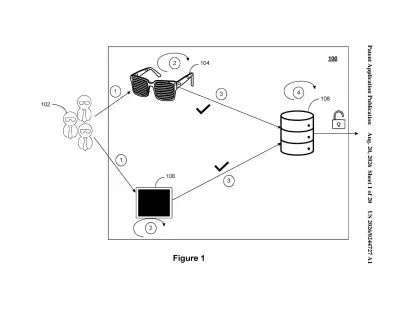
Here's the setup: you have a primary device (think your phone or a high-trust headset) and several secondary devices (smart glasses, a wristband, earbuds). When you authenticate on the primary one, it generates a special one-time credential and sends it to your other devices, which then unlock automatically. You don't type a PIN on each one.
The system is also built with a pecking order baked in. Your phone has the highest trust level, so it's the gatekeeper. Secondary devices can't unlock each other or grant themselves higher privileges. That hierarchy matters a lot in workplace settings, where an IT department might want strict control over which devices can do what.
… generating a secondary authentication credential based on the first authentication input; and transmitting the secondary authentication credential to one or more secondary devices …
Translation: Your main device creates a spare login key and beams it to your other gadgets.
How the primary device generates and sends unlock credentials
The patent describes a hierarchical authentication system where devices are assigned privilege levels. The first device (highest privilege) receives a standard authentication input, such as a PIN, biometric scan, or passkey, and uses it to generate a secondary authentication credential. That credential is transmitted over a secure channel to one or more lower-privilege devices, causing them to unlock.
Key technical components include:
- Cryptographic device identification: each device has a verified identity so the primary device knows exactly who it's talking to before sharing the credential
- Privilege-based access control: secondary devices can't escalate their own permissions or unlock devices at the same or higher trust tier
- Secure channels: credentials travel over encrypted connections, not plain Bluetooth or Wi-Fi broadcasts
The patent also covers device replacement scenarios (what happens when you swap in a new pair of glasses) and synchronized state management (keeping lock and unlock states consistent across the constellation). Enterprise controls are explicitly mentioned, meaning a company could define which devices are allowed to receive credentials and under what conditions.
The credential generated is described as being derived from the original authentication input, not a copy of it, which means your actual password or biometric data doesn't travel to the secondary devices.
… hierarchical privileges are maintained where the first device has higher authentication privileges than the secondary devices.
Translation: Devices are ranked so your primary machine holds supreme power over the others.
What this means for AR glasses and wearable device setups
For Meta, this filing maps directly onto the product reality of selling Ray-Ban Meta smart glasses, Quest headsets, and any future wrist-worn or ambient computing devices. Right now, each device in that family has its own login flow. A system like this would let your phone serve as the trust anchor for everything else you're wearing, which matters a lot when a device like glasses has no good keyboard or fingerprint reader to begin with.
The enterprise angle is also real. Companies deploying mixed fleets of headsets and phones already wrestle with per-device authentication policies, and a hierarchical credential model gives IT teams a cleaner way to enforce access rules. The broader pattern of new Big Tech patents in the authentication and wearables space shows multiple companies racing to solve the same problem: how do you secure a body-area network of devices without making the login experience miserable.
Meta's 131st filing we've tracked since May adds to a body of work that includes finger-rub menu scrolling, shared AI agent memory, and much more across our full Meta coverage.
Source: US 2026/0244727 A1 at the USPTO (PDF). Full patent text and figures are in the official publication.
Get our take in your Top Stories
Liked this breakdown? Add Patentlyze as a preferred source on Google, and our plain-English take shows up more often in your Top Stories the next time Meta patent news breaks.
Add Patentlyze on Google
One click.
There are more where this came from
We read the new patents from Big Tech, carmakers and more and send you the ones worth knowing. Plain English, free, every week.
The drawings · 20 sheets
20 drawing sheets from US 2026/0244727 A1 · click any drawing to enlarge


Show the other 12 sheets


More from Meta
All 192 Meta patents →
More in Security
All 354 Security patents →
Microsoft
Microsoft Patents a System That Detects Fake Caller Numbers Before Your Phone Rings
Sony
Sony Patents a Two-Layer Photo Verification System That Proves Images Are Unaltered
Microsoft
Microsoft Patents a Way to Hide Your Identity Inside Every Stylus Stroke
Apple