
Microsoft Files Patent for AI That Writes the Blueprint for Fake Test Data
Microsoft's patent lets an AI write the rulebook for fake test data, then hands the heavy lifting to a plain program that can produce millions of rows. The AI does the thinking once, and the fast tool does the repetition.
What Microsoft's fake-data patent actually does
Every time a company wants to know whether its database can survive a busy day, someone has to fill it with a mountain of realistic-looking records. Using real customer files is a privacy risk, so teams invent fake ones, sometimes millions of rows' worth.
Microsoft's patent splits that job in two. First, an AI model is asked about a field such as healthcare, and it writes the ground rules: patient weights should land between these two numbers, check-out times must come after check-in times, and each visit gets a reason from this list. Then a plain program with no AI inside follows those rules and produces as many rows as you ask for, quickly.
Free-text columns, like a doctor's comments, get a similar shortcut. The AI writes a batch of sample sentences, and a small, simple model learns to produce endless variations of them.
… generate an argument for a scalable data generation tool by transforming the plurality of data parameters; cause the scalable data generation tool to generate scaled synthetic data in accordance with the argument, wherein the scalable data generation tool is a non-artificial-intelligence data generation tool; …
Translation: The AI creates rules for a traditional program to build the fake data.
How the AI hands rules to a plain data tool
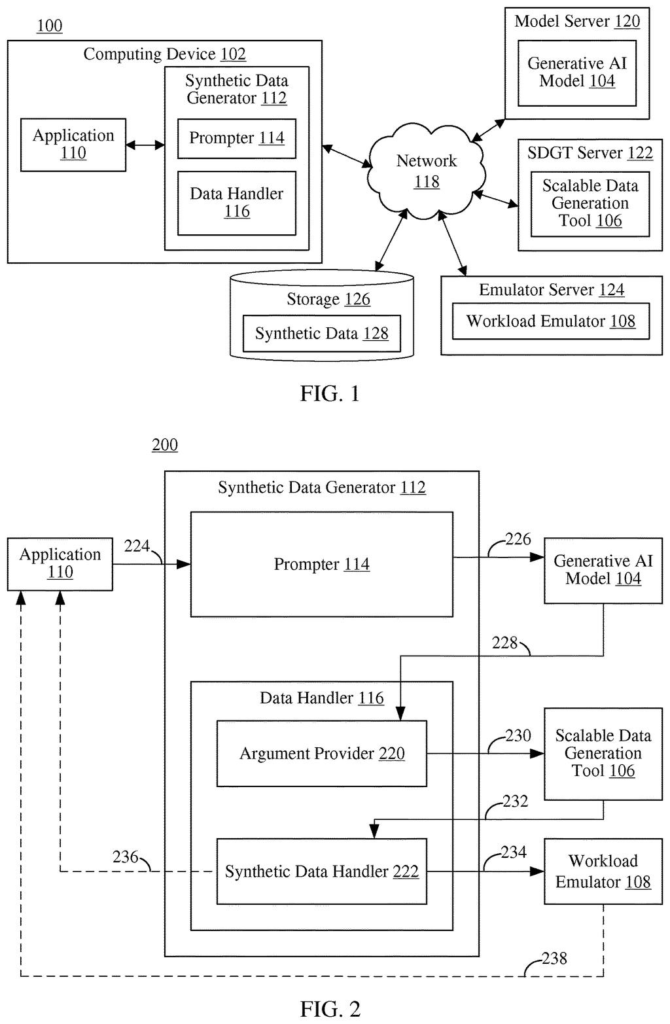
The system starts with a prompt (a written instruction) that names a domain, such as healthcare or finance. The prompt can be built automatically from a schema file (a sheet of metadata listing column names and data types). A generative AI model, such as a large language model (the AI behind chatbots), replies with data parameters: boundaries or relationships for each column of a table. The filing gives three examples:
- Ranges: a minimum and maximum, such as patient weight, or a start and end date.
- Category lists: the allowed entries for a column, such as reasons for a visit.
- Dependent columns: pairs like a disease and a matching symptom, so one column constrains another.
The system transforms those parameters into an argument (a package of settings) and sends it, possibly through an API (a standard way for programs to talk to each other), to a scalable data generation tool. The claims say this tool is a non-AI tool, so it picks values inside the boundaries at high speed. The finished table can then feed a workload emulator, which runs a test and produces a performance benchmark.
The claims also cover checking the AI's parameters against a schema, regenerating ones that fail, and prompting the AI several times to refine its answers. For sentences, the AI writes training examples and a lightweight model learns from them. The description names a Markov chain (a model that guesses each next word from the current one) as an example.
A parameter associated with the domain that specifies a boundary for synthetic values in a column of data is received from the AI model.
Translation: The artificial intelligence decides the specific limits for the fake information.
Why privacy-safe test data matters to Microsoft
If you have ever wondered how a company tests a system against millions of records without peeking at real people's information, this is the problem. Making all that fake data with an AI model alone takes a long time and a lot of computing power. Writing the settings for a simple generator by hand is slow too, and a new kind of workload means writing them all over again.
Here the AI does the thinking once, in a few short answers, and the fast tool does the grunt work. You would never see this directly, but it points to quicker testing of the databases and business software that handle your records, built without those records anywhere near the test.
Microsoft's 29th filing we've tracked in AI training and infrastructure since May follows earlier applications like one on numeric AI communication and one on conditional cloud logging.
Shipping this needs no new hardware. Every piece in the filing is software: a call to a language model, a package of settings, a random-value tool and a small sentence generator. The filing's own code fragments show each step.
The shortest route to a product is a testing tool where you type "healthcare" and a row count and get a benchmark back. What has to exist first is plumbing: access to a language model, a place to store the results, and a rig that runs the test workload.
The open question is quality. Random picks inside a range only look realistic if the AI's rules are good, which is why the claims add checks, retries and confidence scores. Sensible, close to ready, and mostly routine engineering.
Get our take in your Top Stories
Liked this breakdown? Add Patentlyze as a preferred source on Google, and our plain-English take shows up more often in your Top Stories the next time Microsoft patent news breaks.
There are more where this came from
We read every patent application Big Tech publishes and send you the ones worth knowing. Plain English, free, every week.
The drawings
21 drawing sheets from US 2026/0349901 A1 · click any drawing to enlarge


Show the other 13 sheets


Want this weekly breakdown for a company we don't cover? Patentlyze Pro →
Be the first to weigh in