
Microsoft Files Patent for AI Programs That Skip English and Talk in Numbers
Right now, AI programs that work together write each other notes in English, which the next program has to reread and reinterpret. Microsoft's patent application has them pass raw number lists instead, and adds a converter for when their number formats don't match.
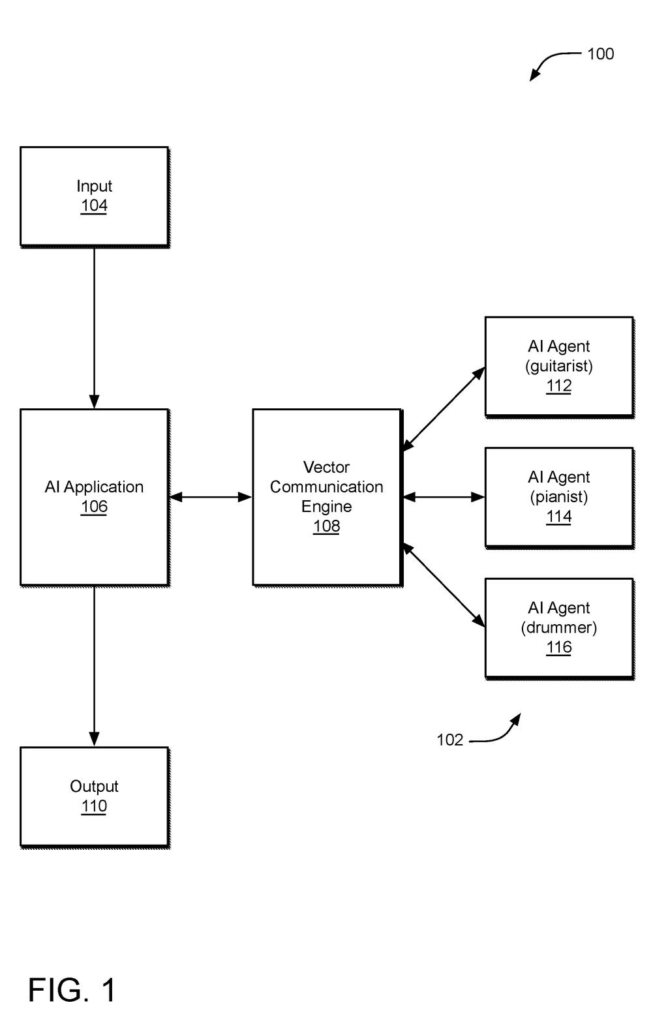
What Microsoft's number-based AI chat does
Every time one AI program hands a task to another, it has to turn its internal thinking into plain English, and the receiver has to turn those words back into its own internal thinking. Something gets lost on each trip, a bit like the party game Telephone.
Microsoft's patent application describes a go-between that skips the English. AI programs already store ideas as long strings of numbers (called vectors). This system passes those numbers straight from one program to the next. If the two programs store ideas in different number formats, a converter in the middle translates one format into the other, with no English step.
The filing's example is a virtual rock band: one AI plays pianist, another guitarist, and they write a song together without a human stepping in. The company says skipping the words cuts both muddled meaning and waiting time.
A method of communicating between multiple AI agents, the method comprising: receiving a first vector message from a first AI agent, wherein the first vector message embodies a vector representation format of the first AI agent corresponding to an embedding model used by the first AI agent to generate the first vector message; …
Translation: This patent outlines a system where artificial intelligence programs talk directly to each other using internal math data.
How Microsoft's adapter translates AI number codes
The core is a vector communication engine, a middle layer that sits between AI agents. A vector (also called an embedding) is the list of numbers a model uses internally to represent meaning. Instead of each agent writing a sentence, the engine forwards the vector itself.
Before a conversation starts, each agent registers with a conversation manager. It supplies an identifier (such as a URL), a friendly name, the embedding model it uses (including its dimension, meaning the length of its number list), and whether it sends, receives, or both. A communication manager then checks each message against that registration information:
- Same or compatible model: the message goes straight through.
- Different models: the filing's example is a GPT-4o agent talking to a Mistral 7B agent. A vector pair adaptor converts the message by building a mapping between the two models' embedding spaces (each model's own internal map of meaning). One claim describes training a hypernetwork (a network that learns the conversion) to do this.
- No converter, or receiver unreachable: an error goes back to the sender.
The conversation manager also tracks success and failure notices, can load new conversion libraries as new models appear, and keeps an audit log. The engine can be one central piece or spread across the agents themselves.
A vector communication engine enables vector-based communications by multiple AI agents by receiving a first vector message from a first AI agent.
Translation: A special communication engine allows AI systems to exchange numerical messages without translating them into human language first.
Why skipping English could speed up AI teams
If you use AI tools that pass work between several programs, such as one that researches and another that writes, every handoff in words costs time and can blur meaning. Microsoft's filing says going straight from numbers to numbers cuts both, and uses less memory and computing because the translation steps disappear.
It also tackles a practical snag: different companies' models don't share a number format. A converter in the middle would let a team mix models from different makers in one conversation. The filing also describes an audit log so a person can check afterward how the conversation went. Keep in mind this is an application, and the filing gives no measured speed or accuracy results.
Microsoft's 44th filing we've tracked since May in our AI teams watchlist follows one picking answer formats and one reducing grading work.
The price of skipping English is that nobody can read the conversation. Words let a person glance at what two AI programs told each other, and strings of numbers give you nothing to glance at. The filing offers an audit log, but it describes the log as a way to verify the process and never explains how a human would read the numbers themselves.
The second cost is the converter. When two programs use different number formats, the middle layer has to learn a conversion between them, and the filing itself promises only "minimal distortion," which still allows some error. A smaller version of the Telephone problem could return, this time inside the math.
The trade reads as worth making for teams where speed matters and the agents mostly share a model. For mixed teams, the value depends on how well the conversion holds up, and the filing shows no test numbers to judge that.
Get our take in your Top Stories
Liked this breakdown? Add Patentlyze as a preferred source on Google, and our plain-English take shows up more often in your Top Stories the next time Microsoft patent news breaks.
There are more where this came from
We read every patent application Big Tech publishes and send you the ones worth knowing. Plain English, free, every week.
The drawings
6 drawing sheets from US 2026/0339761 A1 · click any drawing to enlarge


Want this weekly breakdown for a company we don't cover? Patentlyze Pro →
Be the first to weigh in