
Microsoft Patents an AI That Reads Your Emoji Reactions to Summarize Meetings
A thumbs-down on a budget slide or a confused face on a proposal could soon tell Microsoft's AI exactly which parts of your meeting need more attention. Microsoft has filed a patent for a system that turns emoji reactions into structured sentiment data, then feeds it to a large language model to produce meeting summaries that go beyond what was said to include how people felt about it.
What Microsoft's emoji-powered meeting summaries actually do
Imagine sitting through a long planning meeting where half the team is clearly confused by one slide and excited about another, but the auto-generated notes afterward read like a flat list of topics with no sense of the room. That gap is what this patent tries to close.
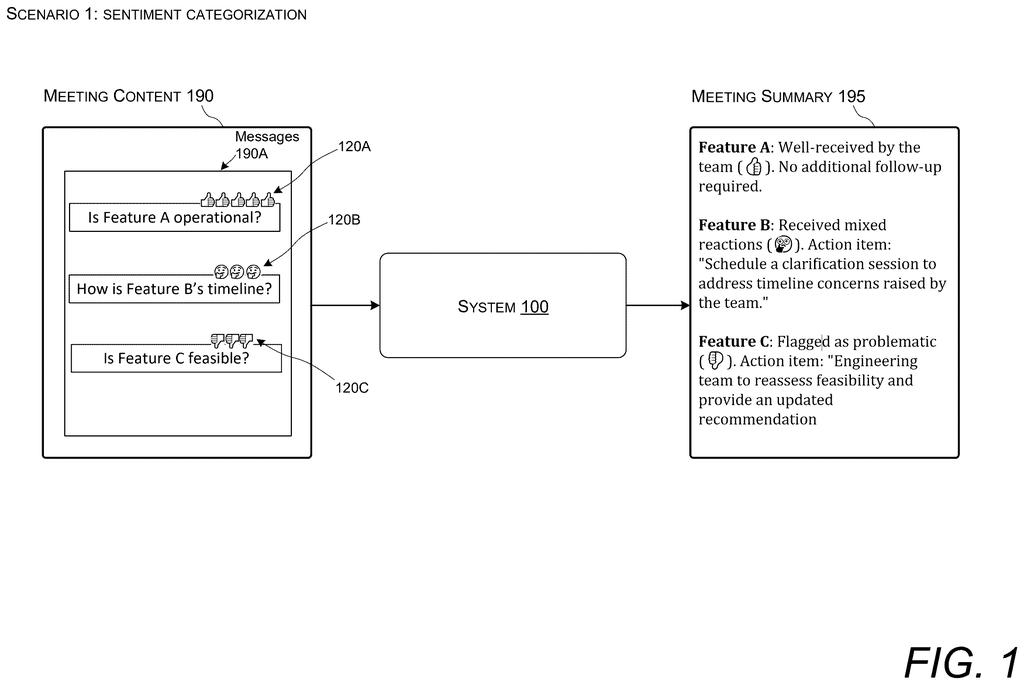
Microsoft's idea is to treat every emoji reaction in a meeting as a data point. When you tap the thumbs-down or the question-mark emoji next to a shared document or a chat message, the system logs that reaction, links it to the specific piece of content it was attached to, and notes what category of feeling it represents. After the meeting, all of that gets handed to an AI alongside the chat transcript and file comments.
The result is a summary that doesn't just say "Q3 budget was discussed" but might flag that twelve people reacted with confusion emojis to the revenue forecast section, suggesting it needs a follow-up. Think of it as giving the AI a rough read on team mood, one emoji at a time.
… instructions for causing a Large Language Model to generate a meeting summary describing one or more topics of the meeting content and a summary of one or more individual sentiment descriptions associated with the one or more topics …
Translation: It tells an AI model to build a meeting recap that matches topics with the feelings expressed.
How the system maps emojis to sentiment for the AI
The system collects two streams of data during a meeting: the text content (chat messages, comments in shared files, and transcribed discussion) and the emoji reactions that participants attach to specific messages or file sections.
Each emoji is categorized by sentiment. A laughing face maps to one sentiment description, a red X to another, a thumbs-up to another. The patent calls this mapping "grounding data", essentially a translation table that tells the AI what each emoji class means emotionally.
All of this gets assembled into a structured prompt sent to a Large Language Model (LLM), which is the same class of AI behind tools like ChatGPT or Microsoft Copilot. The prompt instructs the LLM to:
- Identify the main topics covered in the meeting
- Tally how many reactions of each sentiment type were attached to content about each topic
- Write a summary that links the topics to those sentiment tallies
The final output is a meeting summary that describes both the substance of what was discussed and the emotional temperature of the room around each topic, based on reaction counts. A topic that attracted many confused-face emojis would be flagged differently from one that drew mostly positive reactions.
The techniques disclosed herein leverage emoji reactions during meetings to dynamically create AI-enhanced summaries that capture both the content and sentiment of the discussion.
Translation: The system uses emojis shared in meetings to automatically build smart AI summaries of what was discussed and how people felt.
What this means for Teams users drowning in meeting notes
For anyone who uses Microsoft Teams regularly, the practical payoff is a meeting recap that tells managers which decisions landed well and which ones left the team unconvinced, without anyone having to speak up explicitly. Quiet dissent and confusion that never made it into the spoken discussion could show up in the summary as a pattern of question-mark or thumbs-down reactions.
The flip side is that this only works if people actually use emoji reactions during meetings, and many Teams users rarely do. If reaction behavior doesn't change, the summaries will look much like today's AI-generated notes. The system's value scales directly with how actively your team engages with it.
Microsoft files its 24th entry in the AI vision work we've tracked since May, building on ideas like one that maps media files and one on meeting brainstorms.
The person who benefits most from this is the manager who walked out of a meeting knowing something was wrong but couldn't put it in writing. When seven people react with confusion to the same moment and that shows up explicitly in the summary, the follow-up conversation has a starting point instead of a hunch.
For everyone else, the value depends on a habit forming. Emoji reactions in meetings are currently more reflex than signal, and most people don't use them at all. If the system gives reactions a visible payoff, people may start using them more deliberately, which is what makes the summary useful in the first place.
The failure this prevents is a specific and common one: a clean summary of a meeting where nothing actually got resolved, and nobody flagged it. That failure is quiet, which is why it's so costly.
There are more where this came from
We read every patent application Big Tech publishes and send you the ones worth knowing. Plain English, free, every week.
The drawings
8 drawing sheets from US 2026/0303393 A1 · click any drawing to enlarge


Want this weekly breakdown for a company we don't cover? Patentlyze Pro →
Be the first to weigh in