
Microsoft Patents a System That Turns a Pile of Media Files Into a Searchable Map
What if your photo library could tell you not just what files exist, but how every person, place, and object in them is connected to everything else? That is the basic idea behind this Microsoft patent.
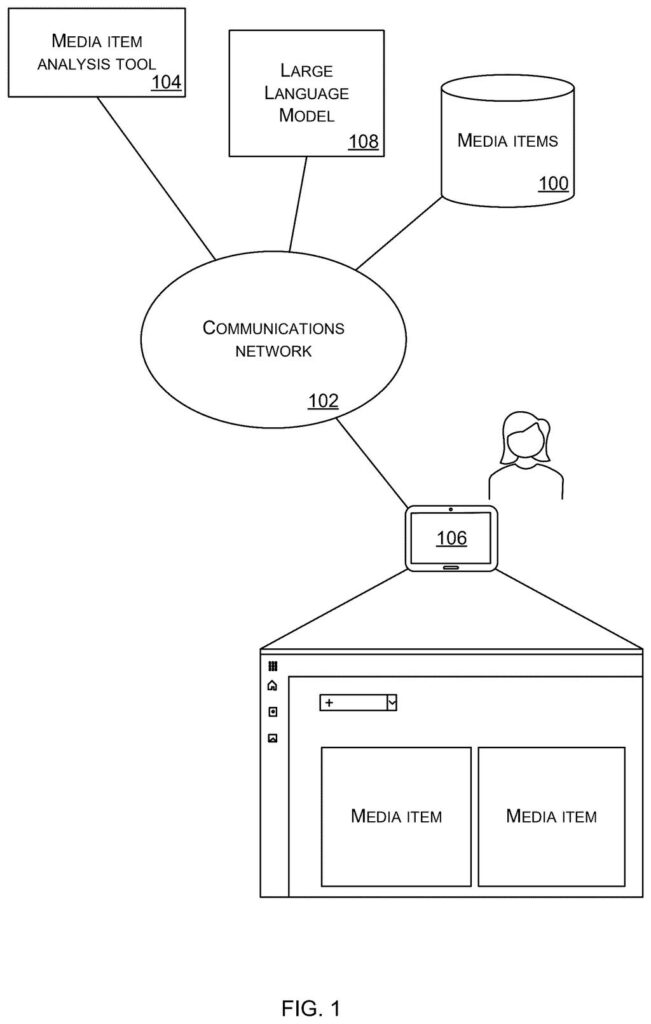
What Microsoft's media graph database actually does
Imagine you work at a company that has collected millions of product photos, training videos, and scanned documents over the years, all dumped into shared drives with inconsistent names and no real organization. Finding anything specific, or knowing whether you already have it, is a nightmare.
Microsoft's patent describes a system that takes a large batch of media files, automatically weeds out near-identical duplicates (keeping only the best copy of each), and then uses an AI language model to generate a plain-language description of what each file actually shows. Those descriptions, along with tags and technical details about each file, feed into a graph database, a structure that maps out relationships between files and the people, objects, or scenes inside them.
The result is something closer to a knowledge base than a file folder. You could search not just for a filename but for concepts: find every image that contains a particular product alongside a particular setting, for example, without manually tagging a single file yourself.
inputting, into a Large Language Model (LLM), the media item, the label, the metadata and a request; and receiving from the LLM a description of content depicted in the media item …
Translation: The system feeds photos and data into an AI model to get back written summaries of what is shown.
How the pipeline cleans, labels, and connects each file
The system works in a sequence of well-defined steps.
- Ingestion and deduplication: A batch of media files is loaded into memory. The system identifies which files are near-copies of each other and ranks them (by quality, resolution, or other criteria). Only the top-ranked version of each group survives to the next stage.
- Metadata extraction and labeling: For each surviving file, the system computes metadata (technical attributes like dimensions, format, timestamps, and detected objects or faces). Part of that metadata becomes a concise label attached to the file.
- LLM description: Each file, together with its label, its metadata, and a prompt, is fed into a Large Language Model (an AI system like the kind that powers chat assistants). The LLM writes a natural-language description of what the file depicts.
- Graph database construction: The system builds a graph database, think of it as a web of connected dots rather than a flat table. Each media file gets one dot (node). Each entity inside the file (a person, a brand logo, a location) gets a separate dot. Those dots are then linked together, and the entity dots are annotated with the file's metadata.
The graph structure means you can traverse relationships: starting from one image, you can follow edges to every other image that shares an entity, or from an entity to every piece of media that contains it.
A graph database of the filtered media items is created using the descriptions, the metadata, and the labels.
Translation: The cleaned files and their AI descriptions are organized into a connected network map.
What this means for Microsoft's AI search products
For Microsoft, this kind of infrastructure sits directly underneath products like Microsoft 365's search, SharePoint, and any future AI assistant that needs to reason over a company's stored media. A graph structure lets an AI answer questions like "show me all videos where the CEO appeared in 2024" without requiring humans to manually tag every file.
For you as a user, the practical payoff would be a search experience where you describe what you are looking for in plain language and the system finds it, even if the files were never named or organized sensibly. The deduplication step also matters: large organizations waste significant storage on redundant copies, and a system that automatically picks the best version before indexing could cut that cost meaningfully.
Microsoft's 23rd filing in the AI vision work we've tracked since May builds on ideas like one that reads your intent and one that runs brainstorms.
Claim 1 is broad. It does not lock down a specific model architecture, a particular deduplication algorithm, or even a named graph database format. What it claims is the overall pipeline: ingest, deduplicate and rank, label, feed to an LLM for description, and store in a graph with entity nodes connected to media nodes. That breadth means the claim, if granted as written, could cover a wide range of implementations built by other companies that follow the same general sequence.
That breadth may also be exactly why it faces examination scrutiny. Each individual step (deduplication, LLM captioning, graph storage) is well-established on its own. The patent's argument for novelty rests on combining them in this specific order with this specific graph structure, which patent examiners often push back on as obvious.
Microsoft's interest in AI-powered media organization shows up across several product lines, so this filing fits a clear internal need even if the claim ends up narrowed before grant. Whether it survives unchanged or not, it signals where Microsoft thinks the architecture for AI-ready media libraries is heading.
There are more where this came from
We read every patent application Big Tech publishes and send you the ones worth knowing. Plain English, free, every week.
The drawings
13 drawing sheets from US 2026/0288866 A1 · click any drawing to enlarge


Want this weekly breakdown for a company we don't cover? Patentlyze Pro →
Be the first to weigh in