
Microsoft
Microsoft · AI / ML · Filed Jul 20, 2026 · USPTO published Nov 12, 2026 · This week's release
Microsoft Files Patent to Help Phones and Robots Tell Where They Are From Video
A camera that tracks its own movement can be thrown off by a passing pedestrian or a blocked view. Microsoft's patent application has an AI give every tracked spot a trust score before any position math happens.
- Publication number
- US 2026/0359995 A1(US20260359995A1)
- Applicant
- Microsoft Technology Licensing, LLC
- Filed · Published
- Jul 20, 2026 · Nov 12, 2026
- Inventors
- Rui WANG, Marc André Léon POLLEFEYS, Weirong CHEN
- Status when we published
- Waiting for an examiner
- Document
- 20 claims
- US classification
- 382/103
- Parent application
- Continuation of 18/400,708 (filed Dec 29, 2023)(18400708)
What Microsoft's camera-tracking patent does
Your phone can't simply look around and know where it is. To follow your walk down a hallway, it picks out spots in each video frame, like the corner of a table, and hunts for those same spots in the next frame. That breaks down when someone walks past, something blocks the view, or a blank wall gives it nothing to latch onto.
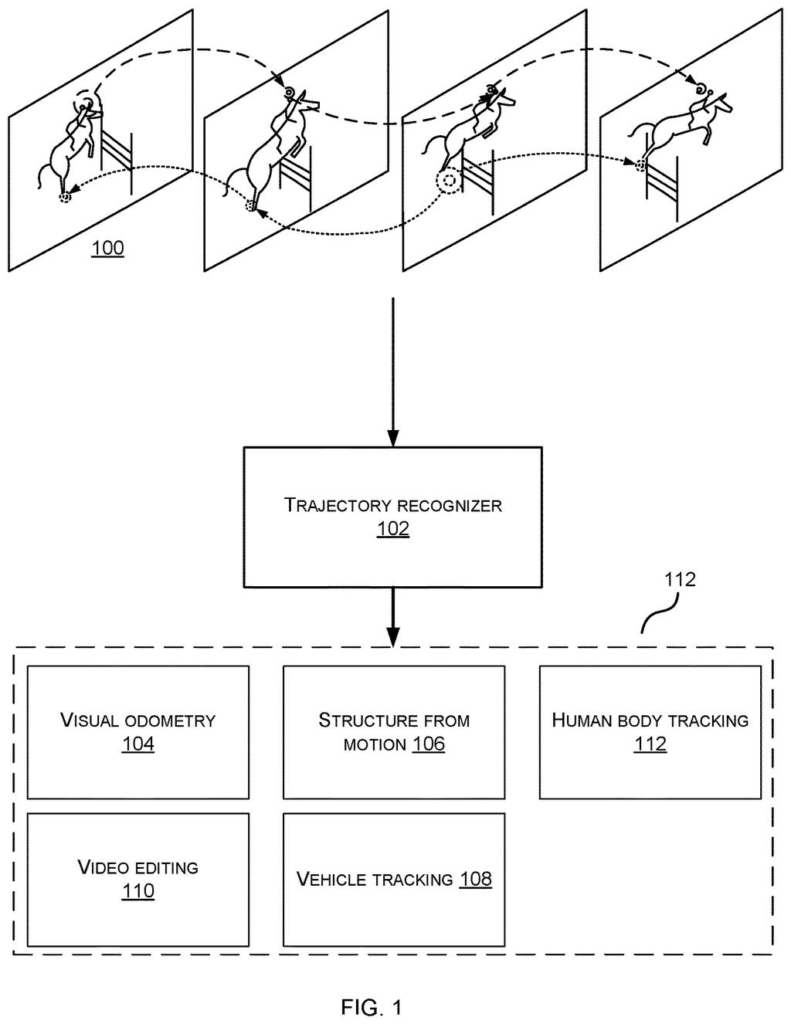
Microsoft's patent application has a neural network (a type of AI) follow each spot across a whole run of frames and attach a trust score to it. The AI also guesses whether the spot is hidden at any given moment, and whether it sits on something still, like a wall, or something moving, like a person.
Only the visible, still, high-trust spots are then used to work out how the camera moved. The shaky evidence gets thrown out first.
… computing, using a neural network, a plurality of trajectories for respective points represented in the plurality of images, and confidence data associated with the plurality of trajectories; …
Translation: An AI tracks how specific points in camera frames move and measures how sure it is about that motion.
How the tracker filters out unreliable points
The system takes a run of video frames from a moving camera, usually 8 or more, and picks query points (specific pixels to follow) from any one of them. A neural network then traces each point through every frame, producing a trajectory, the path of that same spot across the video.
For each trajectory the network also outputs:
- A visibility guess for each frame (is the spot hidden behind something?)
- A static-or-moving label (is it on a wall or on a walking person?)
- confidence data, a measure of how sure the network is, built from a probability curve (a Cauchy distribution) that gets refined over several passes
Tracking runs both forward and backward in time. Extra anchor points are picked near edges using a Sobel filter (a standard way to find sharp changes in brightness), which helps the network compare very different spots. The part that reads the images can be a transformer (an AI design that weighs how image patches relate) or a lighter convolutional design with flexible, widening filters.
To find the camera's position and direction, the system keeps only trajectories that clear thresholds for confidence, visibility and stillness. It then runs a sliding-window bundle adjustment (a calculation that adjusts camera positions and 3D point locations together until they match the footage), weighted by confidence. In the described test, the visibility and still-or-moving cutoffs were both 0.9.
The outputs comprise: a trajectory depicting the point in each of the plurality of images, as well as, for each trajectory, a prediction of visibility of the trajectory in each of the images and a prediction of whether the trajectory depicts a static or moving surface in the environment.
Translation: The system predicts whether objects in the camera view are moving or staying still.
Why phones, headsets and robots could care
If your phone, headset or robot finds its way by camera, the weak spot is usually a messy scene: people walking by, something covering part of the view, a plain white wall. Screening out bad evidence before the position math runs is aimed at exactly those moments. The filing lists head-worn computers, robots, self-driving vehicles and camera phones as places this could run.
The same tracked paths could also feed 3D scene building, human body tracking, video editing and vehicle tracking, according to the filing. It is a continuation of an earlier Microsoft application from December 2023, so it refines an idea already on file. The company reports better results than current methods in its own experiments, which is worth remembering when you read the claims.
Microsoft's 30th filing in our AI vision coverage since May adds to a run that includes one on reading floor plans and one on watching game screens.
Source: US 2026/0359995 A1 at the USPTO (PDF). Full patent text and figures are in the official publication.
Get our take in your Top Stories
Liked this breakdown? Add Patentlyze as a preferred source on Google, and our plain-English take shows up more often in your Top Stories the next time Microsoft patent news breaks.
Add Patentlyze on Google
One click.
There are more where this came from
We read every patent application Big Tech publishes and send you the ones worth knowing. Plain English, free, every week.
The drawings · 7 sheets
7 drawing sheets from US 2026/0359995 A1 · click any drawing to enlarge


More from Microsoft
All 646 Microsoft patents →
More in AI vision
All 339 AI vision patents →
Nvidia
Nvidia Patents a System for Teaching Robots to Pick Objects Out of a Bin
Nvidia
Nvidia Patents a Two-Stage AI Pipeline for Teaching Robots to Grab Objects
Nvidia
Nvidia Patents Software That Detects Which Way Objects Face in Photos
Nvidia
No comments yet