
Activision (Microsoft)
Microsoft · AI / ML · Filed Apr 30, 2026 · USPTO published Nov 19, 2026 · This week's release
Microsoft Files Patent for a Checkup Tool That Finds Why Voice Software Mishears Words
A Microsoft patent application has a clever way to find out why voice software mishears people: have a computer read the same transcript aloud, then compare the mistakes. The gap between the real and synthetic versions points to the culprit.
- Publication number
- US 2026/0369265 A1(US20260369265A1)
- Applicant
- MICROSOFT TECHNOLOGY LICENSING, LLC
- Filed · Published
- Apr 30, 2026 · Nov 19, 2026
- Inventors
- Haoxuan LI, Rui JIANG, Yang LIU, Edward C LIN, Lei SUN, Che ZHAO
- Status when we published
- Waiting for an examiner
- Document
- 20 claims
- US classification
- 704/243
- Parent application
- Continuation of 18/707,542 (filed May 3, 2024)(18707542)
What Microsoft's speech-recognition checkup does
You're dictating notes into a work app, and it keeps mangling the same words. Is it your accent, the noisy office, or a word the software never learned? Working that out is surprisingly hard, even for the people who set the software up.
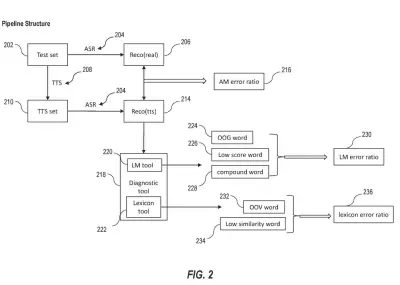
Microsoft's patent application describes a checkup tool for that mystery. It takes a batch of real recordings with correct written transcripts, then has a computer read those same transcripts aloud in a clean synthetic voice. Both versions go through the speech recognizer, and the tool compares the mistakes. If the real recordings go wrong far more often than the clean copies, the trouble is probably the sound itself, like background noise or accents. If both go wrong on the same words, the problem is likely vocabulary or grammar.
The tool then tells the person in charge what to collect next, such as more recordings from similar settings or sample sentences for the trouble words.
obtaining a test dataset comprising (i) audio data having a plurality of natural speech utterances and (ii) a transcription of the plurality of natural speech utterances; generating a text-to-speech dataset comprising audio data having a plurality of synthesized speech utterances based on the transcription of the plurality of natural speech utterances; …
Translation: The tool compares real human speech recordings with computer generated voice clips of the exact same words.
How real and computer-voiced audio get compared
Modern speech recognition has three parts. The acoustic model matches sounds to speech units, the language model guesses which words are likely to follow each other, and the lexicon is a dictionary of words and their pronunciations. The filing's diagnostic tool tries to work out which part is to blame for each mistake.
For the acoustic model, it runs real recordings and computer-spoken copies of the same transcripts through the system, then compares how many edits each output needs. In the filing's example, the real set needed 6,549 edits (a 12.9% word error rate) and the synthetic set needed 3,342 (6.6%). Subtract, divide by 6,549, and you get an acoustic model error ratio of 49%.
The clean synthetic audio then serves as a reference for the other two parts. Words that still fail get sorted into types:
- Language model: words it has never seen, words with too little context, or words wrongly glued together or split apart.
- Lexicon: words missing from the dictionary, or pronunciations that don't match.
Each part gets its own score, and the tool suggests targeted data to collect: audio from a similar scenario, sample sentences for each trouble word, or a listen-and-check of pronunciations. In one test, adding text pulled from web search results for the trouble words lowered the word error rate from 12.82% to 12.30%.
Systems identify a first set of errors in the first acoustic model output and a second set of errors in the second acoustic model output. Finally, based on comparing the first set of errors and the second set of errors, an acoustic model error ratio is generated.
Translation: By comparing where the software messed up on real versus synthetic voices, the system measures its overall accuracy.
Why custom voice software may get easier to fix
The practical win is for the people who set up speech software for a specific job: a company with its own jargon, noisy work settings, or customers with strong accents. According to the filing, it can be hard to tell why a customized system underperforms, and harder still for someone without AI training to fix it. This tool turns a single accuracy number into a short to-do list: collect more audio like this, add sentences for these words, check these pronunciations.
For you, the payoff would show up as fewer mangled names and terms in the transcripts, captions and voice searches you rely on. The filing describes the process as repeatable in rounds: gather the suggested data, retrain, and test again to see whether the score improved.
That makes this Microsoft's 22nd filing in voice and speech AI we've tracked since May, a set that also includes training game characters on voice reactions and AI game recaps from play history.
Source: US 2026/0369265 A1 at the USPTO (PDF). Full patent text and figures are in the official publication.
Get our take in your Top Stories
Liked this breakdown? Add Patentlyze as a preferred source on Google, and our plain-English take shows up more often in your Top Stories the next time Microsoft patent news breaks.
Add Patentlyze on Google
One click.
There are more where this came from
We read every patent application Big Tech publishes and send you the ones worth knowing. Plain English, free, every week.
The drawings · 12 sheets
12 drawing sheets from US 2026/0369265 A1 · click any drawing to enlarge


Show the other 4 sheets


More from Microsoft
All 681 Microsoft patents →
More in AI / ML
All 2,738 AI / ML patents →
Amazon
Amazon Files Patent for Transcription That Gets Rare Names and Jargon Right
IBM
IBM Patents a Voice Survey That Asks Follow-Up Questions When Your Answers Are Vague
Meta
Meta Patents a System That Rebuilds Tired Ads From Their Own Parts
Google
No comments yet