

Google
Google · AI / ML · Filed Jul 13, 2026 · USPTO published Nov 12, 2026 · This week's release
Google Patents a Way to Teach Speech AI New Languages Without Retraining It
Instead of retraining a speech AI for every new language, Google describes leaving it untouched and bending the incoming sound until a Lithuanian 'ne' looks like an English 'no.'
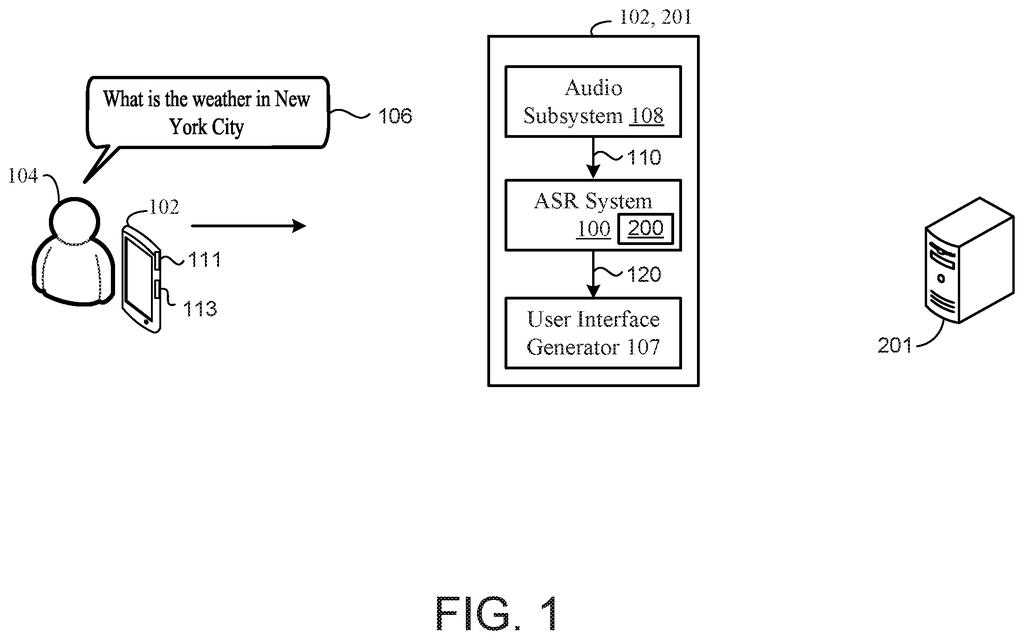
- Publication number
- US 2026/0360354 A1(US20260360354A1)
- Applicant
- Google LLC
- Filed · Published
- Jul 13, 2026 · Nov 12, 2026
- Inventors
- Bo Li, Yu Zhang, Mr. Nanxin Chen, Rohit Prabhavalkar, Mr. Chao-Han Huck Yang, Tara N. Sainath, Trevor Strohman
- Status when we published
- Waiting for an examiner
- Document
- 20 claims
- US classification
- 704/232
- Parent application
- Continuation of 18/490,808 (filed Oct 20, 2023)(18490808)
What Google's language-adapter patent actually does
Today, a voice assistant that has mastered English can't automatically follow Lithuanian. Teaching it a new language usually means a long round of extra training, and the retrained model can end up too big to run on a phone. Languages with little recorded speech to learn from get left behind.
Google's filing takes a different route. It leaves the English-trained model completely untouched and bolts on two small add-ons that are the only parts that learn. One reshapes the incoming audio so a Lithuanian 'ne' sounds more like an English 'no.' The other nudges the model's internal signals so the two words look alike once they're inside.
Because the original model never changes, it keeps what it already knows. And the new pieces are small, so the whole package stays light enough for a phone.
obtaining a pre-trained automatic speech recognition (ASR) model configured to generate a latent projection output and a corresponding speech recognition result from an input audio sequence, wherein parameters of the pre-trained ASR model are frozen …
Translation: Google starts with an existing speech recognition model and locks its core settings so they cannot change.
How the frozen model gets two small add-ons
The starting point is a speech recognition model (software that turns spoken audio into text) that is already trained, in the filing's example on English. Its internal settings, called parameters, are frozen, meaning training never changes them. Google then attaches two small trainable pieces.
- Input module: adds a learned 'continuous embedding' (a set of numbers tuned during training, which the description also calls trainable noise) to the incoming audio, nudging it toward speech the model already knows.
- Latent module: trainable layers inserted into the encoder (the part that turns sound into the model's internal representation) that adjust those internal signals so a Lithuanian word lands near its English counterpart.
Each add-on mixes two ingredients: one that depends on the specific sample in front of it, and one universal piece that stays the same for every sample. The description gives each new language its own universal piece. In training, the model transcribes a sample, the result is scored against the correct transcript (the loss), and backpropagation (the standard method for working out which numbers to adjust) updates only the two add-ons.
The filing also describes optional extras: bridged connections between the added layers, and learning from untranscribed audio by hiding chunks of the signal and checking that the model reaches the same answer.
… adapting the ASR model to learn how to recognize speech in the second language by training the input reprogramming module and the latent reprogramming module while parameters of the ASR model are frozen …
Translation: The system teaches the AI a new language by training only small add on modules instead of retraining the whole model.
Why smaller language add-ons matter for phones
If you speak a language with little recorded speech online, voice typing and assistants tend to work worse for you. This filing describes a cheaper way to close that gap: instead of building a whole new model for each language, you add a small package of learned pieces on top of one that already exists. The filing's own argument is that this keeps the model small enough to run on a device, so recognition can happen on the phone itself.
It also suggests one base model could carry add-ons for several languages, since the description covers training on speech from other languages too. The filing names no product and gives no accuracy numbers in the text we reviewed, so how well it performs is an open question.
Google's 67th filing in the voice and speech AI work we've tracked since May adds to a run that includes one on noise-free voice commands and one on fixing misheard names.
Source: US 2026/0360354 A1 at the USPTO (PDF). Full patent text and figures are in the official publication.
Get our take in your Top Stories
Liked this breakdown? Add Patentlyze as a preferred source on Google, and our plain-English take shows up more often in your Top Stories the next time Google patent news breaks.
Add Patentlyze on Google
One click.
There are more where this came from
We read every patent application Big Tech publishes and send you the ones worth knowing. Plain English, free, every week.
The drawings · 7 sheets
7 drawing sheets from US 2026/0360354 A1 · click any drawing to enlarge


More from Google
All 1,079 Google patents →
More in AI / ML
All 2,637 AI / ML patents →
Nvidia
Nvidia Patents a Two-Stage Speech Transcription System That Handles Multiple Languages at Once
Nvidia
Nvidia Patents a Way to Train One Speech AI Across Dozens of Languages at Once
Nvidia
Nvidia Files Patent to Stop AI From Forgetting Text While Learning Speech
Microsoft
No comments yet