
Samsung
Motorola · Cell phone · Filed May 13, 2025 · USPTO published Nov 19, 2026 · This week's release
Motorola Patents a Phone That Only Hears Voices Its Camera Can See
Motorola's patent filing ties your device's ears to its eyes: if a voice comes from outside the camera's view, the device simply doesn't listen. It also describes a way for a phone and a laptop to decide, using your gaze, which one answers you.
- Publication number
- US 2026/0371006 A1(US20260371006A1)
- Applicant
- Motorola Mobility LLC
- Filed · Published
- May 13, 2025 · Nov 19, 2026
- Inventors
- Ranjeet Gupta, Rahul Bharat Desai, Giles Tucker Davis
- Status when we published
- Waiting for an examiner
- Document
- 20 claims
- US classification
- 381/150
- Examiner
- BEKEE, CHIMEZIE EZERIWE (Art Unit 2691)
What Motorola's camera-guided listening does
Every time you say a voice command in a room with more than one gadget, there's a small chance two of them answer at once. Your phone chimes in, your laptop chimes in, and neither one knows the other exists. Add a noisy train or a stranger talking behind you, and things get messier.
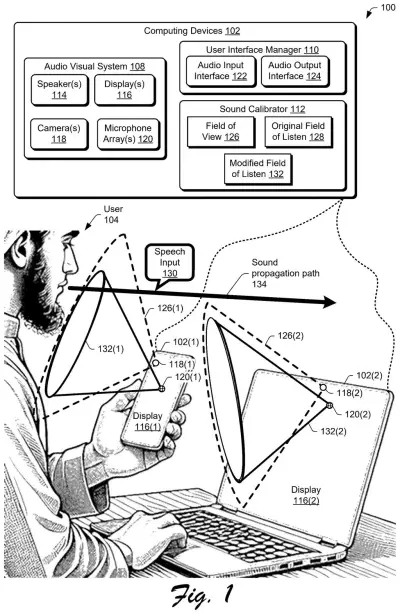
Motorola's idea is to make the microphones obey the camera. The device works out the cone of space its camera can see, then shrinks the area its microphones pay attention to so it sits inside that cone. Voices from behind the device, or from off to the side, get ignored.
When two devices both hear you, the filing describes using sensors, such as where you're looking, to pick which one responds. It can also check your face before it acts on sensitive requests.
… project a field of listen of the microphone array within boundaries of the three-dimensional space that define the field of view; further sample the sound as a speech input based on whether a sound propagation path of the sound enters the field of listen or misses the field of listen …
Translation: The phone only listens to sounds coming from the exact area the camera can see.
How Motorola lines up the mics with the lens
The patent covers a device with a microphone array (at least three microphones, placed so they can tell which direction a sound comes from) and a camera. The device calculates the camera's field of view, the pyramid or cone of space the lens can see, using the horizontal and vertical viewing angles.
It then builds a field of listen, the region the microphones will pay attention to, and fits it inside that camera cone. Because the camera and microphones sit in different spots on the device, the system adjusts the coordinates to compensate for the offset.
When a sound arrives, the device estimates its sound propagation path (the direction the sound traveled to reach the device). If the path enters the field of listen, the sound is sampled as speech and acted on. If it misses, the device filters it out.
The claims also cover a multi-device version:
- Detect nearby devices whose fields of view or listening overlap with its own.
- Use sensor data, such as gaze direction, proximity, or usage history, to decide which device answers.
- Optionally verify the user with a face or voice match, then allow later voice requests without checking again.
Why your phone and laptop might stop fighting
The practical payoff is a device that is harder to confuse. In the filing's examples, a commuter dictates an email on a train while an announcement and a loud neighbor are ignored, and a passerby behind a device can't shout commands at it. If you've ever had two devices answer the same "hey" at once, the gaze-based tiebreaker speaks to that annoyance.
There are tradeoffs. The idea relies on a camera that stays on, and the device has to be pointed roughly at you for it to work. The filing frames the camera as a privacy and security aid, but the always-on-camera is itself something many people will want to think about. As a patent application, this describes a concept and says nothing about a product.
Source: US 2026/0371006 A1 at the USPTO (PDF). Full patent text and figures are in the official publication.
Get our take in your Top Stories
Liked this breakdown? Add Patentlyze as a preferred source on Google, and our plain-English take shows up more often in your Top Stories the next time Motorola patent news breaks.
Add Patentlyze on Google
One click.
There are more where this came from
We read the new patents from Big Tech, carmakers and more and send you the ones worth knowing. Plain English, free, every week.
The drawings · 9 sheets
9 drawing sheets from US 2026/0371006 A1 · click any drawing to enlarge


Show sheet 9

No comments yet