
Samsung
Samsung · Cell phone · Filed Jul 10, 2026 · USPTO published Nov 19, 2026 · This week's release
Samsung Files Patent to Stop Camera Stabilization From Confusing Phone Autofocus
The part of your phone camera that steadies shaky hands can mislead the part that decides where to focus. A new Samsung patent application describes a correction that fixes the focus readings using the stabilizer's own position.
- Publication number
- US 2026/0370942 A1(US20260370942A1)
- Applicant
- Samsung Electronics Co., Ltd.
- Filed · Published
- Jul 10, 2026 · Nov 19, 2026
- Inventors
- Jaehyoung PARK, Sangbum JEONG, Jonghoon WON
- Status when we published
- Waiting for an examiner
- Document
- 20 claims
- US classification
- 348/208.2
- Parent application
- Continuation of PCT/KR2024/020768 (filed Dec 20, 2024)(PCTKR2024020768)
What Samsung's autofocus correction actually does
You're walking along a trail, phone in hand, trying to photograph your dog bounding ahead. Your hand shakes, so a tiny motor inside the camera nudges the lens the opposite way to cancel the wobble. That keeps the picture steady, but it can also trip up the system that decides where to focus.
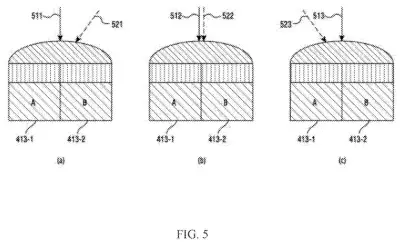
Here's the snag. Many phone cameras focus by comparing light on tiny sensors packed under each pixel. When the stabilizer slides the lens off-center, light lands at a slightly different angle, so some of those sensors look brighter than others. The camera can't tell whether that difference comes from the scene or from the lens shifting. The filing says the gap can reach about 80% in either direction.
Samsung's answer is to check where the stabilizer has moved the lens, then adjust the focus readings to cancel out the false brightness differences before focusing. In some cases it skips the adjustment, because it wouldn't help.
acquire first AF data from the image sensor; generate second AF data by correcting the first AF data based on a parameter for the OIS operation; and perform an auto focus (AF) function based on the second AF data.
Translation: The phone adjusts its autofocus readings by factoring in the physical movements of the image stabilization system.
How the camera cancels out stabilizer drift
Phone cameras with optical stabilization use a gyro sensor (a tiny motion detector) to feel shake, then slide the lens or the image sensor to cancel it. A hall sensor (a magnetic position sensor) can report exactly where the lens ended up.
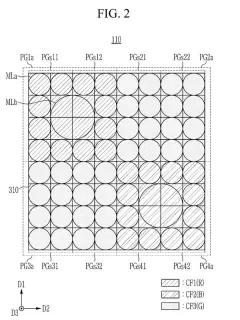
Samsung's design takes the first set of focus readings from the image sensor, which the filing calls "first AF data." It then corrects those readings using the stabilizer's position, described as two coordinates: how far the lens center sits from the sensor center along each axis. The corrected "second AF data" is what actually drives the focus. The filing describes sensors with four photodiodes (light-catching elements) under each micro lens, so the camera can measure focus offsets both side to side and up and down.
The details the claims cover:
- Lookup table: stored brightness adjustments tied to the lens position and the chief ray angle (the angle at which light reaches each pixel).
- Skipping the fix: when the direction of the focus measurement is perpendicular to the lens shift, the correction is left out.
- Adjusting weights: when the two directions line up horizontally, the table's weightings are adjusted. The filing says this avoids storing a table for every possible lens position.
- Switching direction: if the lens keeps moving the same way for a set time, the camera changes which direction it uses to measure focus.
The filing names tracking a subject, panning, super-resolution shots and panoramas as situations where this helps.
The electronic device can perform an autofocus function on the basis of autofocus data corrected on the basis of parameters for the optical image stabilization operation.
Translation: By adjusting for stabilization movements, the camera can focus properly without getting confused by its own anti-shake system.
What this means for shaky, panning phone shots
If you shoot photos of kids, pets or anything else that moves, you probably also shoot with shaky hands and a panning camera. Those are the moments when a phone's stabilizer is working hardest, and the filing says the focus system gets less reliable exactly then. Fixing that could mean fewer shots that look steady but land soft on the wrong spot.
For Samsung, this detail can set camera quality apart in a spec war where megapixel counts are already high. Packing more photodiodes into each pixel makes focus measurement more precise, but it also makes it more sensitive to lens shift. This filing is the cleanup work that keeps that sensor design paying off in real photos. As with any patent application, it shows what Samsung describes, not a feature you can expect on a phone.
This is the 171st Samsung filing since May in our camera sensor push watchlist, adding to work like the faint stripes fix and the dark photo color rebuild.
Source: US 2026/0370942 A1 at the USPTO (PDF). Full patent text and figures are in the official publication.
Get our take in your Top Stories
Liked this breakdown? Add Patentlyze as a preferred source on Google, and our plain-English take shows up more often in your Top Stories the next time Samsung patent news breaks.
Add Patentlyze on Google
One click.
There are more where this came from
We read every patent application Big Tech publishes and send you the ones worth knowing. Plain English, free, every week.
The drawings · 11 sheets
11 drawing sheets from US 2026/0370942 A1 · click any drawing to enlarge


Show the other 3 sheets


More from Samsung
All 1,662 Samsung patents →
More in Cell phone
All 494 Cell phone patents →
Samsung
Samsung Files Patent for a Camera Sensor Fix That Captures Shadows and Highlights Faster
Samsung
Samsung Files Patent for a Camera Fix That Saves Battery Without Adding Photo Noise
Samsung
Samsung Files Patent for a Slimmer Phone Camera With Focus Parts Tucked Into Its Base
Samsung
No comments yet