
Samsung Patents a Neural Network System for Cleaner Real-Time Shadows
Noisy, grainy shadows are one of the most stubborn visual artifacts in real-time 3D rendering — and Samsung thinks a neural network sorting lights by type is the right fix.
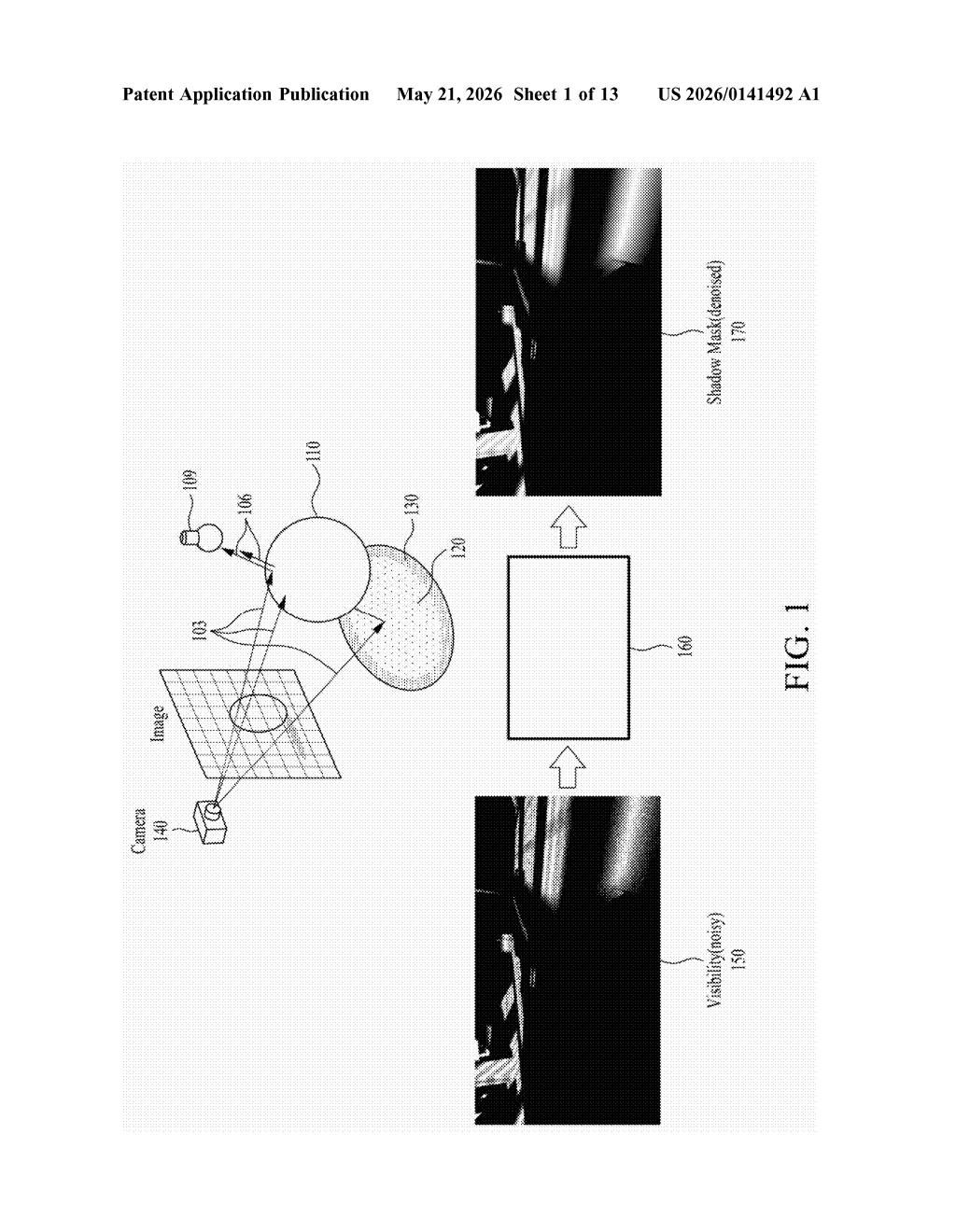
What Samsung's shadow-denoising rendering actually does
Imagine you're playing a game or watching a rendered film and the shadows on the ground look grainy or pixelated, like a badly printed photo. That graininess — called shadow noise — is a common side effect of how modern graphics engines calculate lighting quickly. The more light sources in a scene, the worse it tends to get.
Samsung's patent describes a system that first looks at every light in a scene and sorts them into categories — think "sunlight," "point light," "area light," and so on. For each category, it builds a special image called an input texture that captures what shadows from that light type look like.
That texture gets fed into a neural network, which produces a "shadow mask" — essentially a smart filter that knows where the noise is and cleans it up. The cleaned mask is then applied back to the original scene to produce a much smoother final image, without having to re-render everything from scratch.
How the neural network classifies lights and builds shadow masks
The core idea here is light-type-aware shadow denoising. Most denoising approaches treat all shadows the same — one neural network tries to clean up everything at once. Samsung's method splits the problem first.
The pipeline works in four steps:
- Classify lights — the system reads metadata about every light in the rendered scene (position, type, intensity) and buckets them into distinct light types (e.g., directional, point, spot, area).
- Generate input textures — for each light type, a texture is rendered or extracted that encodes the noisy shadow contribution from just that category of light.
- Run the neural network — each input texture is passed through a neural network model (the patent doesn't specify the architecture, but this is consistent with U-Net-style or convolutional denoising networks common in graphics research) that outputs a shadow mask — a per-pixel map of how much noise needs to be suppressed.
- Apply the mask — the shadow masks for each light type are composited back onto the rendered scene to remove noise while preserving shadow shape and detail.
By decomposing the problem by light type, each neural network pass handles a simpler, more consistent input — which generally means better denoising quality than a single catch-all pass.
What this means for real-time graphics and game rendering
Real-time shadow rendering is one of the biggest quality gaps between pre-rendered film CGI and interactive graphics like games or XR experiences. Techniques like ray tracing produce realistic shadows but generate enormous amounts of noise at interactive frame rates — which is why denoising is now a critical part of the GPU rendering pipeline (see NVIDIA's DLSS and AMD's FSR).
Samsung makes GPUs for mobile devices (Exynos) and is a player in XR hardware. A light-type-aware denoising approach could make real-time rendering on lower-power hardware look substantially cleaner — relevant for mobile gaming, AR headsets, or any scenario where you can't just throw more compute at the problem.
This is solid, incremental graphics research — not a flashy consumer feature, but the kind of foundational rendering work that quietly ends up inside GPU drivers and game engines. The light-classification approach is a sensible engineering choice that makes the denoising problem more tractable. Whether Samsung ships this in an Exynos driver or licenses it, the underlying idea is worth watching.
Get our take in your Top Stories
Liked this breakdown? Add Patentlyze as a preferred source on Google, and our plain-English take shows up more often in your Top Stories the next time Samsung patent news breaks.
There are more where this came from
We read every patent application Big Tech publishes and send you the ones worth knowing. Plain English, free, every week.
Want this weekly breakdown for a company we don't cover? Patentlyze Pro →