
Nvidia
Nvidia · AI / ML · Filed Jun 22, 2026 · USPTO published Oct 8, 2026 · Oct 8 release
Nvidia Files Patent for Video Streaming That Cleans Up Blocky Frames
Streaming video turns into smudgy squares when the connection is weak. Nvidia's filing has an AI write small correction notes for each frame and ride them along inside the same stream.
- Publication number
- US 2026/0311380 A1(US20260311380A1)
- Applicant
- NVIDIA Corporation
- Filed · Published
- Jun 22, 2026 · Oct 8, 2026
- Inventors
- Vipul Parashar
- Status when we published
- Waiting for an examiner
- Document
- 1 claim
- US classification
- 382/156
- Parent application
- Continuation of 17/707,633 (filed Mar 29, 2022)(17707633)
What Nvidia's video cleanup patent actually does
A soccer match streams to a phone over weak train Wi-Fi. The ball turns into a cluster of gray squares every time it moves, and the grass smears into mush. That blockiness is what happens when a video is squeezed hard to fit through a slow connection.
Nvidia's filing describes a two-step fix. First the video is shrunk the usual way, using a standard format your phone already understands. Then an AI model compares the squeezed frame with the original and writes a small set of correction notes, which travel inside the same stream.
On your end, the phone reads those notes and nudges the blocky pixels back toward what the camera actually saw. Some of your limited bandwidth now goes to the notes instead of the picture, and the patent argues that bargain comes out ahead.
… use one or more neural networks to generate image enhancement data for the one or more images including second residual information determined in a neural network feature space; …
Translation: It relies on artificial intelligence to figure out how to improve picture quality.
How the AI writes corrections for each frame
The claim covers a processor that builds a video frame's encoding from two kinds of leftover information. A residual is the difference between the original frame and the squeezed version, in other words the detail that got thrown away.
- Pixel-domain residual: subtract the compressed frame from the original, pixel by pixel.
- Feature-space residual: a neural network first turns images into "features" (its own internal summary of edges, textures and shapes), then takes the difference there. The result is the enhancement data.
- Final encoding: both residuals feed into the output.
The description says the network is trained with a scoring formula that rewards similarity to the original (a measure called SSIM) and penalizes data used (bits per pixel), balanced by a weighting number. In one example, a 1 Mbps connection gives 900 kbps to the standard video and 100 kbps to the enhancement data.
The enhancement data is placed in an extra-message slot in the stream (called an SEI message) so the stream stays compliant with the video standard. The filing says the approach can cut bitrate by at least 15% to 20% while improving image quality.
… one or more images are generated based, at least in part, upon one or more compressed images and image enhancement data generated using one or more neural networks.
Translation: The system rebuilds video frames by combining compressed data with AI enhancements.
Why blocky streaming video is worth fixing
If you stream on a phone or a shaky home connection, this targets the flaw you notice most: blocky edges around moving objects like a ball. The pitch is better-looking video from the same amount of data, or the same look from less of it. The filing puts the savings at 15% to 20% of the bitrate (the data sent per second).
For Nvidia, the idea ties AI to something every video service pays for. The filing is a follow-up to an application first filed in March 2022, so the idea has been around a while. The benefit also depends on the receiving device running the AI step, so players and TVs would need to go along.
Nvidia's 27th patent application we've tracked since May in the AI photo editing race follows earlier work on fixing multi-camera seams and showing how objects age.
Source: US 2026/0311380 A1 at the USPTO (PDF). Full patent text and figures are in the official publication.
Get our take in your Top Stories
Liked this breakdown? Add Patentlyze as a preferred source on Google, and our plain-English take shows up more often in your Top Stories the next time Nvidia patent news breaks.
Add Patentlyze on Google
One click.
There are more where this came from
We read the new patents from Big Tech, carmakers and more and send you the ones worth knowing. Plain English, free, every week.
The drawings · 56 sheets
56 drawing sheets from US 2026/0311380 A1 · click any drawing to enlarge


Show the other 48 sheets


More from Nvidia
All 665 Nvidia patents →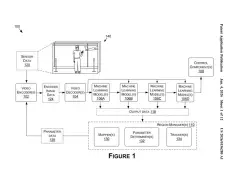
More in AI image & video
All 226 AI image & video patents →
Adobe
Adobe Patents AI Video Generator That Keeps Scenes Consistent Across Frames
Google
Google Patents a Way to Rebuild Any Video Using Just a Few Sample Frames
Adobe
Adobe Patents a Training System That Teaches AI Video to Track Moving Objects Frame by Frame
Adobe
No comments yet