
Nvidia
Nvidia · AI / ML · Filed May 13, 2025 · USPTO published Nov 19, 2026 · This week's release
Nvidia Patents Object Outlines That Trade Detail for Speed on Cars and Robots
Most vision software outlines a stop sign and a bicycle with the same fixed budget of points. Nvidia's patent application has the AI choose how many corner points each object needs, and lets engineers turn the overall detail up or down to match the chip.
- Publication number
- US 2026/0365197 A1(US20260365197A1)
- Applicant
- NVIDIA Corporation
- Filed · Published
- May 13, 2025 · Nov 19, 2026
- Inventors
- Rui SHEN
- Status when we published
- Approved; patent expected soon
- Document
- 20 claims
- US classification
- 701/23
- Examiner
- LEE, TYLER J (Art Unit 3663)
What Nvidia's adjustable object outlines do
Today, most systems that outline an object in a photo work from a fixed budget: a box with set corners, a curve with a set number of control points, or a grid of pixels marked yes or no. A bicycle needs far more detail than a stop sign, yet the budget stays the same. Older wave-based methods also tend to round off sharp corners.
Nvidia's filing describes a different recipe. Its AI describes an outline as a blend of smooth waves, and it also decides for itself how many corner points a given object needs. A stop sign might need a few. An oval might need none.
The useful twist is that you can turn the detail up or down. A small chip inside a car or robot can use a quick, rough outline, while a data center can afford a much finer one, all from the same basic method.
… predict, using a machine learning model, a quantity of time-domain keypoints; calculate a set of time-domain keypoints based at least on the predicted quantity and a set of Fourier coefficients associated with a Fourier descriptor …
Translation: An artificial intelligence model figures out how many points are needed to outline an object.
How Nvidia's AI rebuilds an outline from waves
The system starts with an ordinary 2D camera image that shows an object. A trained neural network (a program that learns patterns from examples) looks at it and produces two things: a set of Fourier coefficients and a keypoint count. Fourier coefficients are numbers that describe a closed shape as a stack of smooth waves added together. More waves mean finer detail.
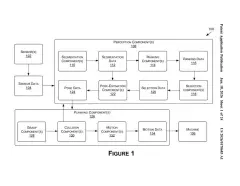
A later math step, an inverse Fourier transform (the reverse of breaking a shape into waves), turns those numbers back into actual positions on the image. The predicted keypoint count decides how many of those positions are marked as key corners. If it predicts zero, as it might for a circle or oval, the system instead samples a preset number of points, such as 25, 50 or 100, along the curve.
The detail dial is the degree of the descriptor, called K, which sets how many coefficients (2K+1) the network predicts. The filing gives K=7 as a fit for a vehicle or robot with limited computing power, and K=100 to 200 for servers. A multi-exit network can offer both: earlier layers output a K=7 outline, later layers a K=200 one.
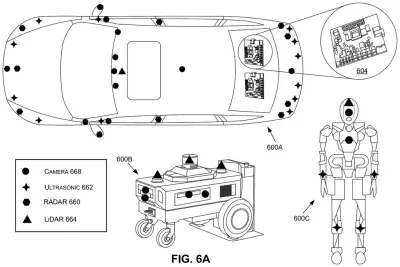
Training uses images paired with correct outlines, and the model is adjusted until its outlines match. The claims end with a machine acting on the result through control or navigation operations. One claim describes a vehicle with CPUs, GPUs, accelerators and outward-facing sensors.
By varying the number of predicted Fourier coefficients, the disclosed techniques are operable to generate boundary representations having differing degrees of accuracy and requiring differing amounts of computational resources.
Translation: Adjusting the detail level lets the system trade precision for processing speed.
Why a sliding detail dial matters for robots
For you, the practical effect would show up in machines that have to see edges quickly: driver-assist systems, warehouse robots, delivery bots. A car cannot wait on a cloud server to trace a pedestrian, so a fast, cheap version matters. The same method can produce a finer version where computing power is plentiful, such as when automatically labeling data used to train other AI. The filing also lists uses in simulation, augmented reality and security cameras.
The patent office has approved this application, and once Nvidia pays the final fee it should be issued as a granted patent. A patent is not a product announcement. The filing names Nvidia's DriveSIM and Isaac Sim tools only as places the method could be tested.
That makes this Nvidia's 117th filing we've tracked since May in the self-driving sensing race, following one on a location double-check system and one on a radar chip that pre-processes data.
Source: US 2026/0365197 A1 at the USPTO (PDF). Full patent text and figures are in the official publication.
Get our take in your Top Stories
Liked this breakdown? Add Patentlyze as a preferred source on Google, and our plain-English take shows up more often in your Top Stories the next time Nvidia patent news breaks.
Add Patentlyze on Google
One click.
There are more where this came from
We read every patent application Big Tech publishes and send you the ones worth knowing. Plain English, free, every week.
The drawings · 12 sheets
12 drawing sheets from US 2026/0365197 A1 · click any drawing to enlarge


Show the other 4 sheets


More from Nvidia
All 665 Nvidia patents →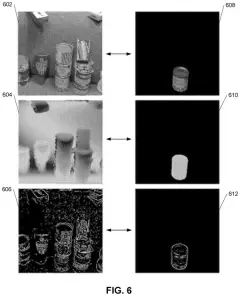
More in AI vision
All 351 AI vision patents →
Microsoft
Microsoft Files Patent for Teaching Robots to Grip Things by Watching Human Hands
Microsoft
Microsoft Files Patent for Teaching Robot Hands to Handle Objects They've Never Seen
Microsoft
Microsoft Files Patent to Help Phones and Robots Tell Where They Are From Video
Adobe
No comments yet