
Nvidia
Nvidia · AI / ML · Filed Jul 16, 2025 · USPTO published Nov 19, 2026 · This week's release
Nvidia Files Patent for Locating Hundreds of Factory Cameras With One Walk-Through
Hundreds of cameras in a warehouse each need to be told exactly where they are and which way they point. Nvidia's patent application says one person with a roving camera could do it in a single walk.
- Publication number
- US 2026/0368929 A1(US20260368929A1)
- Applicant
- NVIDIA Corporation
- Filed · Published
- Jul 16, 2025 · Nov 19, 2026
- Inventors
- Shuo Wang, Qunjie Zhou, Di Zeng, Sujit Biswas, Jun Liu, Kefei Ren, Chirag Ashokbhai Majithia, Vojtech Panek, Laura Leal-Taixe
- Status when we published
- Examiner raised objections; the company can respond
- Document
- 20 claims
- US classification
- 348/144
- Examiner
- BROWN JR, HOWARD D (Art Unit 2488)
What Nvidia's camera walk-through actually does
Imagine you run a warehouse with hundreds of cameras bolted to the walls and ceiling, and your software needs to know exactly where each one is and which way it faces. Today, someone sits at a screen and clicks matching landmarks, like a doorway corner, between each camera's view and a floor plan. Then they repeat it for the next camera, and the next.
Nvidia's patent application swaps that clicking for a walk-through. Someone carries a camera rig through the building (or flies it on a drone), stopping near each fixed camera to line up roughly with its view. Software stitches the footage into a 3D map of the space, then compares each fixed camera's picture to the walk-through frames to find the closest match.
Since the system knows where the roving camera was for that frame, it can work out where the fixed camera is and which way it points. The payoff is a location and direction for every camera with far less hand work.
… determining a first image of the plurality of first images that corresponds with the second image of the camera; determining, based at least in part on a first pose of the movable camera system associated with the first image that corresponds with the second image, a second pose of the camera; …
Translation: The system matches a movable camera view with a fixed camera view to calculate the exact position of the fixed camera.
How a roving camera pins down fixed ones
The claims cover a method with four main steps, repeated for each fixed camera in the building:
- Collect: a movable camera system (the filing says it can be a stereo pair, meaning two cameras mounted together) records images while it travels through the space.
- Match: the software finds features (distinct spots like corners and edges) in every image and turns each into a descriptor (a numeric fingerprint of the pixels around it). It picks the walk-through image that shares the most matching features with the fixed camera's picture.
- Locate: because the 2D points in that image are tied to 3D points in the map, a standard geometry calculation (called perspective-n-point) gives the fixed camera's position and orientation.
- Store: rotation and translation values are saved as an extrinsic calibration matrix, the record of where a camera sits and where it points.
The 3D map comes from SLAM (simultaneous localization and mapping, which tracks a device's position while it builds a map) and structure from motion (rebuilding 3D scenes from flat photos). Nvidia names its own GPU-accelerated versions, cuVSLAM and cuSFM.
The walk-through only works if some frame was shot close to each fixed camera's viewpoint. The filing describes a field-of-view overlap of 70 to 90 percent as a match, and also describes skipping the image-matching step and comparing a camera's picture straight to the 3D map.
A plurality of first images of an environment is captured using a movable camera system that traverses the environment. A second image of the environment is captured using a camera of the environment.
Translation: A walking camera records the space while fixed cameras take their own separate snapshots.
Why factories with hundreds of cameras care
If you run a site with hundreds of cameras, the practical gain is time. The filing says calibration has to be done for everything from basic object tracking to bird's-eye-view systems that merge many camera feeds, and the manual version scales badly. It also covers places where no floor plan exists, which is a harder case for today's methods.
This is a patent application, and the examiner's first review rejected the claims as filed, which is routine at this stage and usually followed by amendments. Nothing here says Nvidia is selling a calibration product. It does show the company working on the setup layer that camera-based factory and warehouse systems depend on.
That makes this Nvidia's 48th filing in Enterprise AI we've tracked since May, following one on frames sharing static and one on merging AI steps.
Source: US 2026/0368929 A1 at the USPTO (PDF). Full patent text and figures are in the official publication.
Get our take in your Top Stories
Liked this breakdown? Add Patentlyze as a preferred source on Google, and our plain-English take shows up more often in your Top Stories the next time Nvidia patent news breaks.
Add Patentlyze on Google
One click.
There are more where this came from
We read every patent application Big Tech publishes and send you the ones worth knowing. Plain English, free, every week.
The drawings · 18 sheets
18 drawing sheets from US 2026/0368929 A1 · click any drawing to enlarge


Show the other 10 sheets


More from Nvidia
All 665 Nvidia patents →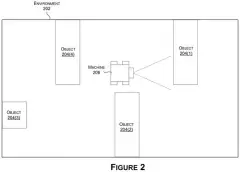
More in AI / ML
All 2,738 AI / ML patents →
Disney
Disney Files Patent for Game Worlds That Change With Live Events
Samsung
Samsung Files Patent for Phone Photo Cleanup That Pauses When Your Battery Runs Low
Adobe
Adobe Files Patent for AI Images Where You Choose What Sits in Front
Google
No comments yet