
Adobe
Adobe · AI / ML · Filed May 7, 2025 · USPTO published Nov 12, 2026 · This week's release
Adobe Files Patent for AI Images Where You Choose What Sits in Front
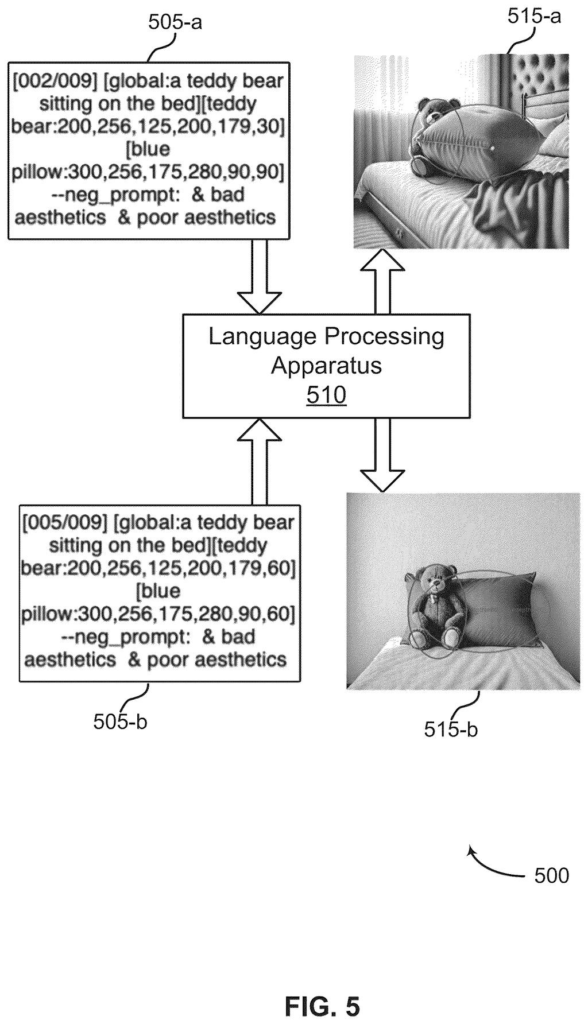
Ask an AI image tool for a teddy bear and a pillow, and it decides which one sits in front. An Adobe patent application hands that choice back to you with a single number.
- Publication number
- US 2026/0360024 A1(US20260360024A1)
- Applicant
- ADOBE INC.
- Filed · Published
- May 7, 2025 · Nov 12, 2026
- Inventors
- Supreeth Narasimhaswamy, Hareesh Ravi
- Status when we published
- Examiner raised objections; the company can respond
- Document
- 20 claims
- US classification
- 345/581
- Examiner
- SUN, HAI TAO (Art Unit 2616)
What Adobe's depth-aware image prompt actually does
You type 'a teddy bear sitting on a bed' into an AI image tool, and the bear shows up wherever the AI feels like putting it. Maybe it's tucked behind the pillow when you wanted it out front. You can rewrite the prompt and try again, but you're mostly rolling dice.
Adobe's filing adds a few extra numbers to the request. Alongside your description, you give each object an oval that marks where it sits, how big it is and how much it's tilted, plus one number for how far it is from the camera.
Change the tilt number and the bear turns. Change the depth numbers for the bear and a blue pillow and they stack differently in the scene. The AI still paints the whole picture itself, but it follows your layout.
obtaining an input prompt comprising a representation of an object and a depth value for the object; encoding the input prompt to generate a text embedding representing the object and the depth value; and generating, using an image generation model, a synthetic image based on the text embedding …
Translation: Users type what they want and specify its depth layer so the AI builds a custom image.
How the oval and depth number reach the model
The filing describes a system that adds layout information to an ordinary text prompt. For each object, the user supplies an ellipse (an oval) defined by its center point, the lengths of its two axes and its tilt in degrees, plus a depth disparity value for the object's center. In the filing's convention, a higher value means the object is closer to the camera.
A text encoder (the part that turns words into numbers a computer can work with; the filing gives a T5 encoder as an example) reads the prompt, the oval and the depth number together. It produces one embedding, a list of numbers standing in for the whole request. A diffusion transformer (an image model that starts from visual noise and removes it, guided by that embedding) then builds the picture. The claims describe this as denoising image tokens, which are small patches of the picture tagged with their positions.
The filing also covers:
- Several objects in one image, each with its own depth value
- Giving the position visually, with the system converting that mark into text
- Broader '3D location information' instead of only a depth number
- Training the model on prompts that include depth values
What depth control means for AI image editing
If you've ever fought an AI image tool to get two objects into the right arrangement, this is the problem Adobe is going after. The filing says existing tools can't control position and depth together, and older fixes like bounding boxes (plain rectangles) or stick-figure skeletons lose fine detail. Setting both could mean fewer retries when you're building a scene.
The filing doesn't name a product, and the examiner's first review rejected the claims as filed, a routine step that usually leads to amendments. It shows what Adobe is exploring; nothing in it says when, or whether, you'd see this in an app.
Adobe's 47th filing we've tracked on controllable AI images since May adds to a run that includes decorative text box patterns and editable letter art.
Source: US 2026/0360024 A1 at the USPTO (PDF). Full patent text and figures are in the official publication.
Get our take in your Top Stories
Liked this breakdown? Add Patentlyze as a preferred source on Google, and our plain-English take shows up more often in your Top Stories the next time Adobe patent news breaks.
Add Patentlyze on Google
One click.
There are more where this came from
We read every patent application Big Tech publishes and send you the ones worth knowing. Plain English, free, every week.
The drawings · 15 sheets
15 drawing sheets from US 2026/0360024 A1 · click any drawing to enlarge


Show the other 7 sheets


More from Adobe
All 264 Adobe patents →

More in AI / ML
All 2,637 AI / ML patents →
Google
Google Files Patent for Image AI That Sums Up a Photo From All Its Pieces
Samsung
Samsung Files Patent for One AI Model That Handles Many Editing Jobs
Nvidia
Nvidia Files Patent for AI Video Built From Frames That Share Their Static
Microsoft
No comments yet