
Nvidia Patents AI Models That Shrink and Grow to Match Your Chip's Workload
Your GPU is constantly juggling tasks, so why should an AI model demand the same amount of computing power whether the chip is quiet or slammed? Nvidia's new patent describes a system that watches the chip's workload in real time and automatically scales the AI model up or down to match.
How Nvidia's self-adjusting AI models actually work
Ever noticed how a laptop fan screams the moment you open a video call while something else is already running? That kind of overload happens constantly inside the chips powering AI systems, and there's usually no graceful way for the AI to back off and give the chip some breathing room.
Nvidia's patent describes a system that monitors how busy a chip is at any given moment and then picks a lighter or heavier version of an AI model to match. If the chip is under pressure, the model trims itself down to stay fast. When resources free up, it scales back to full quality. You'd see this play out as fewer dropped frames, faster responses, or steadier accuracy instead of unpredictable slowdowns.
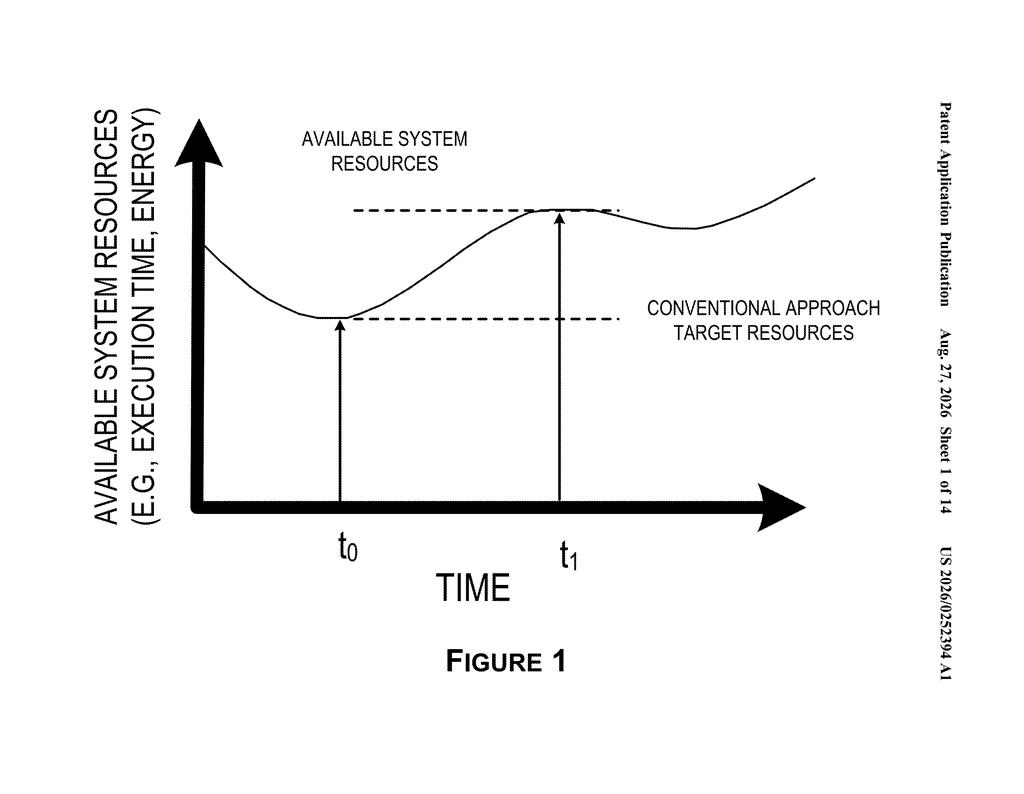
The system tracks resource availability at multiple time horizons: what's happening right now, what's likely to happen soon, and what longer-term trends look like. A separate small model then decides which version of the main AI to run. The whole thing happens during inference, meaning while the AI is already doing its job, with no need to stop and restart.
… generate, based at least on the one or more resource profiles, a configuration of a multi-configuration model during execution of the multi-configuration model using the processor.
Translation: The chip automatically adjusts the AI model's size and complexity while it is running based on available hardware resources.
How the chip profiles itself and picks a model configuration
The patent centers on what Nvidia calls a multi-configuration model: a single AI model that has been built to run at several different sizes or quality levels. Think of it like a streaming video player that can drop from 4K to 720p without buffering rather than crashing.
A resource profiling layer continuously measures metrics on the chip (things like memory bandwidth, compute utilization, and power draw) and produces what the patent calls resource profiles. These profiles cover three time windows:
- Current profile, what the chip is doing right now
- Near-term profile, a short-range prediction of upcoming load
- Long-term profile, slower trends, such as thermal buildup over minutes
A configuration selection model (a smaller, fast-running AI) takes those profiles as input and picks the best-fitting version of the main model to activate. This selection runs during inference (while the AI is already producing outputs), so the switch happens on the fly without restarting the pipeline.
The performance constraints that guide those choices, such as acceptable latency, minimum accuracy, or a power budget, are set in advance. The system then treats those as guardrails, picking the highest-quality configuration that still fits within whatever the chip can currently support.
… a multi-configuration model may be dynamically scaled or optimized by modifying its structure or parameters during inference or runtime based on specified performance constraints (e.g., latency, accuracy, power or energy consumption) and a (e.g., current, predicted future) resource profile of the processor …
Translation: The AI model changes its internal structure in real time to balance speed and accuracy against battery or power limits.
What adaptive AI models mean for real-world GPU performance
For anyone using AI-powered features in real-time applications, such as autonomous vehicles, video processing, or on-device assistants, this matters because those systems can't afford to pause when the chip gets busy. A self-scaling model means the AI keeps running at a usable level instead of falling behind or hogging resources that other tasks need. The practical payoff is steadier, more predictable behavior rather than occasional spikes of slowness that are hard to diagnose.
Nvidia already sells chips purpose-built for AI inference, from data center GPUs to the Jetson line used in robotics and edge devices, and this patent fits squarely into the challenge of making those chips work efficiently under variable real-world loads. It's the kind of infrastructure-level work that rarely shows up in product announcements but shapes how well every AI feature above it performs. Readers following new Big Tech patents in the AI chip space will recognize this as part of a broader push to make on-device and edge AI less brittle when compute resources fluctuate.
That makes this Nvidia's 32nd filing we've tracked since July in our AI chip wars watch, adding to work like split math hardware and self-reshaping AI models.
The most honest way to read this patent is as Nvidia solving a problem its own customers already complain about: AI models that perform well in testing but behave erratically when deployed on real hardware that's doing other things at the same time.
For the person using a product built on this technology, the change would be subtle but meaningful. You'd stop noticing the occasional freeze or quality drop that happens when the chip gets overloaded, which is exactly what separates a product people trust from one they learn to work around.
The detail worth attention is that this system doesn't just react to slowdowns after they happen. It anticipates load that's about to arrive and adjusts in advance, which is a harder problem and a more useful one to solve.
Get our take in your Top Stories
Liked this breakdown? Add Patentlyze as a preferred source on Google, and our plain-English take shows up more often in your Top Stories the next time Nvidia patent news breaks.
There are more where this came from
We read every patent application Big Tech publishes and send you the ones worth knowing. Plain English, free, every week.
The drawings
14 drawing sheets from US 2026/0252394 A1 · click any drawing to enlarge


Want this weekly breakdown for a company we don't cover? Patentlyze Pro →
Be the first to weigh in