Nvidia
Nvidia · AI / ML · Filed Sep 22, 2025 · USPTO published May 14, 2026 · May 14 release
Nvidia Patents a Text-to-3D Pipeline for Simulation-Ready Virtual Characters
Nvidia is patenting a pipeline that takes a plain-English description — say, 'a hooded medieval tunic' — and spits out a fully simulation-ready 3D object geometry, no manual modeling required. The clever part is that it's built specifically for physics simulation, not just visual rendering.
- Publication number
- US 2026/0134627 A1(US20260134627A1)
- Applicant
- NVIDIA CORPORATION
- Filed · Published
- Sep 22, 2025 · May 14, 2026
- Inventors
- Xueting LI, Umar IQBAL, Ye YUAN, Jan KAUTZ, Shalini DE MELLO, Miles MACKLIN, Jonathan Christian LEAF, Gilles DAVIET
- Status when we published
- Waiting for an examiner
- Document
- 20 claims
- US classification
- 345/419
- Parent application
- Claims priority from a provisional application 63720102 (filed Nov 13, 2024)
How Nvidia turns a text description into a 3D character
Imagine you're building a virtual world and you need a character wearing a specific outfit. Normally, you'd either hire a 3D artist or spend hours in modeling software. Nvidia's patent describes a system where you just describe what you want in plain English and the software generates the 3D geometry automatically.
The system is designed so the resulting objects aren't just pretty to look at — they're ready to drop straight into a physics simulation. That means the virtual clothing can drape, collide, and move like real fabric would, without extra work from a developer or artist.
This is particularly interesting for fields like robotics training, game development, and digital twins, where you need lots of varied virtual objects fast — and you need them to behave realistically in a simulated environment, not just sit there looking nice.
How the diffusion model converts language into object geometry
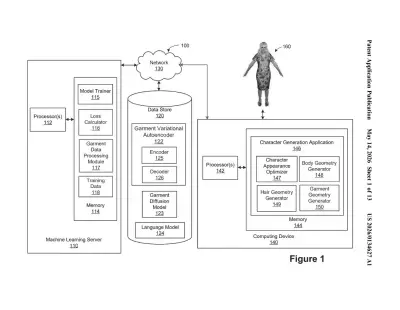
The core pipeline works in three stages, each handled by a different trained neural network component.
- Language embedding: Your natural language description (e.g., "a loose linen shirt with rolled-up sleeves") is first converted into a language embedding — essentially a dense numerical representation that captures the semantic meaning of the text.
- Diffusion model to geometry embedding: That language embedding is fed into a trained diffusion model (the same class of AI behind image generators like Stable Diffusion, but here operating in 3D geometry space rather than pixel space) to produce a geometry embedding — a compact representation of the shape of the object.
- Decoder to surface representation: A trained decoder takes that geometry embedding and outputs an object surface representation — a mathematical description of the object's surface, likely in a format like a mesh or implicit surface.
Finally, the surface representation is converted into usable first object geometry — the actual 3D structure of the virtual object. The patent specifically mentions garments as a key use case, with a dedicated garment geometry branch in the training architecture, suggesting the system is tuned to handle the complex, deformable surfaces that clothing requires in physics simulations.
What this means for game dev, robotics, and virtual worlds
For anyone building simulated environments at scale — think robotics companies training manipulation policies, game studios populating open worlds, or VFX pipelines — the bottleneck has always been content creation speed. Generating physically accurate 3D assets by hand is slow and expensive. A text-driven pipeline that outputs simulation-ready geometry could dramatically cut that cost.
Nvidia's positioning here is strategic. The company already owns the dominant physics simulation platform (Omniverse) and the dominant AI training hardware. A tool that auto-generates simulation-ready content from text fits neatly into that ecosystem — and could tighten the lock-in for developers building on Nvidia's stack.
Source: US 2026/0134627 A1 at the USPTO (PDF). Full patent text and figures are in the official publication.
Get our take in your Top Stories
Liked this breakdown? Add Patentlyze as a preferred source on Google, and our plain-English take shows up more often in your Top Stories the next time Nvidia patent news breaks.
Add Patentlyze on Google
One click.
There are more where this came from
We read the new patents from Big Tech, carmakers and more and send you the ones worth knowing. Plain English, free, every week.
More from Nvidia
All 665 Nvidia patents →
More in AI simulation
All 193 AI simulation patents →
Nvidia
Nvidia Patents a Training Method for Turning Text Into 3D Objects
Nvidia
Nvidia Patents an AI Pipeline That Turns Video Into Animatable 3D Characters
Nvidia
Nvidia Patents an AI Pipeline for Generating Animatable 3D Characters
Nvidia