
Nvidia
Nvidia · Automotive · Filed May 16, 2025 · USPTO published Nov 19, 2026 · This week's release
Nvidia Files Patent for Building the Driving Test a Self-Driving Car Must Pass
Proving a self-driving car is safe takes far more than a good demo drive. Nvidia's patent filing lays out how to plan a test set, down to the hours needed and the mix of weather, roads and countries.
- Publication number
- US 2026/0369111 A1(US20260369111A1)
- Applicant
- NVIDIA Corporation
- Filed · Published
- May 16, 2025 · Nov 19, 2026
- Inventors
- Kenny Chowdhary, Mark Koren, Carl Johan Zanden, Hans Jonas Nilsson, Michael Cox, Sever Ioan Topan
- Status when we published
- Approved; patent expected soon
- Document
- 20 claims
- US classification
- 701/32.8
- Examiner
- RAMIREZ, ELLIS B (Art Unit 3658)
What Nvidia's safety test dataset patent covers
How many hours of driving would you need to watch before you trusted a robot driver? In one example from the filing, the answer is at least 10,000 hours with zero crashes, and closer to 30,000 hours if you want to be 95% sure the car crashes less than once per 10,000 hours.
Nvidia's patent filing describes a way to plan that test footage up front. You start with a safety goal, work out how much footage proves it, then split the footage to match where the car will really drive: so much in the U.S., so much in Europe, so much at night, so much in the rain.
The footage can come from old recordings, from cars sent out on planned routes, or from simulation. It gets labeled with the correct answers, locked away from the teams that train the car, and replayed into the car's software as if it were live.
determining, based at least on one or more failure thresholds associated with one or more safety goals of a machine, one or more quantities of test data associated with statistically validating performance of one or more systems or components of the machine with respect to the one or more safety goals; …
Translation: The system calculates how much test data is needed to prove the vehicle meets specific safety targets.
How Nvidia sizes and balances the test data
The patent covers a pipeline that turns a safety goal into a finished set of test recordings. Each goal carries a failure threshold, such as no more than one collision per 10,000 hours. The system runs a fault-tree analysis (a step-by-step breakdown of how a collision could happen, for example through a perception, planning or braking failure) to work out how much test data is needed. With a 95% confidence target, the filing's example calls for about 30,000 failure-free hours.
Next, an operational usage model (a forecast of where and when the machines will really drive) sets target shares. One example: 40% of hours in the U.S., 30% in Europe, plus set portions at night or in bad weather. The system collects recordings to fill each slot and keeps gathering more until every quota is met.
The data can come from:
- Stored recordings from past driving
- Vehicles sent along planned routes
- Simulated sensor data from tools such as Nvidia's DriveSIM
Labelers then add ground truth (the correct answers, like boxes around pedestrians or lane layouts), following a spec tied to each goal. The set sits in access-restricted storage, and test routes are chosen to differ from training routes. Finally, the recordings are replayed into the car's perception, planning or control software as if they were live sensor feeds, and the outputs are compared with the ground truth.
… the system(s) may use models indicating anticipated machine usage to determine a target distribution for the quantity of the test data across various real-world conditions.
Translation: It figures out how to spread the tests across different real world driving environments.
Why Nvidia's self-driving test plan matters
If you ride in a self-driving car or share a road with one, the number you care about is how it was tested. This filing describes a way to keep that testing honest: enough hours, a realistic mix of places and weather, and a locked-away test set that the car's builders can't train on by accident. The description also names simulators like DriveSIM and Isaac Sim as sources for rare, hazardous scenes that are hard to record in real life.
The patent office has approved this application, and once Nvidia pays the final fee it should be issued as a granted patent. The claims also reach beyond cars to robots and other machines, so the method could apply to any machine that needs a statistical safety case.
This is the 112th Nvidia filing we've tracked since May in the self-driving sensing race, joining earlier work like one fixing colors in harsh light and one flagging strange traffic.
Source: US 2026/0369111 A1 at the USPTO (PDF). Full patent text and figures are in the official publication.
Get our take in your Top Stories
Liked this breakdown? Add Patentlyze as a preferred source on Google, and our plain-English take shows up more often in your Top Stories the next time Nvidia patent news breaks.
Add Patentlyze on Google
One click.
There are more where this came from
We read every patent application Big Tech publishes and send you the ones worth knowing. Plain English, free, every week.
The drawings · 20 sheets
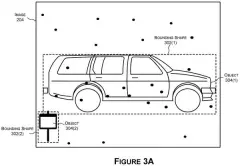
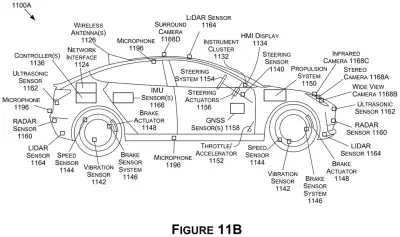
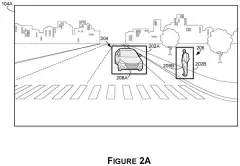
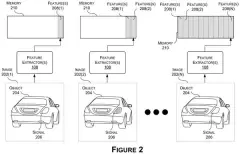
20 drawing sheets from US 2026/0369111 A1 · click any drawing to enlarge


Show the other 12 sheets


More from Nvidia
All 665 Nvidia patents →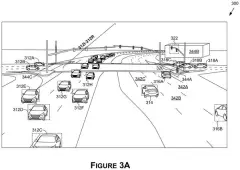
More in Automotive
All 377 Automotive patents →
Mobileye (Intel)
Intel's Self-Driving Safety Patent Can Pull an Autonomous Car Over
Amazon
Zoox Files Patent to Help Self-Driving Cars Guess Which Path to Check First
Qualcomm
Qualcomm Files Patent for a Self-Driving Car That Explains Moves You Once Overrode
Waymo (Google)
No comments yet