
Nvidia
Nvidia · Display · Filed Jul 21, 2026 · USPTO published Nov 19, 2026 · This week's release
Nvidia Files Patent for Keeping Camera Colors True in Harsh Lighting
Nvidia's patent application shrinks camera data by squeezing only the brightness, so each pixel's mix of red, green and blue stays the same. It then recalibrates the color fix against a chart of known colors.
- Publication number
- US 2026/0370771 A1(US20260370771A1)
- Applicant
- NVIDIA Corporation
- Filed · Published
- Jul 21, 2026 · Nov 19, 2026
- Inventors
- Yongshen Ni
- Status when we published
- Waiting for an examiner
- Document
- 20 claims
- US classification
- 382/167
- Parent application
- Continuation of 18/419,351 (filed Jan 22, 2024)(18419351)
What Nvidia's color-true camera patent does
Ever shot a photo straight into a sunset and had the sky come out a strange shade? Cameras built for extreme lighting have a version of this problem, and for a car's cameras the stakes are higher than a ruined vacation shot.
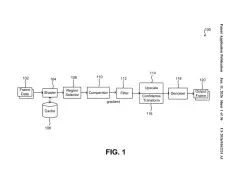
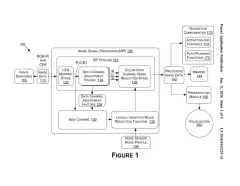
The sensors in these cameras record far more detail than the chip behind them can handle, so the data has to be squeezed down. Squeeze it carelessly and colors drift. Nvidia's patent application describes squeezing only the brightness, then scaling each pixel's red, green and blue values by the same amount so their balance stays put.
It also recalibrates the color-fixing step that comes afterward, using a photographed chart of squares with known colors as the answer key.
… apply the luminance gain values to each color channel of respective pixels of the image to obtain a compressed image in which a color ratio of each pixel is preserved …
Translation: It adjusts the color channels so the image maintains accurate colors after compression.
How the brightness squeeze keeps colors intact
Camera sensors built for extreme lighting (called HDR sensors) record each color value in great detail, for example 24 bits per color channel (bits are the digits used to describe a value). The image signal processor, or ISP, the chip that turns raw sensor data into a picture, may handle only 20 bits. So the data has to be compressed on the way in.
The patent describes doing that in a specific order:
- Work out each pixel's brightness as a weighted mix of its red, green and blue values (the example uses 25%, 50% and 25%).
- Squeeze that brightness with a power curve, a smooth non-linear formula. One example in the claims is y = 3.6869 × x0.7549.
- Divide the squeezed brightness by the original to get a gain, then multiply red, green and blue by that same gain so their ratios never change.
The second half is calibration. A camera photographs a color chart (the example has 24 colored squares) whose true colors are known. The same squeeze is applied to the chart image, and the gaps between the camera's colors and the true ones are used to compute a color correction matrix, a grid of numbers that nudges colors back toward accurate values. The filing mentions methods such as least squares to fit it.
The filing says older approaches split the brightness curve into several straight-line segments (five in its example), each with its own calibration and extra hardware. One curve avoids that.
… apply one or more dynamic range compression operations to brightness values associated with the target image to obtain compressed brightness values …
Translation: The system shrinks the heavy brightness data down to fit the processing pipeline.
Why car and robot cameras could care
If your car, a delivery robot or a security camera has to see in harsh lighting, accurate color is part of seeing correctly. The filing says HDR sensors are popular in driver-assist systems because they keep detail in both bright and dark areas. This patent aims to keep their colors accurate after the data is shrunk to fit the chip.
It also targets cost and lag. The older multi-segment method needs extra hardware and processing, which the filing says adds latency (delay). A single curve with one calibration step is simpler to build into a chip, which suits a company that supplies the processors inside such cameras and vehicles. For you, the effect would be invisible: fewer odd color shifts in footage that onboard software depends on.
That makes this Nvidia's 111th filing we've tracked since May in self-driving sensing, adding to work like the anomaly-spotting camera patent and the street gap-filling AI.
Source: US 2026/0370771 A1 at the USPTO (PDF). Full patent text and figures are in the official publication.
Get our take in your Top Stories
Liked this breakdown? Add Patentlyze as a preferred source on Google, and our plain-English take shows up more often in your Top Stories the next time Nvidia patent news breaks.
Add Patentlyze on Google
One click.
There are more where this came from
We read every patent application Big Tech publishes and send you the ones worth knowing. Plain English, free, every week.
The drawings · 13 sheets
13 drawing sheets from US 2026/0370771 A1 · click any drawing to enlarge


Show the other 5 sheets


More from Nvidia
All 665 Nvidia patents →
More in Display
All 741 Display patents →
Sony
Sony Patents Tiny Walls That Stop Camera Pixels From Disturbing Each Other
Sony
Sony Patents a Folded Graphite Strip to Cool a Camera Sensor That Moves
Sony
Sony Patents a Ranging System That Borrows Unused Detector Hardware to Measure Longer Distances
Sony
No comments yet