
Nvidia
Nvidia · Automotive · Filed Jul 14, 2026 · USPTO published Nov 19, 2026 · This week's release
Nvidia Files Patent for Self-Driving Cars That Can Tell When Their Sensors Are Blocked
A self-driving car that can't tell its sensor is covered in mud may trust what it sees. Nvidia's patent describes a check that the filing says can run in under a millisecond, versus 50 for an AI object detector.
- Publication number
- US 2026/0367232 A1(US20260367232A1)
- Applicant
- NVIDIA Corporation
- Filed · Published
- Jul 14, 2026 · Nov 19, 2026
- Inventors
- Erik Manfred LEITCH, Joachim PEHSERL, Richard Zachary ROBINSON, David Ambrose WEHR
- Status when we published
- Waiting for an examiner
- Document
- 1 claims
- US classification
- 701/29.1
- Parent application
- Continuation of 18/169,776 (filed Feb 15, 2023)(18169776)
What Nvidia's sensor-health check actually does
Imagine you're driving at night and a splash of mud covers part of your windshield. You'd notice right away and slow down. A self-driving car's sensors can get just as dirty, but the car has no way of seeing that its own eyes are smudged.
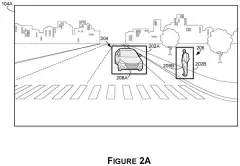
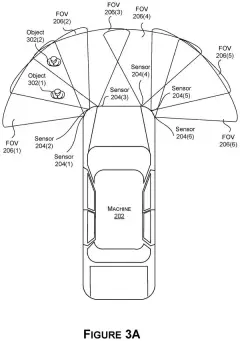
Nvidia's patent describes a way for the car to check on its sensors constantly. It slices each sensor's view into regions, looks at the readings in each one, and compares them with what the same type of sensor normally sees under clear conditions. If a region looks off, the system works out how likely it is that the sensor is blocked, or that it can't see as far as it should.
The result is a running health report the rest of the car can use to slow down, hand control back to the driver, or ask for the sensor to be cleaned.
… determining a performance level of the sensor based at least on the plurality of statistics and historical information associated with the sensor, the performance level being based at least on posterior probabilities calculated for the plurality of statistics relative to a plurality of hypotheses corresponding to different performance levels for the sensor …
Translation: The car figures out how well its sensors are working by comparing current data to past records and statistical probabilities.
How the car scores a blocked or short-sighted sensor
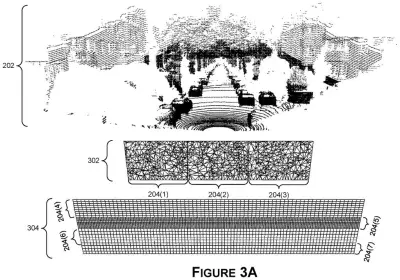
The patent covers a method for watching over a sensor's health. Data from a sensor, such as a camera image or a laser-scanner point cloud (a cloud of distance readings), is laid out on a flat 2D grid that matches what the sensor can see. That view is cut into regions, for example horizontal stripes, and each stripe is cut into smaller pieces.
For each region, the system computes simple statistics, like the share of readings that came back invalid. The claim centers on checking how consistent each small piece is with the larger region around it. Those numbers then go through Bayesian inference (a way of updating a best guess as new evidence arrives). The system holds several hypotheses, such as "not blocked," "partly blocked," or "range limited to a shorter distance," and works out how likely each one is.
The starting guess comes from historical data from the same type of sensor, which can be sorted by things like road type, weather or time of day. After each camera frame or laser spin, the new result becomes the starting guess for the next one.
The output is a set of plain measures, such as the share of the view that is blocked or the sensor's current maximum range. The filing's example plot shows range falling from about 200 meters to about 5 as obstruction builds up. The car's driving software can then compensate.
… transmitting, to one or more components, one or more indications of the performance of the sensor to cause the one or more components to perform one or more operations in view of or accounting for the performance of the sensor …
Translation: The system warns other parts of the vehicle so it can adapt when a sensor stops working properly.
Why a muddy sensor matters for self-driving cars
If you ride in or drive a car with driver-assist features, its sensors are the car's only view of the world, and snow, mud or heavy rain can cut that view short. A car that knows a sensor is partly blind can slow down, hand control back to you, or have the sensor cleaned before it acts on bad information.
The patent also frames this as a cheap check. The filing says it avoids the large labeled training sets that AI-based approaches need, and it can switch to simpler statistics on weaker hardware. It also lists uses beyond cars, including robots, drones and warehouse vehicles.
This is the 114th Nvidia filing we've tracked since May in the self-driving sensing race, joining earlier applications like one on spotting drowsy drivers and one on testing self-driving cars.
Source: US 2026/0367232 A1 at the USPTO (PDF). Full patent text and figures are in the official publication.
Get our take in your Top Stories
Liked this breakdown? Add Patentlyze as a preferred source on Google, and our plain-English take shows up more often in your Top Stories the next time Nvidia patent news breaks.
Add Patentlyze on Google
One click.
There are more where this came from
We read every patent application Big Tech publishes and send you the ones worth knowing. Plain English, free, every week.
The drawings · 11 sheets
11 drawing sheets from US 2026/0367232 A1 · click any drawing to enlarge


Show the other 3 sheets


More from Nvidia
All 665 Nvidia patents →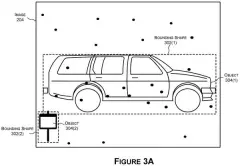
More in Automotive
All 377 Automotive patents →
Qualcomm
Qualcomm Files Patent for a Self-Driving Car That Explains Moves You Once Overrode
Qualcomm
Qualcomm Patents a Self-Driving Vision System That Spends Less Effort on Parked Cars
IBM
IBM Patents a Plan to Shuffle Cars Around So Their Sensors Use Less Battery
Qualcomm
No comments yet