
Nvidia
Nvidia · Automotive · Filed May 13, 2025 · USPTO published Nov 19, 2026 · This week's release
Nvidia Files Patent for a Car Camera That Spots Drowsy Drivers by Their Blinks
Nvidia's patent application says a blink alone may not reliably tell a drowsy driver from an alert one, so it also checks where you were looking and how your head was angled during that blink.
- Publication number
- US 2026/0369081 A1(US20260369081A1)
- Applicant
- NVIDIA Corporation
- Filed · Published
- May 13, 2025 · Nov 19, 2026
- Inventors
- Rahul Viney Aggarwal, Nishant Puri, Zhengmin Zhang, Shagan Sah, Rajath Bellipady Shetty
- Status when we published
- Rejected again; the company can still amend or appeal
- Document
- 20 claims
- US classification
- 348/148
- Examiner
- NOH, JAE NAM (Art Unit 2481)
What Nvidia's blink-based drowsiness check does
Imagine you're on a long night drive. You glance at the mirror, then the road, then the mirror again. Your eyes close and open constantly, and a camera watching you could have a hard time telling a normal check of your surroundings from the start of a nod-off.
Nvidia's filing tries to fix that by looking at more than the blink itself. A camera aimed at the driver measures how long each blink lasts, how fast the eyelid moves and how wide the eye opens afterward. It also notes where you were looking and how your head was tilted during that blink. An AI model boils that surrounding detail down into a short summary, then weighs it alongside the blink measurements to estimate how likely you are to be drowsy.
The goal is fewer false alarms and fewer missed warnings. If the system decides you're drowsy, the filing says it could sound an alert or turn cruise control or an autonomous driving feature on or off.
… determining, based at least on at least one attribute of the one or more attributes, one or more blinks and a temporal interval defined based at least on a start and an end of at least one blink of the one or more blinks; …
Translation: The system measures how long your eyes stay closed during each individual blink.
How the system reads gaze and head pose per blink
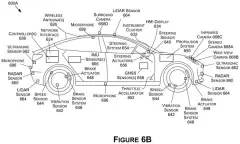
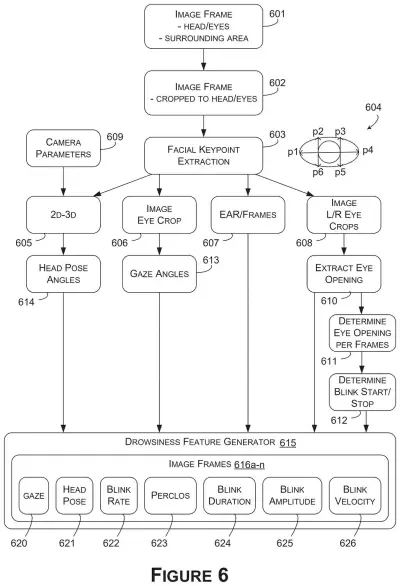
The system starts with a camera pointed at the driver. Neural networks (AI models trained on many examples) pull details out of each video frame: how open the eyes are, where the eyes are pointing (gaze), and how the head is angled (head pose). A blink is spotted when the eyes close and reopen, and the system marks the start and end of it.
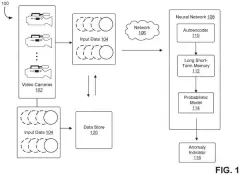
Here is the piece the claims center on. Only the gaze and head-pose readings from the frames between the start and end of that blink are selected. A first part of the neural network squeezes them into a reduced dimensional representation, which just means boiling many numbers down to a short summary. In one described example, that summary is a single context score.
- Blink measurements: duration, eyelid speed, how wide the eye reopens, blink rate, and PERCLOS (the share of frames in a time window where the eye is closed).
- Same depth: the context score enters the network alongside those measurements at the same layer, so the two are weighed together.
- Joint training: the two network parts are trained together, so the score becomes whatever helps most at spotting drowsiness.
The filing says the values are loaded into the network when a blink ends. They can be padded with extra values before and after, so short and long blinks fit the same input size. It also mentions steering wheel angle or lane position as possible extra context.
… processing eye attributes occurring during the plurality of blinks in first neural network layers to produce a reduced dimensional representation (i.e., a context).
Translation: An AI condenses your blinking patterns and head movements into a simple data profile.
What this means for Nvidia's in-car monitoring
If a car can tell a tired driver from an alert one more reliably, you get fewer pointless beeps and a better chance of a warning when it counts. The filing says the system could trigger an alert or switch features like cruise control on or off. It points to uses in semi-autonomous driving, fleet management and insurance risk assessment, and it ties the work to driver monitoring safety standards such as Euro NCAP.
The patent examiner issued a final rejection of this application on October 20, 2026, though Nvidia can still amend the claims or appeal. Until that plays out, treat this as a look at how Nvidia approaches driver monitoring, not a feature headed to your car. The filing names no specific product.
This is the 113th Nvidia filing we've tracked in our self-driving sensing race watchlist since May, adding to work like one defining the driving test and one keeping camera colors true.
Source: US 2026/0369081 A1 at the USPTO (PDF). Full patent text and figures are in the official publication.
Get our take in your Top Stories
Liked this breakdown? Add Patentlyze as a preferred source on Google, and our plain-English take shows up more often in your Top Stories the next time Nvidia patent news breaks.
Add Patentlyze on Google
One click.
There are more where this came from
We read every patent application Big Tech publishes and send you the ones worth knowing. Plain English, free, every week.
The drawings · 15 sheets
15 drawing sheets from US 2026/0369081 A1 · click any drawing to enlarge


Show the other 7 sheets


More from Nvidia
All 665 Nvidia patents →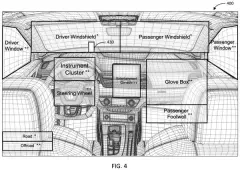
More in Automotive
All 377 Automotive patents →
Qualcomm
Qualcomm Files Patent for Tagging Car Video With Details About the Camera That Shot It
Qualcomm
Qualcomm Patents a Car Vision System That Reads Roads Without a Fixed Grid
Waymo (Google)
Waymo Patents a System That Predicts All Nearby Drivers' Moves at Once
Qualcomm
No comments yet