
OpenAI
OpenAI · AI / ML · Filed Sep 12, 2025 · USPTO published Nov 19, 2026 · This week's release
OpenAI Patents a Coding AI That Skips Setup for Simple Questions
Asking an AI a simple question about your code shouldn't mean it first downloads a gigabyte of software. OpenAI's patent application describes a coding assistant that checks what you asked for and skips the heavy setup when you only want an answer.
- Publication number
- US 2026/0367891 A1(US20260367891A1)
- Applicant
- OpenAI OpCo, LLC
- Filed · Published
- Sep 12, 2025 · Nov 19, 2026
- Inventors
- Maxwell Johnson, Thibault Sottiaux
- Status when we published
- Waiting for an examiner
- Document
- 20 claims
- US classification
- 717/106
- Parent application
- Claims priority from a provisional application 63806537 (filed May 15, 2025)
What OpenAI's ask-versus-change coding setup does
Every time you ask an AI coding assistant a quick question about your project, it may first spend minutes building a workspace and downloading every tool the project depends on. You wanted an answer, and instead you wait on setup the AI never needed.
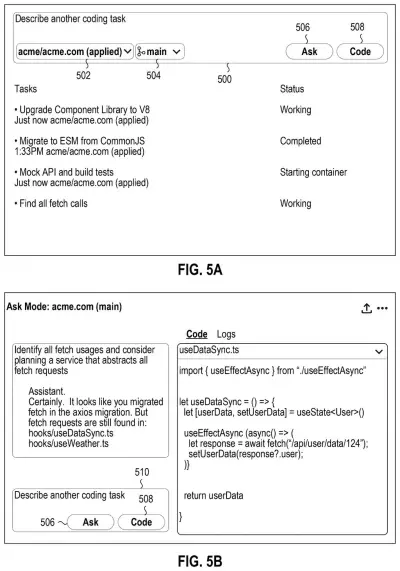
OpenAI's patent application describes a fix. The system works out what kind of job you asked for. If you want the AI to change the code (build it, test it, edit it), it sets up the full workspace. If you only want to ask about the code, it grabs the project files and skips the heavy downloads. The filing says that can cut startup from minutes to seconds.
For questions about earlier work, the system can also hand the AI a record of what happened last time, like the commands that ran and the edits that were made, so it can explain its own changes.
… retrieving packages identified by the code repository to build a target identified by the code repository based on a type of the agentic software development task …
Translation: The system downloads required software tools before letting the AI write any code.
How OpenAI's coding agent sets up its workspace
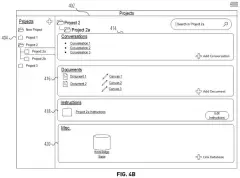
The instruction you send includes four things: the project's repository (the stored copy of its code), a branch (a separate working version of that code), a plain-English description of the job, and a setting that says whether this is a development task or a code query. A container (a sealed, disposable workspace on a server) then pulls down the repository.
Next comes the decision at the center of the claims. For a development task, the system also reads the project's dependency list and installs packages (the outside libraries and tools the code needs) so the AI can build, test and edit. For a code query, those packages are left out. The filing notes that JavaScript projects can reach 1 GB of dependencies.
Questions can also point at earlier work. The system can pull data from a previous task, such as a console log (a record of the commands typed and printed, plus changes to code files), and give it to the AI along with the repository.
The description adds other details. Secrets such as access tokens are deleted before the AI gets in, and the container's internet access is cut off. You can run several containers at once to compare variants, and finished work comes back as a proposed change for you to review.
receive an instruction to perform an agentic software development task in a code repository …
Translation: It starts by taking a developer's request to work on a specific software project.
Why faster answers matter for AI coding tools
If you use an AI coding assistant, the wait before it starts working is dead time. Sorting requests into "change this" and "explain this" means quick questions about your project could come back faster, because the assistant skips downloads it doesn't need just to read code.
For OpenAI, the filing says the repeated downloads waste computing resources, so skipping them also trims the cost of running each request. The filing's screens show two buttons, Code and Ask, and let you launch several tasks at once, which the document describes as an autonomous team of developers.
This is the 14th OpenAI filing we've tracked under our AI assistant & agent coverage since May, following earlier applications like one on shared project folders and one on topic-sensitive rules.
Source: US 2026/0367891 A1 at the USPTO (PDF). Full patent text and figures are in the official publication.
Get our take in your Top Stories
Liked this breakdown? Add Patentlyze as a preferred source on Google, and our plain-English take shows up more often in your Top Stories the next time OpenAI patent news breaks.
Add Patentlyze on Google
One click.
There are more where this came from
We read every patent application Big Tech publishes and send you the ones worth knowing. Plain English, free, every week.
The drawings · 11 sheets
11 drawing sheets from US 2026/0367891 A1 · click any drawing to enlarge


Show the other 3 sheets


More from OpenAI
All 58 OpenAI patents →
More in AI assistant & agent
All 436 AI assistant & agent patents →
Google
Google Patents a Team of Specialist AI Helpers Behind a Single Chat Box
Microsoft
Microsoft Files Patent for Giving AI Coding Helpers Better Background Reading
IBM
IBM Files Patent for an AI That Designs New Molecules Step by Step
Google
No comments yet