
Google
Google · AI / ML · Filed Apr 28, 2026 · USPTO published Nov 12, 2026 · This week's release
Google Patents a Team of Specialist AI Helpers Behind a Single Chat Box
Google describes a chat assistant that doesn't answer alone. It works like a switchboard, sending your question to specialist AI helpers and writing one reply from their notes. The company's own tests claim fewer made-up facts and a reply in about 3 seconds instead of 8.
- Publication number
- US 2026/0359364 A1(US20260359364A1)
- Applicant
- GOOGLE LLC
- Filed · Published
- Apr 28, 2026 · Nov 12, 2026
- Inventors
- Nayyar Azam, Ashutosh Kumar Mishra, Qiang Zhang, Aobo Li, Jesus Crespo, Sravani Burela, Rajan Bhargava, Muzzafer Ali, Zhinan Wang, William McKee, Wan-Huang Yang, Roman Kamyk, Spencer Morningstar, Yi Xu, Siqing Wang, Jamie Nicole Powell, Xiaolan Zhou, Kai Yao, Zhou Yu, Ilia Naimagon, Wei Chen, Diogo Andrade, Xiaoye Lan
- Status when we published
- Waiting for an examiner
- Document
- 20 claims
- US classification
- 707/749
- Parent application
- Claims priority from a provisional application 63803443 (filed May 9, 2025)
What Google's chat-box AI team actually does
Ever asked a chatbot a question and gotten a confident answer that turned out to be made up? That is the problem Google is trying to shrink here, using a help chat inside an advertising platform as its main example.
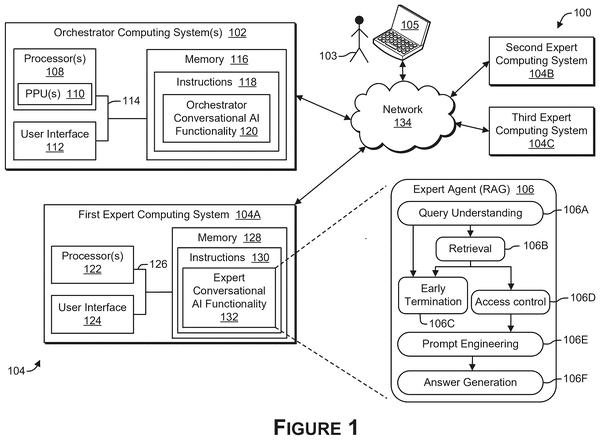
Instead of one giant AI answering everything, Google describes a coordinator that reads your question, checks which screen you are on and what you have said before, and decides which specialist to ask. One specialist might know billing, another ad performance, another why an ad got rejected.
The coordinator collects what the specialists found and writes a single reply for you. In Google's own experiments, described in the filing, factual accuracy rose from about 87% to about 97%, and the wait for a reply dropped from about 8 seconds to about 3.
generating, based on (i) the user request and (ii) one or more contextual signals, a response development plan specifying one or more specialized AI agents of the plurality of specialized AI agents …
Translation: The system figures out which expert helpers to use based on your question and background details.
How Google's planner picks which agent to ask
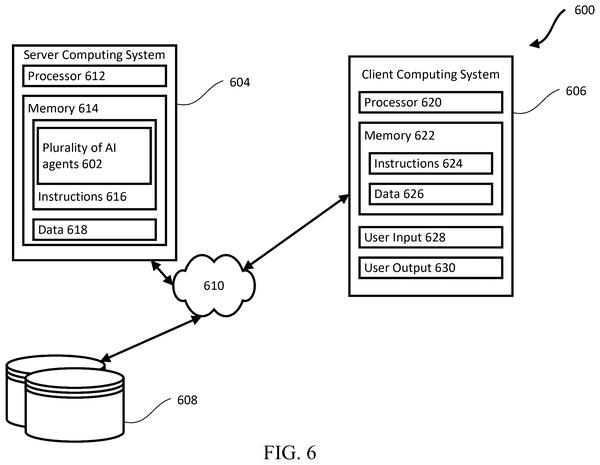
Google's filing describes an orchestrator (a coordinator program) that sits between you and a group of specialized AI agents (smaller AI helpers, each set up for one subject). When you type a request, the orchestrator builds a response development plan: a short list of which specialists to ask, and in what order. It bases that plan on your request plus contextual signals such as your chat history, details about your business or account, and what is currently on your screen.
Next it writes custom questions, which the filing calls synthetic queries, for each chosen specialist. The examples include reporting, optimization, billing, policy and diagnostics agents, plus web search and web crawler agents. It can ask them all at once, or ask one and use the answer to shape the next question.
Two details stand out:
- The orchestrator keeps a separate memory of past exchanges with each specialist, kept in isolation so one subject's history doesn't clutter another's.
- A specialist can hand back its working notes (intermediate reasoning) and the source data behind them, instead of a finished answer. The orchestrator then writes the reply itself.
If two specialists disagree, the orchestrator resolves the conflict. It can also act for you, by remotely taking control of an input function on your device, such as the mouse pointer.
Each specialized AI agent is configured to analyze queries specific to a respective domain.
Translation: Every individual AI helper is designed to focus only on its own specific area of expertise.
Why Google says this cuts errors and wait time
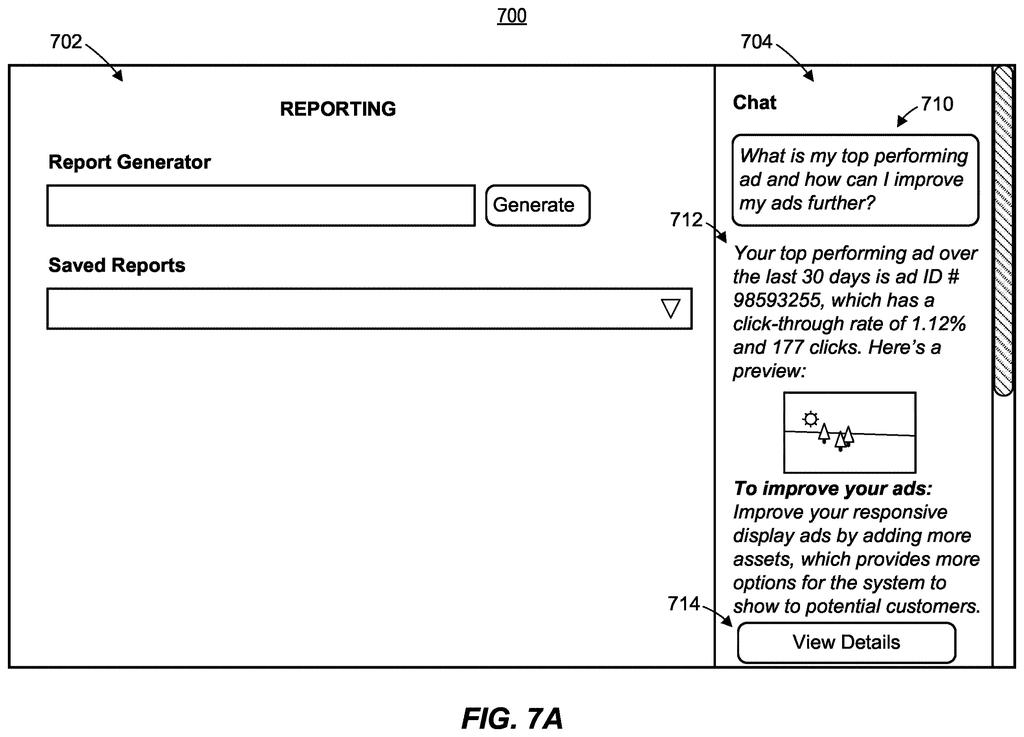
If you have used a help chat inside a complicated website, you know the two big complaints: it takes too long, and it sometimes invents things. This filing goes after both. The example in the document is a digital advertising platform, where a business owner might ask which ad is doing best, or why one was rejected, and get an answer plus a button that fixes the problem.
The design also lets a company add or remove specialists as needed, and the filing describes progress messages like 'Looking for your best-performing ad' that appear while the system works. For you, that could mean fewer wrong answers and less staring at a blank screen. Keep in mind that the accuracy and speed figures come from the company's own experiments, and this is a patent application, not a shipped product.
Google's 38th filing we've tracked since May in our AI models working together watchlist builds on earlier applications like blending models to resist tricks and turning vague prompts into campaigns.
Source: US 2026/0359364 A1 at the USPTO (PDF). Full patent text and figures are in the official publication.
Get our take in your Top Stories
Liked this breakdown? Add Patentlyze as a preferred source on Google, and our plain-English take shows up more often in your Top Stories the next time Google patent news breaks.
Add Patentlyze on Google
One click.
There are more where this came from
We read every patent application Big Tech publishes and send you the ones worth knowing. Plain English, free, every week.
The drawings · 11 sheets
11 drawing sheets from US 2026/0359364 A1 · click any drawing to enlarge


Show the other 3 sheets


More from Google
All 1,079 Google patents →
More in AI assistant & agent
All 413 AI assistant & agent patents →
Microsoft
Microsoft Patents a System That Hides a Crowd of AI Agents Behind One Chat Window
Microsoft
Microsoft Patent Shows Two AI Models Collaborating to Enhance Chat Support
Nvidia
Nvidia Patents an AI That Routes Your Questions to a Panel of Specialist AIs
Salesforce
No comments yet