
OpenAI
OpenAI · Security · Filed Sep 12, 2025 · USPTO published Nov 19, 2026 · This week's release
OpenAI Files Patent to Keep Your Passwords Away From Its Coding AI
Before an AI coding assistant gets to touch your project, this OpenAI patent application has the system delete the login keys it just used to fetch your code.
- Publication number
- US 2026/0367887 A1(US20260367887A1)
- Applicant
- OpenAI OpCo, LLC
- Filed · Published
- Sep 12, 2025 · Nov 19, 2026
- Inventors
- Calvin French-Owen, Joshua Snyder, Karthik Rangarajan
- Status when we published
- Waiting for an examiner
- Document
- 20 claims
- US classification
- 717/106
- Parent application
- Claims priority from a provisional application 63806537 (filed May 15, 2025)
What OpenAI's password-wiping setup actually does
A building manager lets a contractor into a locked office, then takes the key back before the contractor starts work. That is roughly the idea in this OpenAI patent application, with an AI coding assistant playing the contractor.
When you ask an AI to fix a bug in your private code, the system first needs your login credentials, such as a password-like token, to fetch that code. The patent describes using them for that one job, then deleting the files that hold them before the AI is let in. The AI works on a copy of your code in a sealed workspace and can't dig the credentials up later.
The filing also describes cutting off or narrowing the workspace's internet access after setup, so a misbehaving AI can't send anything out. You get the help of an AI developer without handing it your keys.
… starting a container based on a command including instructions to store user secrets to a file system of the container, wherein the container includes a service for interacting with an AI model via an internal network interface and an external network interface for accessing a public network …
Translation: The system launches a secure sandbox environment equipped to talk to the AI model and the public internet.
How the workspace gets cleaned before the AI enters
The claim covers a method with three moves. The system receives a plain-language request to do a software task on a code repository (the stored folder holding a project's code). It starts a container (a sealed, disposable mini-computer inside a server) using a startup command that writes the user's secrets, meaning things like access tokens and API keys, onto the container's file system. Then it removes those secrets from the file system before the AI model gets access to the container through a service.
The container has an internal connection, which lets the service talk to the AI model, and an external one that reaches the public internet. The external one lets the container download the code and software packages it needs during setup.
The description walks through an example timeline:
- Secrets are stored encrypted twice, once with the user's key and once with a random project key the user never sees.
- The back end decrypts them and passes them to the container at startup.
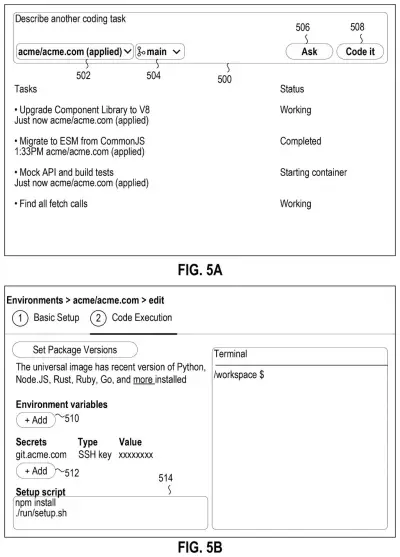
- A startup script uses a token to clone (copy down) the private repository, then runs a command that deletes the token file.
- Tools like SSH keep what they need in memory, which the AI model can't directly reach.
Add-on claims cover disabling or narrowing the container's internet access afterward, and letting the user enter secrets on the same screen where the task starts.
receive instructions to perform a software development task in natural language based on a code repository; start a container based on a command including instructions to store user secrets to a file system of the container …
Translation: It takes plain text coding instructions and spins up a secure workspace loaded with your private credentials.
Why AI coding agents need locked-down workspaces
If you let an AI work on your company's private code, it needs access to that code, and getting it usually takes a password or token. If that token stays in a file in the AI's workspace, a mistake or a misbehaving AI could expose it. This design shrinks that window: the token is used once and is gone before the AI starts.
It also shows how OpenAI describes running coding agents: each one is a worker placed in a sandbox with controlled doors. The filing describes running several tasks at once, like a small team of developers. Each would need its own protected workspace, and this patent covers part of that plumbing.
This is the 12th OpenAI filing we've tracked since September in our AI guardrails race, building on a locked-down coding workspace and an AI security code checker.
Source: US 2026/0367887 A1 at the USPTO (PDF). Full patent text and figures are in the official publication.
Get our take in your Top Stories
Liked this breakdown? Add Patentlyze as a preferred source on Google, and our plain-English take shows up more often in your Top Stories the next time OpenAI patent news breaks.
Add Patentlyze on Google
One click.
There are more where this came from
We read every patent application Big Tech publishes and send you the ones worth knowing. Plain English, free, every week.
The drawings · 10 sheets
10 drawing sheets from US 2026/0367887 A1 · click any drawing to enlarge


Show the other 2 sheets


More from OpenAI
All 58 OpenAI patents →
More in Security
All 353 Security patents →
IBM
IBM Files Patent for Turning Plain-English Requests Into Security Alert Rules
Samsung
Samsung Patents a System That Keeps AI Programs From Misusing Your Phone's Data
IBM
IBM Files Patent for a Secret Quiz That Proves an AI Model Is the Real One
Salesforce
No comments yet