
Qualcomm Files Patent for Using Phones and Cell Towers as Landmarks for Cameras
Your phone and the nearest cell tower already have locations the network keeps track of. Qualcomm's patent application would use that knowledge to teach a nearby camera exactly where it is pointed.
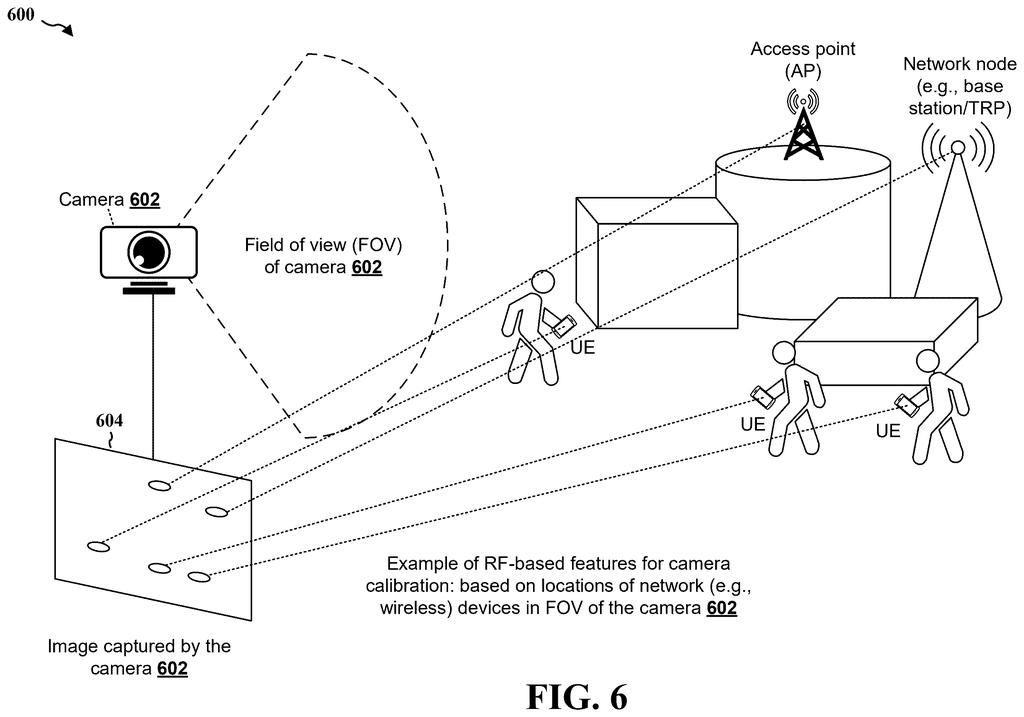
What Qualcomm's radio-assisted camera setup does
You're walking through a dimly lit parking garage, and a camera on the wall has to work out exactly where you are. For that, the camera first needs to know its own aim and how its lens bends the scene. The usual tricks, like spotting landmarks or checking a 3D map, fall apart in the dark, indoors, or where no map exists.
Qualcomm's patent application skips the visual landmarks and uses radio instead. Phones, Wi-Fi access points and cell towers already have known or estimated locations, and some of them are sitting in the camera's view. A network server finds a camera that can see them, then matches each device's spot in the photo to its real-world position. That pairing tells the system how the camera is aimed.
Once that's settled, the camera can place other things in the frame, even ones with no radio at all, like a wall or a box. The filing also describes a privacy option: the camera can send only the pixel spots, not the whole image.
transmit, for a network entity, a request to estimate locations of one or more objects in a defined area using visual-based positioning; receive, from the network entity, a set of training points and a set of images for the defined area captured by at least one camera …
Translation: The system asks for object locations and receives training points alongside camera images of the area.
How phones and towers become camera reference points
The filing covers two sides of one process. On the device side, a phone or base station (called the first network node) asks the network to estimate where objects in an area are, using someone else's camera. The network replies with training points, pairs that link a spot in a photo (a pixel location) to a real-world position, plus the images. The requesting device is standing in that camera's view, so its own known or estimated location is one anchor.
From those pairs, the device estimates a projective transformation (the math that maps real-world points onto a flat image), stored as a calibration matrix, a grid of numbers describing the camera's position, aim and lens. It can rescale the data first so pixels and world coordinates are comparable, and pick a subset of points with RANSAC (repeatedly fitting a model while ignoring outliers) so bad matches don't skew the result.
On the network side, a server receives the request, picks a camera-carrying node that has the requester in view (possibly by querying a database of nearby cameras), asks it for images, and receives them. It can then match the requester's location to its pixels and send training points back.
Either the server or the device can do the heavy math. In one option described, the camera sends only pixel positions instead of full images, for privacy.
… estimates a projective transformation between a world location of an object and a pixel location of the object in the at least one image, based on the set of training points and a known location or an estimated location of the first network node.
Translation: It figures out how real-world physical coordinates line up with pixels in a camera image.
What this means for cameras on phones and drones
Cameras are everywhere, but a camera only becomes a measuring tool once someone tells it exactly how it's aimed. For cameras that move, such as phones, VR glasses, drones and cars, that setup keeps going stale. Qualcomm's approach would let the wireless network do the re-aiming using signals and locations it already tracks, which could help in places like dim warehouses where visual landmarks fail.
For you, the payoff would be more reliable location tracking for things a camera can see, such as inventory in a warehouse or a person carrying a phone. The filing also stresses that the method relies only on network assets, which it says gives a privacy advantage over other calibration methods. As with any patent application, nothing here says it will become a product.
Qualcomm's 583rd filing in our Qualcomm coverage since May adds to a run that includes faster game reflections and fog-cutting brake-light detection.
A camera that doesn't know where it's pointing can't tell you where anything is. That problem is real for any camera that moves, like a phone, a drone or a pair of VR glasses, because every nudge changes the math and the setup has to be redone.
Qualcomm's answer fits the size of that headache. Phones, Wi-Fi access points and cell towers already have locations the network tracks, so the reference points are free and always nearby. Nobody has to build a 3D map of every room first.
The open question is accuracy. A phone's own location guess can be rough, and the whole scheme depends on those guesses anchoring the camera well. The filing handles this by discarding the worst matches, but it gives no results, so we can't say how well it holds up in a crowded space.
Get our take in your Top Stories
Liked this breakdown? Add Patentlyze as a preferred source on Google, and our plain-English take shows up more often in your Top Stories the next time Qualcomm patent news breaks.
There are more where this came from
We read every patent application Big Tech publishes and send you the ones worth knowing. Plain English, free, every week.
The drawings
18 drawing sheets from US 2026/0350837 A1 · click any drawing to enlarge


Show the other 10 sheets


Want this weekly breakdown for a company we don't cover? Patentlyze Pro →
Be the first to weigh in