
Qualcomm
Qualcomm · AI / ML · Filed May 8, 2025 · USPTO published Nov 12, 2026 · This week's release
Qualcomm Files Patent for Phones That Learn From Days Like Today
Your phone could learn your routines without sending your data to the cloud, but only if it stops rereading weeks of your life every time it makes a guess. Qualcomm's patent application has it pull up just the past days that look like today.
- Publication number
- US 2026/0359715 A1(US20260359715A1)
- Applicant
- QUALCOMM Incorporated
- Filed · Published
- May 8, 2025 · Nov 12, 2026
- Inventors
- Andrea ROSSI, Diyan TENG, Mehul SOMAN, Emanuele COSENZA, Nauman SHAHID
- Status when we published
- Waiting for an examiner
- Document
- 23 claims
- US classification
- 706/12
What Qualcomm's day-matching phone AI does
Imagine your phone has been logging your day for four weeks, one snapshot every five minutes. That adds up to more than 8,000 snapshots, and each time it wants to guess where you are headed, it would have to weigh every one of them. Your battery would not enjoy that.
Qualcomm's patent describes a shortcut. The phone first bundles each day into one chunk. A small AI model then checks today against those chunks and flags which past days look similar. Maybe last Tuesday and the Tuesday before match your routine, while the weekend in between does not. Only the matching days get a close look.
The phone still reads those days in fine five-minute detail, so it can make guesses like you are about to head home. It just skips the days that would not help, and it does all of this on the device itself.
Systems and techniques are provided for attention-based meta-learning using context distillation.
Translation: The patent describes a method for helping devices learn from your daily routines.
How the mask picks which past days to keep
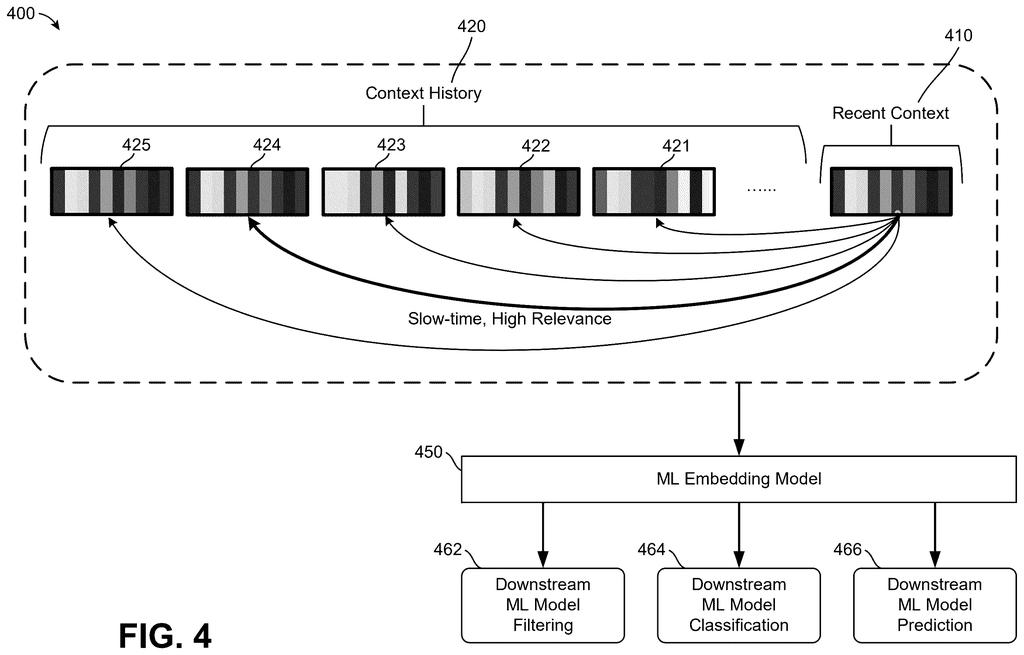
The system starts with a user context history: a long log of frames, each one a summary of what the phone's sensors picked up over a short window. The filing gives 5 minutes as an example, and one claim sets it at 10 minutes or less. Each frame holds several channels of features, drawn from sensors like the accelerometer, GPS and Wi-Fi.
From there, the process runs in three steps:
- Repack. The frames are grouped, in order, into a small number of blocks, such as one block per day. One claim puts each block at 12 hours or longer.
- Mask. A separate neural network (a trained pattern-matching model) compares the newest block of data with every old block. It outputs one on/off bit per block, predicting whether that old block resembles the present.
- Attend. Only the blocks marked "on" are kept. An attention step (a method that lets a model weigh which earlier information matters most for each new moment) then runs between the new frames and the kept blocks. It produces a feature vector (a list of numbers summarizing the context) for every new frame at the original fine time detail.
Those outputs can feed other tasks, such as predicting an activity, filling in missing frames, or smoothing out bad readings. In the filing's worked example, 28 days at 288 frames per day is cut down to two selected blocks, which the company calculates as roughly 196 times less computation than standard attention. The mask can also take in non-sensor details like age, job title or calendar.
Why on-device learning needs to stay cheap
If your phone is going to personalize things for you, it either does the learning itself or ships your habits to a server. The filing leans toward the first option, noting that sending sensitive data off the device raises privacy concerns. The catch is that a phone has a small battery and limited memory, and standard attention gets far costlier as the history grows. Picking out the relevant days is how this design tries to keep weeks of history affordable.
The filing says the approach could run on phones, wearables, car computers and XR headsets. For you, that might eventually mean an assistant that notices routines (the filing's example is predicting that you're heading home) without draining your battery. It is a patent application, so nothing here says a product is on the way.
Qualcomm's 29th filing we've tracked since July in our on-device AI privacy push follows earlier applications for a faster small phone AI and smarter touch filtering.
Source: US 2026/0359715 A1 at the USPTO (PDF). Full patent text and figures are in the official publication.
Get our take in your Top Stories
Liked this breakdown? Add Patentlyze as a preferred source on Google, and our plain-English take shows up more often in your Top Stories the next time Qualcomm patent news breaks.
Add Patentlyze on Google
One click.
There are more where this came from
We read every patent application Big Tech publishes and send you the ones worth knowing. Plain English, free, every week.
The drawings · 16 sheets
16 drawing sheets from US 2026/0359715 A1 · click any drawing to enlarge


Show the other 8 sheets


More from Qualcomm
All 624 Qualcomm patents →
More in AI / ML
All 2,637 AI / ML patents →
Microsoft
Microsoft Files Patent for Swappable Add-Ons That Give One On-Device AI New Skills
Microsoft
Microsoft Files Patent to Split AI Work With Your Device Without Giving the Model Away
Google
Google Files Patent for Making a Small AI Think Twice Instead of Growing Bigger
Samsung
No comments yet