
Qualcomm
Qualcomm · Automotive · Filed May 29, 2025 · USPTO published Nov 19, 2026 · This week's release
Qualcomm Files Patent to Help Self-Driving Cars Handle a New City
A self-driving car that learned on Boston streets can stumble in Singapore. Qualcomm's patent application describes a library of reference driving situations meant to ease that jump, and to tell the car when it's out of its depth.
- Publication number
- US 2026/0365198 A1(US20260365198A1)
- Applicant
- QUALCOMM Incorporated
- Filed · Published
- May 29, 2025 · Nov 19, 2026
- Inventors
- Rajeev YASARLA, Hong CAI, Shizhong Steve HAN, Apratim BHATTACHARYYA, Shweta MAHAJAN, Litian LIU, Risheek GARREPALLI, Yunxiao SHI, Hsin-Pai CHENG, Fatih Murat PORIKLI
- Status when we published
- Examiner raised objections; the company can respond
- Document
- 20 claims
- US classification
- 701/23
- Examiner
- KLEINMAN, LAIL A (Art Unit 3668)
- Parent application
- Claims priority from a provisional application 63806190 (filed May 15, 2025)
What Qualcomm's new-city driving patent does
A self-driving system that learned on Boston streets can get rattled in Singapore, where traffic habits, weather and lighting are all different. Fixing that usually means a lot of expensive retraining, and the rare moments that matter most, like fog, snow or an animal crossing the road, barely show up in the training data anyway.
Qualcomm's patent application describes another route. Instead of leaning on a giant AI model, the system builds a compact library of reference driving situations (the filing calls it a scene codebook). Each entry is linked to a typical path the car should take. When the cameras look at the road, the system finds the closest matches in that library and blends their paths into a plan.
It also reports how confident it is. If a scene looks unlike anything in the library, that is a sign of an unfamiliar situation, and the system can flag it and use it to learn faster.
obtain a scene codebook to identify trajectories for one or more scenarios; and implement a neural trajectory planner to predict a trajectory for the vehicle conditioned on a current scenario of the vehicle based on the scene codebook to implement autonomous driving of the vehicle.
Translation: The car uses a digital reference library of city layouts to predict its best path through unfamiliar traffic situations.
How the scene codebook picks a driving path
The claims cover a vehicle computer that obtains a scene codebook and runs a neural trajectory planner (a trained AI model that predicts the path the car should take) based on the car's current situation. A second independent claim covers continuously updating that codebook from camera images while the car is driving.
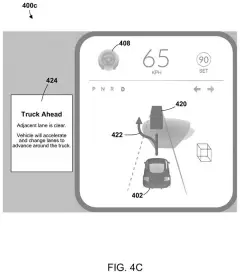
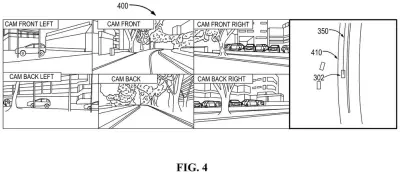
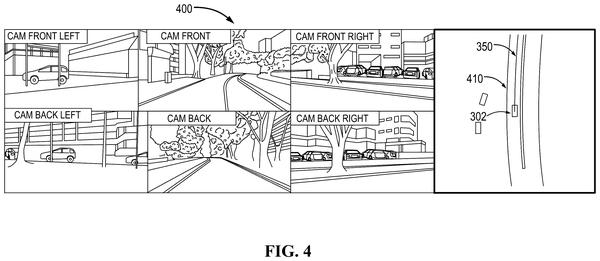
The description fills in the steps. Camera images (six views in the figures, covering front and back) go through a scene tokenizer, which turns the pictures into tokens: small bundles of numbers standing for your own car and for other cars, pedestrians, lane markings and similar objects. The codebook holds learned reference tokens, each paired with a typical trajectory. The planner uses a Gaussian process (a statistical method that gives an answer along with how unsure it is) to measure how closely the current scene matches each entry, then blends the matching paths.
- Training happens first on data from a source city, which builds the codebook.
- In a new city, the codebook module acts as a teacher for the main driving network, supplying stand-in labels when no human-labeled data exists.
- The uncertainty score picks the most useful new examples to learn from and attaches a confidence level to each planned path.
In tests, the filing trained on Boston and tested on Singapore, then reversed it. It reports lower path error and fewer collisions than the baseline model it was built on.
Why a Boston-trained car matters in Singapore
If it works as described, a car built for one city could need less costly retraining before it drives in another. It could also be better prepared for the odd moments, like fog, a fallen tree or a pedestrian stepping out, that cause the worst trouble. The confidence readout gives the car's software a way to flag when it is out of its depth.
Self-driving teams spend heavily on collecting and labeling new data for every region, and the filing pitches this as a cheaper alternative to giant language-model approaches. Keep the limits in mind: the tests used recorded driving data, not live roads, and the examiner's first review rejected the claims as filed, which is routine and usually followed by amendments. The final scope could look different.
That makes this Qualcomm's 61st filing we've tracked since July in the self-driving sensing race, building on one on spatial awareness and one on learning from overrides.
Source: US 2026/0365198 A1 at the USPTO (PDF). Full patent text and figures are in the official publication.
Get our take in your Top Stories
Liked this breakdown? Add Patentlyze as a preferred source on Google, and our plain-English take shows up more often in your Top Stories the next time Qualcomm patent news breaks.
Add Patentlyze on Google
One click.
There are more where this came from
We read every patent application Big Tech publishes and send you the ones worth knowing. Plain English, free, every week.
The drawings · 8 sheets
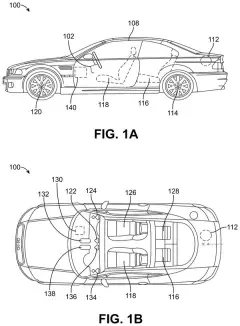
8 drawing sheets from US 2026/0365198 A1 · click any drawing to enlarge


More from Qualcomm
All 637 Qualcomm patents →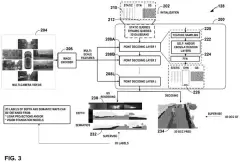
More in Automotive
All 377 Automotive patents →
Nvidia
Nvidia Files Patent to Help Self-Driving Cars Focus on the Few Vehicles That Matter
Nvidia
Nvidia Files Patent to Help Self-Driving Cars Keep Track of the Same Pedestrian or Car
Intel
Intel Files Patent to Keep Self-Driving Cars' Laser Sensors From Confusing Each Other
Nvidia
No comments yet