
Red Hat Patents an AI That Scales Itself Down on Battery-Powered Devices
Running a full AI model on a small edge device, like a factory sensor or a retail kiosk, can drain its battery or overwhelm its processor. Red Hat's new patent describes a system that watches the device's health in real time and dials the AI back before things break.
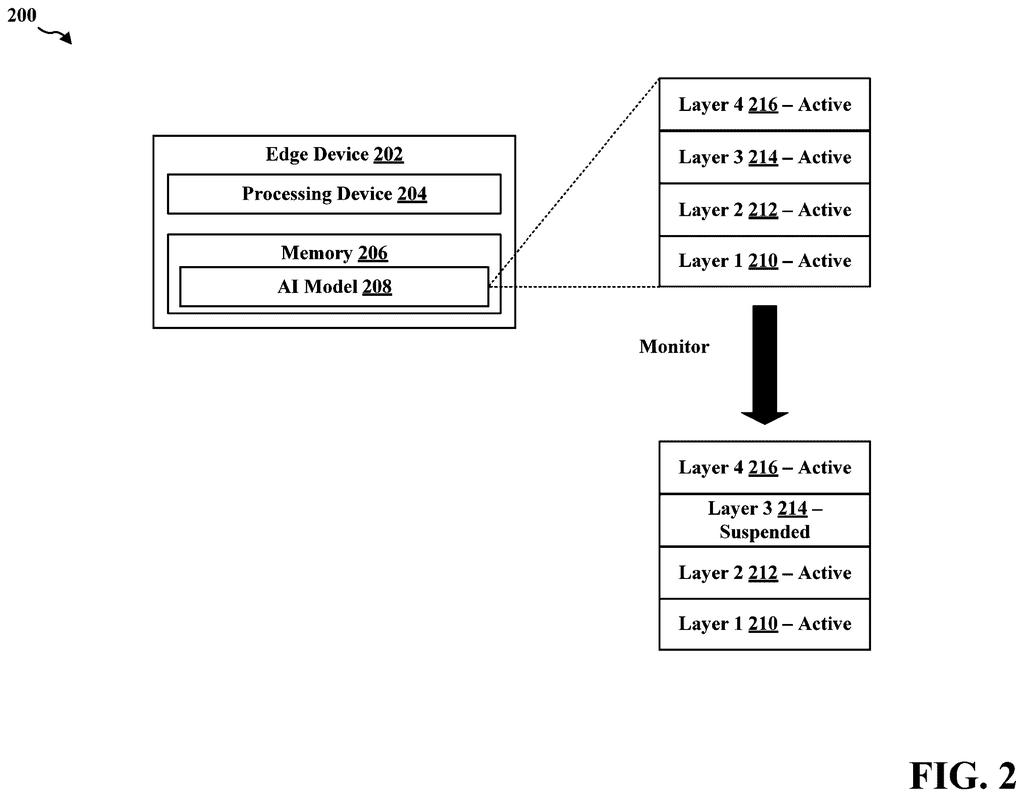
How Red Hat's edge AI hibernation actually works
Have you ever watched your phone slow to a crawl when the battery drops to 5%? The same problem hits AI models running on small, low-power devices in the real world. Those devices, think smart cameras, industrial sensors, or edge computing boxes at a store checkout, have strict limits on power and memory. A fully loaded AI model can push them past those limits fast.
What Red Hat is patenting is essentially a self-regulating dial for AI models on those constrained devices. The system keeps an eye on things like available memory, battery level, or processor temperature. When conditions get tight, it adjusts a piece of the AI model, scaling it down or putting part of it into a kind of hibernation. When conditions improve, the model can ramp back up.
The practical effect is that the AI stays running, just at a level the device can actually handle, instead of crashing or being manually shut off. You get a more reliable AI that lives within its means.
monitoring operational parameters associated with a computing device on which an artificial intelligence (AI) model is deployed; adjusting, by a processing device, a component associated with the AI model based on the monitored operational parameters …
Translation: The system watches how your device is performing and changes how the AI runs to save power or improve efficiency.
How the system monitors and adjusts AI components
The patent describes a three-step loop that runs continuously on an edge device hosting an AI model:
- Monitor: the system tracks operational parameters, meaning real-time readings of the device's resources: things like CPU load, available RAM, power draw, or thermal state.
- Adjust: based on those readings, it modifies a component of the AI model. The patent uses broad language here, so the component could be the number of active neural-network layers, the precision of the math the model does (quantization, meaning swapping 32-bit calculations for 8-bit ones to save energy), or even which parts of the model are held in fast memory versus offloaded.
- Process: the AI then runs inference (produces its answers or predictions) using whichever adjusted configuration is currently active.
The core idea is that the adjustment is adaptive, not a one-time setup. The system keeps re-evaluating and re-tuning as conditions change throughout the device's operating day.
The claim language is intentionally wide, covering any AI model deployed on any computing device, which gives Red Hat a broad patent footprint in the edge-AI management space.
Aspects of the present disclosure relate to an adaptive hibernation mechanism for AI models on edge devices. More specifically, a processing device monitors operational parameters associated with a computing device on which an artificial intelligence (AI) model is deployed.
Translation: Red Hat is developing a way for AI to go into a sleep mode on phones and laptops when it is not needed.
What this means for AI running outside the data center
Edge AI is where the industry is headed: processing data locally on devices rather than shipping everything to a cloud server. That cuts latency (the delay before you get an answer) and reduces data-privacy risk, but it runs headlong into the reality that small devices have small budgets for power and memory. A system that can automatically manage those tradeoffs removes one of the biggest practical barriers to deploying AI in factories, hospitals, retail stores, and remote infrastructure.
For Red Hat, which sells enterprise Linux and Kubernetes-based platforms, this fits squarely into its push to manage workloads at the edge the same way it manages them in the data center. The AI hibernation mechanism is part of a broader industry scramble to make edge AI reliable without constant human intervention, and it sits alongside similar work tracked across this week's Big Tech patents in the edge-computing and on-device AI space.
The tradeoff this design makes is legibility for flexibility: keeping the claim language vague about which 'component' gets adjusted maximizes patent coverage but never answers the hardest engineering question, namely how much degradation is acceptable before output becomes unreliable. A factory vision system that scales down during a busy production run could start missing defects at exactly the wrong moment. Whether that risk is worth keeping the model alive depends on implementation details this filing does not address. It's a reasonable infrastructure bet for Red Hat's edge portfolio, with the real value sitting in the product team's judgment calls.
There are more where this came from
We read every patent application Big Tech publishes and send you the ones worth knowing. Plain English, free, every week.
The drawings
5 drawing sheets from US 2026/0236830 A1 · click any drawing to enlarge


Want this weekly breakdown for a company we don't cover? Patentlyze Pro →
Be the first to weigh in