

Salesforce
Salesforce · Software · Filed Jul 27, 2026 · USPTO published Nov 19, 2026 · This week's release
Salesforce Patents Limited Chat Accounts for People Outside Your Company
Getting a client or contractor into your team's chat app usually means a signup, so most people just send an email. Salesforce's patent application describes a stripped-down guest account that skips most of that hassle.

- Publication number
- US 2026/0370618 A1(US20260370618A1)
- Applicant
- Salesforce, Inc.
- Filed · Published
- Jul 27, 2026 · Nov 19, 2026
- Inventors
- Shanan Delp, Michael Demmer, Ilan Frank, Kevin Marshall
- Status when we published
- Waiting for an examiner
- Document
- 20 claims
- US classification
- 715/758
- Parent application
- Continuation of 18/458,788 (filed Aug 30, 2023)(18458788)
What Salesforce's guest chat account does
Every time you start a project with someone at another company, you hit the same fork: ask them to sign up for your team's chat app, or just email them. Signing up is a hassle, so email usually wins, even though it's less private.
Salesforce's patent application describes a middle path. You ask the chat platform for an invitation and send it to your contact. When they accept, the platform checks whether they already have an account. If they do, the new conversation simply shows up in the app they already use. If they don't, the platform builds them a guest account on the spot.
That guest account is deliberately small. The guest can read and write messages in the chats they were invited to, and that's about it. They can't invite other people, and in the filing's examples they can't create new channels or search beyond their own conversations either. Later, they can upgrade to a full account if they want one.
… generating, based at least in part on the determining that the second client is unassociated with the communication platform, a guest account associated with the second client; …
Translation: The system automatically creates a special guest account for the outsider.
How the invite becomes a locked-down guest login
Claim 1 covers a system running a communication platform, meaning a workplace chat service where people talk in direct messages (private conversations) and channels (shared group chats). Someone at one organization asks to communicate with someone at a different organization. The platform first confirms the requester is authorized to make that request, then generates an invitation and sends it.
When the invitee accepts, the platform looks at a user identifier, which the dependent claims say can be an email address or a phone number, and decides whether it matches an existing account. If it doesn't, the platform creates a guest account and shows the guest a limited interface. That interface has these traits:
- It includes a direct message or channel tied to the invitation.
- It leaves out any way to invite other users.
- It limits all communication to chats the guest was invited to.
Other claims and the description add more limits: no creating channels, search restricted to the guest's own chats, and labels showing the account is a guest type. One example screen even warns the guest that the other person is from a different organization and to take care sharing files.
The description also covers how invitations travel: a link, a QR code, or an email, even pasted onto a business card. Codes can be single-use and can expire after a set number of days. Guest access can last indefinitely or end after a period such as 14 or 30 days. An upgrade button lets a guest move to a full account. If the invitee already has an account, the new chat just appears in their existing full interface.
If the second person is not associated with the communication platform, the communication platform generates a limited functionality user interface to enable the communications between the first person and the second person.
Translation: Outsiders get a restricted interface just for talking with the internal user.
What a guest account means for cross-company chat
If you've ever emailed a contractor or client because getting them into your team's chat tool felt like too much work, this patent application is aimed at you. The idea is to keep a project's conversations in one searchable place instead of scattered across inboxes and text threads, while your company's chat settings stay in effect. The filing itself says the slow approval and signup steps push people toward less secure options.
For Salesforce, a guest account is also a low-pressure first step. Outsiders get a taste of the chat platform, with an upgrade option sitting right in their window. The filing doesn't name a product, and it is an application, not a shipped feature, so what you'd actually see depends on what the company builds.
This is the 109th Salesforce patent application in our Salesforce coverage since May, a corpus that includes filings like the hidden search text AI and the case summary button.
Source: US 2026/0370618 A1 at the USPTO (PDF). Full patent text and figures are in the official publication.
Get our take in your Top Stories
Liked this breakdown? Add Patentlyze as a preferred source on Google, and our plain-English take shows up more often in your Top Stories the next time Salesforce patent news breaks.
Add Patentlyze on Google
One click.
There are more where this came from
We read every patent application Big Tech publishes and send you the ones worth knowing. Plain English, free, every week.
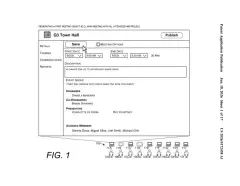
The drawings · 9 sheets
9 drawing sheets from US 2026/0370618 A1 · click any drawing to enlarge


Show the other 1 sheets

More from Salesforce
All 110 Salesforce patents →


More in Software
All 814 Software patents →
Samsung
Samsung Patent Enables Separate Storage Tracking Across Multiple User Accounts

Sony
Sony Files Patent for Catching Players With Second Accounts by Their Button Habits

Samsung
Samsung Patents a System to Bridge Chat Across Different Video Conferencing Apps
Microsoft
No comments yet