
Samsung Patents an AI That Cleans Up Shaky Handwriting and Changes Its Style
Samsung is working on a way for your phone or tablet to automatically tidy up wobbly handwritten notes and then rewrite them in a different penmanship style, all without you lifting a finger.
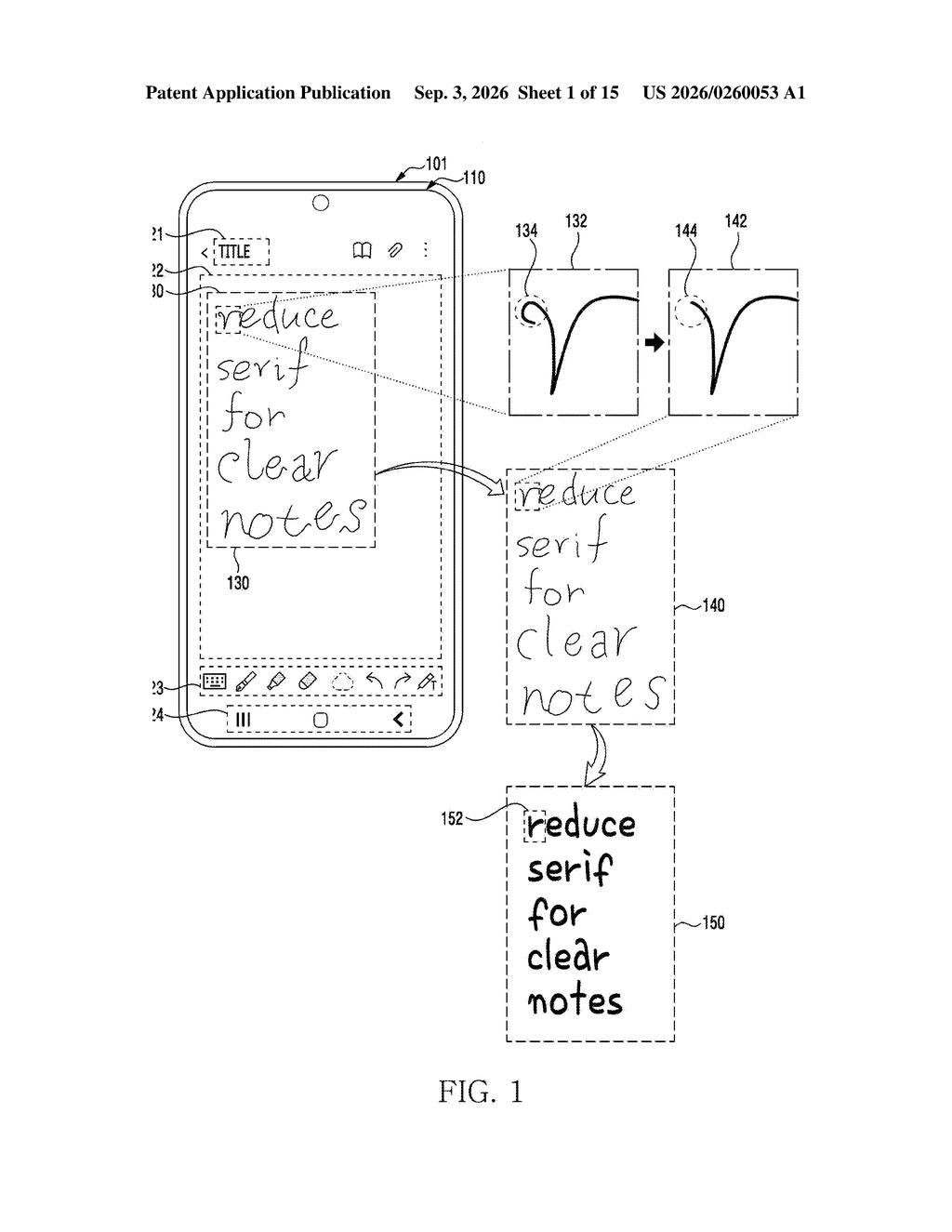
What Samsung's handwriting-cleanup patent actually does
Imagine you're jotting a quick note on your Samsung tablet with a stylus, your hand slips, and a stray line appears mid-word. Right now, fixing that means erasing and rewriting. Samsung's patent describes a system that spots those accidental marks automatically and removes them before they become part of your final text.
But it goes further than cleanup. After tidying up your strokes, the same system can change the style of your handwriting, making it look neater, more calligraphic, or matched to a different penmanship preference you've selected. You pick the style you want, and an AI model reshapes your strokes to match it.
The key detail is that the system tries to keep your handwriting recognizable while applying the new style, using weights that control how much of your original character shapes are preserved versus changed. It's less like replacing your writing and more like giving it a polish.
… detect, by using a plurality of points included in the stroke, a noise segment of the stroke; based on the noise segment of the stroke, execute a function to delete the noise segment from the stroke; modify, by using a model for modifying penmanship of one or more characters represented by a plurality of strokes, a shape of at least one of the plurality of strokes …
Translation: The system pinpoints shaky lines in your handwriting and erases them before reshaping your characters.
How the model strips noise and reshapes each stroke
The patent describes a two-stage process running on a device with a display, memory, and at least one processor.
Stage one is noise detection. As you drag a stylus (or finger) across the screen, the device records the path as a series of points. It analyzes those points to find "noise segments," meaning parts of the stroke that look like accidental marks, tremors, or slips rather than intentional pen movements. Those segments are deleted from the stroke before any further processing happens.
Stage two is style transfer. A trained AI model then takes the cleaned-up strokes and reshapes them according to a penmanship style the user has chosen. The patent describes this using:
- Latent vectors (compressed numerical representations of what a stroke looks like) that are fed into a decoder (the part of the AI that generates the reshaped output)
- Preference information, meaning the user's selected style, which is combined with those vectors to steer the output
- Penmanship maintenance weights, values that control how much of the original stroke shape to keep versus how aggressively to restyle it
The model was trained on handwriting samples covering multiple penmanship styles, so it understands the difference between, say, a relaxed casual script and a more formal upright style, and can shift your strokes toward whichever you prefer.
The model is trained based on handwriting with multiple penmanship styles applied. The device modifies stroke shapes by inputting preference information indicating selected penmanship styles, combining the preference information with latent vectors for decoder input, and determining penmanship maintenance using corresponding weights.
Translation: The AI learns different handwriting styles so it can rewrite your notes in whatever font style you choose.
What this means for Galaxy Note and stylus users
For anyone who uses a Samsung Galaxy tablet or phone with a stylus, this could mean handwritten notes that look presentable without manual cleanup. If you write quickly during a meeting or lecture, the system would handle the stray marks and rough edges automatically, and then optionally reformat the whole thing into a tidier style before you share or save it.
Samsung's run of stylus and handwriting filings suggests the company sees the S Pen experience as a genuine differentiator worth investing in. A feature like this would be most useful in note-taking apps, email composition by hand, or any scenario where how your writing looks matters as much as what it says.
Samsung's 20th filing in the Language AI patents we've tracked since May adds to a run that includes the AI keyboard rewriter and the phone needs predictor.
The noise-removal piece solves something you would notice within your first five minutes of writing on a screen. Accidental marks that used to require manual erasing simply disappear, which means the writing session stays fluid instead of constantly interrupted.
The style-transfer feature is where personal taste becomes the real variable. Having your handwriting automatically smoothed into a more elegant form sounds attractive until it no longer looks like yours, and Samsung's approach includes settings to control how much of your original character survives, which is a smart concession to that discomfort.
Taken together, these two features address the friction that makes most people abandon stylus writing after a week. If they work as described, the product stops feeling like a finicky tool and starts feeling like a natural extension of how you already write.
Get our take in your Top Stories
Liked this breakdown? Add Patentlyze as a preferred source on Google, and our plain-English take shows up more often in your Top Stories the next time Samsung patent news breaks.
There are more where this came from
We read every patent application Big Tech publishes and send you the ones worth knowing. Plain English, free, every week.
The drawings
15 drawing sheets from US 2026/0260053 A1 · click any drawing to enlarge


Show the other 7 sheets


Want this weekly breakdown for a company we don't cover? Patentlyze Pro →
Be the first to weigh in