
Samsung Patents Faster Setup for Connected Home Devices Like Lights and Locks
Setting up a new smart home device usually means hunting through menus, entering Wi-Fi passwords, and waiting through loading screens. Samsung's latest patent tries to reduce that to a single camera scan.
How Samsung's QR-based IoT setup actually works
A new smart plug sits on the counter, blinking impatiently. You know the next step: open an app, hunt for the device, type your Wi-Fi password, wait, hope. Samsung wants to cut most of that out.
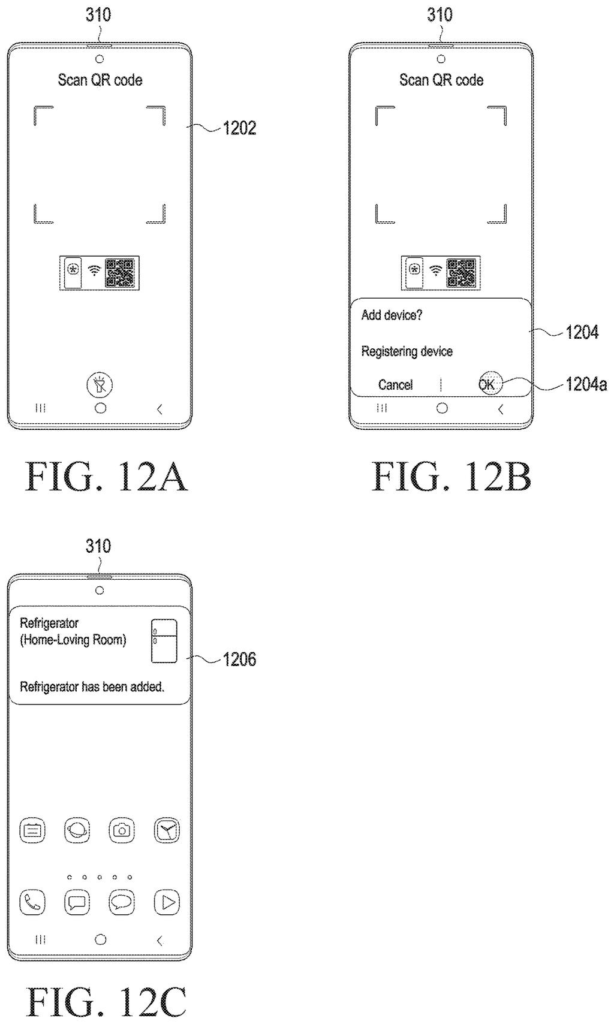
The patent describes a phone that scans a QR code (or similar barcode) printed on a new device. The phone reads the code, figures out what kind of device it is, and automatically sends the Wi-Fi login details over a short-range wireless signal. The new gadget picks up that encrypted message and connects itself to your network.
If the device is older and doesn't support this faster method, the phone switches to a fallback mode where it listens for the device to broadcast its own setup signal instead. Either way, the goal is the same: fewer steps, less typing, faster setup.
… determine whether the external electronic device supports a specified fast onboarding, based on the external electronic device supporting the fast onboarding, encrypt connection information used by the external electronic device to connect to a network with a specified encryption key to generate encrypted data …
Translation: The phone checks if the device can do fast setup, and if so, safely locks up your Wi-Fi details to share them.
How the phone picks a path and pushes encrypted credentials
The system has two distinct paths depending on what the target device supports.
Path 1 (fast onboarding): The phone's camera scans a machine-readable code (a QR code or similar) on the IoT device. That code carries basic device information, including a public encryption key. The phone uses that key to encrypt your Wi-Fi network credentials (the SSID and password), then broadcasts a Bluetooth or similar wireless packet containing both the device's identity and the encrypted credentials. Because the credentials are encrypted with a key only that specific device holds, intercepting the broadcast is useless to an eavesdropper.
Path 2 (legacy scan mode): If the device's information indicates it doesn't support fast onboarding, the phone flips into a passive listening mode. It waits for the IoT device to broadcast an advertising (ADV) packet (a standard Bluetooth Low Energy beacon that announces the device's presence), then proceeds with a more traditional back-and-forth setup exchange.
The key technical insight is that the phone decides which path to take before any connection is attempted, using only the data embedded in the QR code. This avoids failed connection attempts and the timeout delays that make current setup flows frustrating.
- Scan machine-readable code on device
- Read device info and determine onboarding capability
- If fast: encrypt credentials, broadcast to device
- If legacy: enter scan mode and await the device's own beacon
… broadcast, through the communication circuitry, at least one packet containing the device information and the encrypted data, and based on the external electronic device not supporting the fast onboarding, operate the electronic device in a scan mode in order to receive an advertising (ADV) packet broadcast from the external electronic device.
Translation: It then beams out the secure setup data into the room, or switches to standard searching if the gadget is older.
What this means for the smart-home setup experience
For anyone who has ever set up a smart bulb, sensor, or plug, the friction is familiar. Most current IoT onboarding flows require the phone to temporarily join the device's own Wi-Fi hotspot, which drops your internet connection mid-setup and frequently fails. A broadcast-based system where the phone pushes encrypted credentials removes that disconnection step entirely.
The tradeoff baked into this design is that broadcasting credentials, even encrypted ones, is inherently less targeted than a direct device-to-device handshake. Samsung is betting that strong encryption makes the open broadcast safe enough. That reads as a reasonable trade for most home environments, though the security story depends entirely on how well the encryption key printed on the QR code is protected during manufacturing. IoT security filings like this one are part of a broader wave of smart-home standardization patents covered in plain-English patent summaries from major electronics makers.
The dual-path design is the honest part of this patent: Samsung is acknowledging that the smart-home market is full of devices that won't support the new fast path, and baking in a fallback rather than pretending the problem doesn't exist. The cost is complexity. Every code path that branches doubles the surface area for bugs, and a device that misidentifies its own capability in the QR code could land in the wrong path and fail silently. That said, the encryption-via-broadcast approach is a real improvement over the hotspot-switching method most users currently endure, and the tradeoff reads as worth it if Samsung's manufacturing controls are tight enough to keep those QR-embedded keys trustworthy.
There are more where this came from
We read every patent application Big Tech publishes and send you the ones worth knowing. Plain English, free, every week.
The drawings
17 drawing sheets from US 2026/0238508 A1 · click any drawing to enlarge


Want this weekly breakdown for a company we don't cover? Patentlyze Pro →
Be the first to weigh in