
Samsung Patents a Projector That Responds to Your Hand Gestures
Point at a screen, wave your hand, and watch related content appear on the nearest empty wall. That's the core idea behind Samsung's latest projector patent.
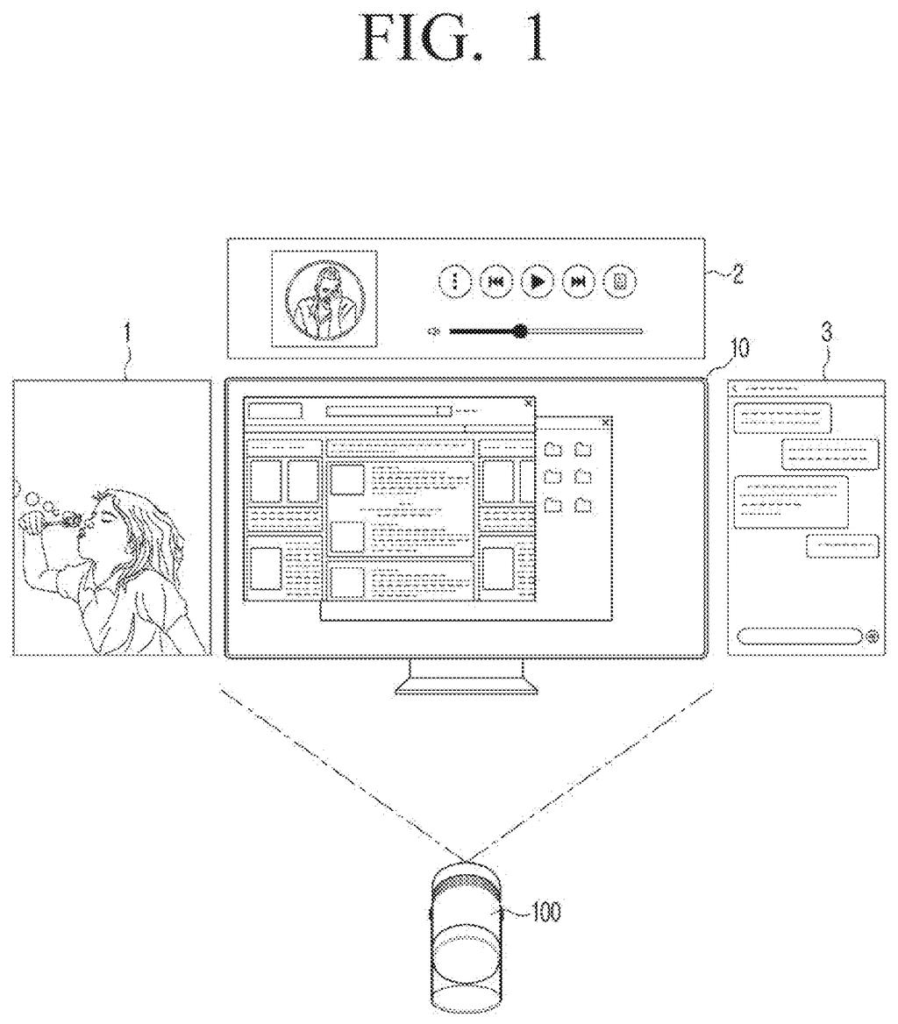
What Samsung's gesture-to-projection system actually does
Right now, getting content from one screen onto a projector means fumbling with menus, cables, or casting apps. Samsung wants to replace that friction with a simple hand gesture.
The patent describes a projector-equipped device that watches for your gestures, figures out what content you're looking at on a nearby screen, and then picks a blank patch of wall, ceiling, or other surface to throw related content onto. You don't pick the surface manually. The device scans the room and chooses a suitable spot on its own.
So if you're watching a cooking video and wave your hand, the projector might pull up an ingredient list and beam it onto the countertop beside you. The idea is that the gesture becomes the remote control, and the room itself becomes the display.
based on first gesture information of a user being obtained through the communication circuit, identify a second content corresponding to the first gesture information based on a first content provided through a first external device …
Translation: The projector detects your hand movements and figures out what to show next based on what is currently playing on a connected device.
How the device maps gestures to content and finds a wall to use
The system has four key pieces working together:
- Communication circuit: reads gesture data from the user, likely via a sensor or camera that tracks hand movements.
- External device awareness: the projector knows what content a nearby screen (a phone, tablet, or TV) is currently showing.
- Environment scanning: the device maps the room and identifies "projectable regions" (flat, usable surfaces) it could beam onto.
- Content matching: when a gesture is detected, the system picks a piece of second content that corresponds to what the user was doing, then projects it onto the region it associates with that first screen.
The phrase "projectable region associated with the first external device" is important. The system doesn't just find any blank wall. It picks a surface that it has already linked to the device the user was interacting with, so the projected content lands close to its source and stays spatially coherent with the room layout.
The patent doesn't specify exactly how gestures are captured, leaving room for cameras, radar sensors, or other detection methods. What it does lock in is the logic: gesture detected, content identified, region chosen, projection displayed.
… display, based on a first projection region associated with the first external device being identified from among at least one projectable region based on environment information corresponding to a projection space, the second content at the first projection region through the projector.
Translation: It scans the room to find a suitable blank wall and projects the new content right onto it.
What this could mean for Samsung's projector lineup
For anyone who has ever tried to share something from a phone onto a bigger screen, the appeal here is obvious. The friction of casting, mirroring, or screen-sharing disappears if a wave of your hand can push content to the nearest available surface. That's a real, everyday convenience, and it's the kind of thing that makes a product feel like it was designed for humans rather than engineers.
The harder question is whether the room-scanning and gesture-reading work reliably enough in varied real-world spaces. Cluttered rooms, moving people, and unusual lighting have a way of defeating ambient-sensing features. If Samsung's steady investment in projector and sensor patents keeps pace, the underlying detection quality will matter as much as the concept itself.
That makes this Samsung's 343rd filing in our Display coverage since May, adding to work like the self-rolling screen and the two-step touch method we've tracked.
The concrete win here is that you stop managing the technology and just use it. You glance at something on a screen, make a gesture, and the right content appears on the nearest available wall or surface. The fumbling moment where you figure out how to send something from one screen to another simply disappears.
What makes this more than a party trick is that the device reads the room. It figures out which surface makes sense given where you are and what you were just looking at, so the projection lands somewhere useful rather than somewhere arbitrary. That spatial awareness is the difference between a feature you use once and one you reach for daily.
If Samsung ships something close to this, the people who notice it most will be the ones who have tried to share a screen in a meeting or a living room and felt the whole moment deflate while they sorted out cables or settings. This removes that deflation entirely.
There are more where this came from
We read every patent application Big Tech publishes and send you the ones worth knowing. Plain English, free, every week.
The drawings
47 drawing sheets from US 2026/0267421 A1 · click any drawing to enlarge


Want this weekly breakdown for a company we don't cover? Patentlyze Pro →
Be the first to weigh in