
Samsung Files Patent for a Glasses-Free 3D Screen That Stays Bright From the Side
Samsung's filing tackles an old glasses-free 3D problem: you can have a bright picture or a wide viewing angle, but rarely both. Its answer is two layers of tiny lenses and a shutter layer that adjusts itself to the picture.
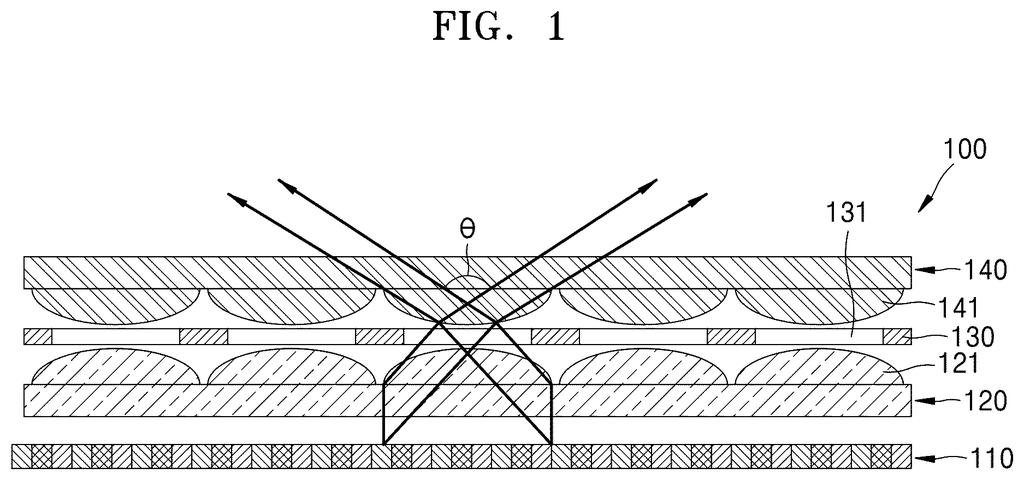
What Samsung's two-lens 3D screen actually does
Imagine you're watching a 3D video on a screen that needs no glasses, and you slide over to the far end of the couch. On many of these displays, the 3D effect falls apart the moment you leave the center spot, or the whole picture turns dim.
Samsung's filing describes a screen that puts two layers of tiny lenses in front of the display. These lenses steer the light so each of your eyes gets a slightly different picture, which is what your brain reads as depth. A thin layer with small openings, called a barrier, sits in the stack to block stray light.
The filing says the design keeps a proper 3D image at 60 degrees or more to either side, without the left and right halves flipping. The barrier can also open wider in flat-looking parts of the picture for more brightness, and tighten up in parts with strong depth for a cleaner image.
… a first lens array which is provided in the display panel and in which a plurality of first lenses are arranged; a second lens array which is arranged spaced apart from the first lens array and in which a plurality of second lenses are arranged …
Translation: The system uses two separate layers of tiny lenses to shape the light.
How the adjustable barrier trades light for depth
A light field display sends slightly different pictures in different directions, so your left and right eyes each get their own view and your brain reads the result as depth. Samsung's first claim builds this from a display panel (an LCD, OLED, LED screen or projector), two layers of tiny lenses called lens arrays, and a barrier, a thin layer with small openings that lets light through.
The panel sits slightly closer to the first lens layer than that layer's focal length (the distance at which a lens brings light into focus). The second lens layer then turns the light into nearly parallel beams, with the edge rays within 1 degree of the center ray. The filing says this gives a viewing angle of 60 degrees or more. In its comparison, a single-lens design flips the left and right sides of the image at plus or minus 60 degrees, while this design does not.
The barrier can change its openings electronically (it may use a liquid crystal layer). An analyzer builds a disparity map, a chart of how much the left and right views differ in each part of the image. Where the difference is small, the openings widen to let in more light. Where it is large, they narrow to cut crosstalk (light from one view leaking into another). The openings can range from 50% to 100%.
A second independent claim drops the barrier and uses three lens layers, two convex and one concave. That shortens the combined focal length, which allows finer lenses and a sharper display.
… a barrier arranged in any one place from among between the display panel and the first lens array, between the first lens array and the second lens array, or in front of the second lens array, wherein the barrier has an aperture that transmits the light.
Translation: A blocking wall with a tiny hole is placed between the layers to control light flow.
Why a wider 3D sweet spot matters for Samsung
Glasses-free 3D has always made you pick: a bright picture that only works from a narrow spot, or a wide viewing range with a dim image. Samsung's filing aims to get both, which would matter most for screens that several people look at from different spots, where nobody sits dead center.
The filing names no product, so treat it as a design for the screen itself. It is also a continuation of earlier applications, the first filed in Korea in 2023, so Samsung has been working on this design for a while. The three-lens version points to a second goal, higher resolution, since shorter lenses can be packed more densely.
Samsung's 122nd filing we've tracked in our display technology watchlist since May adds to ideas like the full-strap screen and wrist-twist messaging.
Every extra layer in front of a screen costs something. Two or three lens sheets mean more material to line up, more thickness, and more places for light to get lost on the way out. The filing says the lens centers and the barrier openings must sit on one shared axis, which is a tight demand for a screen made by the millions.
The adjustable barrier is the sharpest trade in the design. Where the depth effect is strongest, it can close down to half its opening, which cuts brightness in exactly the part of the picture you are most likely to stare at. The filing gives no brightness or sharpness figures, so there is no way to tell how steep that price is.
Still, the trade looks worth making. Giving up some light in the busiest parts of the image for a 3D picture that holds together 60 degrees to either side is a bargain glasses-free screens have needed. The open question is whether it survives mass production.
Get our take in your Top Stories
Liked this breakdown? Add Patentlyze as a preferred source on Google, and our plain-English take shows up more often in your Top Stories the next time Samsung patent news breaks.
There are more where this came from
We read every patent application Big Tech publishes and send you the ones worth knowing. Plain English, free, every week.
The drawings
14 drawing sheets from US 2026/0332738 A1 · click any drawing to enlarge


Show the other 6 sheets


Want this weekly breakdown for a company we don't cover? Patentlyze Pro →
Be the first to weigh in