
Samsung Files Patent for a Smartwatch Whose Strap Is Part of the Screen
Take your smartwatch off and the strap could become a second screen, with the time in the middle and your steps, weather and schedule laid out along each side. Samsung's patent application describes a watch whose display runs from the face into a flexible band.
What Samsung's strap-screen smartwatch does
You unclasp your smartwatch after work and set it on the nightstand. The time stays in the middle, and the strap on either side fills with your step count, the weather and your next appointment, laid out like a tiny dashboard.
That is the idea behind a new Samsung patent application. A watch face is small, so today's watches squeeze a few extras onto it. Checking the details usually means leaving the face for a separate app, which hides the time for a moment. Samsung's design makes part of the strap a screen too.
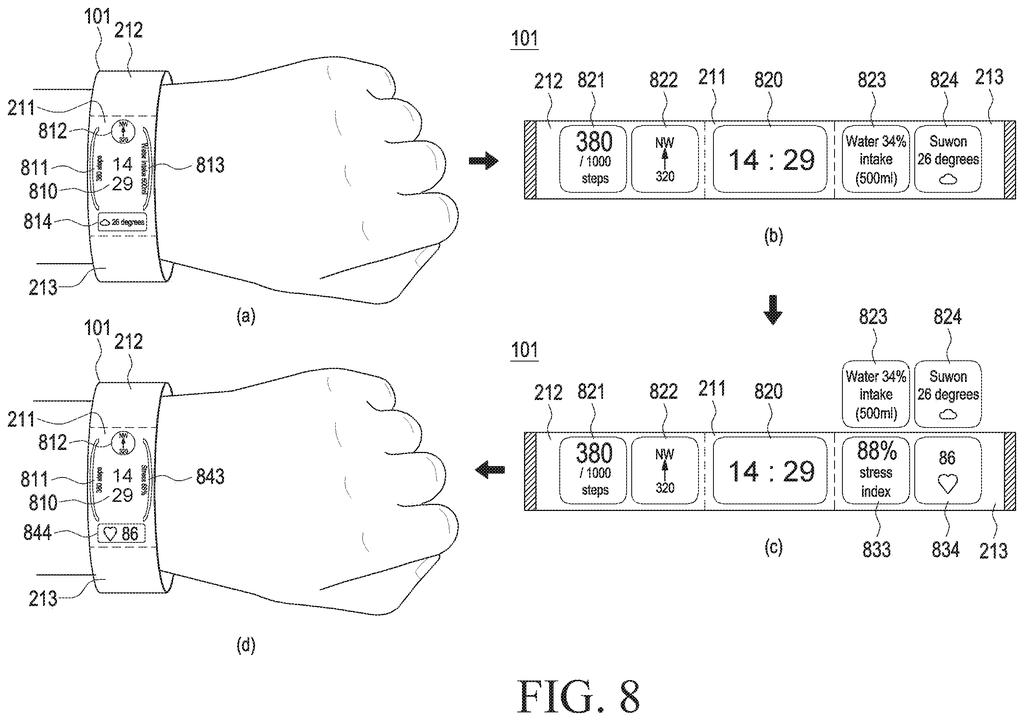
On your wrist, the watch can show only the face or light up part of the strap, depending on a setting you choose. Off your wrist, it can spread out and show fuller versions of the same information. Touch and hold an item and you can swap it for something else from a list.
… display a screen in a landscape orientation on the first area of the display without displaying a screen on the second area of the display …
Translation: It can show wide images on just the watch face without using the strap.
How the watch decides what the strap shows
The device has a main body (the watch face) and a partly flexible strap, with one display that runs across both. The display is split into a first area on the body and a second area on the strap. The software can show a screen in an upright (portrait) or sideways (landscape) orientation, on the first area alone or on both areas together.
Sensors work out whether the watch is on your wrist. The filing lists several ways to tell:
- A bending sensor checks whether the band is curved past a set angle.
- A biometric sensor looks for a signal from your body.
- An optical sensor detects whether you are close to the watch.
- A clasp sensor checks whether the buckle is fastened.
- Motion sensors (an accelerometer and a gyroscope) track movement.
When you take the watch off, the screen can switch layouts. The time stays on the body while extras such as weather, date, steps, heart rate or battery move onto the strap. The face shows simple versions of that information, and the strap shows detailed versions, in shapes like a circle, arc, bar or box.
The filing adds finer touches. The clock text can turn 90 degrees between layouts, and the strap section dims in steps as it bends further. The background image can also stretch wider across the strap, so a family photo might show four people instead of two.
Why a screen on your strap could matter
A smartwatch screen is small, and you mostly use it for a two-second glance. This patent aims at a different moment: when the watch is off your wrist and you have time to read more. A strap that shows fuller weather, schedule or health details could save you a trip into a separate app (a problem the filing itself names), and you would not lose sight of the time while you check.
It also touches how you set up your watch. The filing describes dragging items between a 'worn' layout and an 'off-wrist' layout, so what you place on the strap decides what appears on the face when you put the watch back on. This is a patent application and the filing names no product, so treat it as an idea on paper.
Samsung's 121st filing we've tracked since May in our display technology work, this follows moving messages to the strap and a touch-reactive band.
Claim 1 covers any wearable device where a display stretches from a rigid section into a bendable one, and the software can show a screen in portrait or landscape mode, on one section or both. That description fits a wide category of devices, and the claim text never specifies wrists, watches, straps, or any particular way the bendable part is built.
What that breadth means in practice is that the coverage follows behavior, not construction. Any company shipping a flexible-display wearable that offers those four basic screen arrangements would need to work around this claim, regardless of how differently their device is made.
The dependent claims do add specifics, like narrowing to a smartwatch or adding brightness controls, but those details only come into play if the broad opening claim is successfully challenged. That first claim is the one drawing the boundary, and right now it is drawn around a very large piece of ground.
Get our take in your Top Stories
Liked this breakdown? Add Patentlyze as a preferred source on Google, and our plain-English take shows up more often in your Top Stories the next time Samsung patent news breaks.
There are more where this came from
We read every patent application Big Tech publishes and send you the ones worth knowing. Plain English, free, every week.
The drawings
25 drawing sheets from US 2026/0319544 A1 · click any drawing to enlarge


Show the other 17 sheets


Want this weekly breakdown for a company we don't cover? Patentlyze Pro →
Be the first to weigh in