

Samsung
Samsung · Networking · Filed Mar 23, 2026 · USPTO published Oct 1, 2026 · Oct 1 release
Samsung Patents a System That Routes Signals Between Wearables Through Your Body
What if your smartwatch and your earbuds could talk to each other by sending a tiny signal through your skin? Samsung has filed a patent for exactly that, describing a system where wearable devices can discover each other and choose the best communication path, including one that runs straight through the human body.
- Publication number
- US 2026/0304283 A1(US20260304283A1)
- Applicant
- Samsung Electronics Co., Ltd.
- Filed · Published
- Mar 23, 2026 · Oct 1, 2026
- Inventors
- Vishnu Vardhan Ratnam, Bilal Sadiq, Boon Loong Ng, Vutha Va
- Status when we published
- Waiting for an examiner
- Document
- 20 claims
- US classification
- 455/507
- Parent application
- Claims priority from a provisional application 63778114 (filed Mar 26, 2025)
What Samsung's body-signal wearable link actually does
Ever tried to get two wireless gadgets to talk to each other, only to watch them drop the connection or pick the slowest possible route? That frustration is the problem Samsung is tackling here.
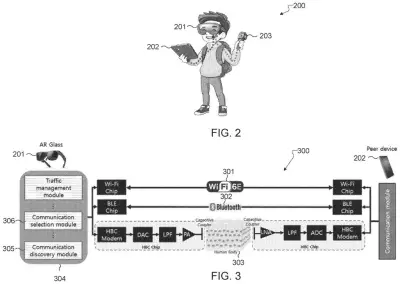
This patent describes a system where two wearable devices, say a smartwatch and a pair of earbuds, can find each other and figure out all the ways they could communicate. One of those options is called human body communication, or HBC, which sends a weak electrical signal along your skin rather than through the air like Bluetooth. The devices then pick whichever mode works best for the moment.
The idea is that your gear handles all of this automatically, without you digging through menus. Your body becomes part of the network connecting your own devices, potentially offering a more private and power-efficient link than a standard radio signal bouncing around the room.
performing, by a first electronic device, discovery of a second electronic device and one or more communication modes associated with the second electronic device, the one or more communication modes including a human body communication mode (HBC) …
Translation: One gadget scans for another and checks if it can send data through your skin.
How devices discover, pair, and switch communication modes
The patent describes a four-step process that runs on the first device (for example, a smartwatch):
- Discovery: The device scans for nearby electronics and lists every communication method each one supports, including whether human body communication is available.
- Association: The two devices perform an initial handshake on one communication mode to establish trust and identity, similar to how a phone pairs with Bluetooth headphones for the first time.
- Mode selection: The first device then evaluates the available options and picks a second, potentially different, communication mode for the actual data transfer.
- Communication: Data flows over that chosen channel.
The standout option in the list is human body communication (HBC). Rather than broadcasting a radio signal outward, HBC uses the body's surface as a conductor, sending a low-power electrical signal from one worn device to another. Because the signal stays close to the skin, it theoretically leaks less into the surrounding environment than Bluetooth or Wi-Fi.
The patent is device-agnostic at the claim level, but the obvious context is Samsung's Galaxy ecosystem, where a watch, earbuds, and a ring might all sit on or near the same body at once.
… selecting, by the first electronic device, a second communication mode to communicate with the second electronic device; and performing, by the first electronic device, communication with the second electronic device in the second communication mode …
Translation: The device picks the best way to talk to the other gadget and starts sending the data.
What this means for future Samsung wearable ecosystems
The real value here is power and privacy. Bluetooth signals radiate in all directions, burning battery and making it easier for nearby devices to detect that a signal is being sent. A body-channel link uses far less power over short distances and keeps the signal confined to the wearer, which matters for health data traveling between a ring and a watch.
For you as a user, the goal is that the system makes these choices invisibly. You put on your devices and they negotiate the best link on their own. Whether Samsung can make HBC reliable enough in everyday conditions, through clothing, movement, and skin variation, is the engineering challenge this patent does not fully answer.
Samsung's 1371st filing in our Samsung coverage since May adds to a growing body of location work, joining simultaneous distance and scanning and low-power device pinpointing.
Source: US 2026/0304283 A1 at the USPTO (PDF). Full patent text and figures are in the official publication.
Get our take in your Top Stories
Liked this breakdown? Add Patentlyze as a preferred source on Google, and our plain-English take shows up more often in your Top Stories the next time Samsung patent news breaks.
Add Patentlyze on Google
One click.
There are more where this came from
We read the new patents from Big Tech, carmakers and more and send you the ones worth knowing. Plain English, free, every week.
The drawings · 7 sheets
7 drawing sheets from US 2026/0304283 A1 · click any drawing to enlarge


More from Samsung
All 1,662 Samsung patents →
More in Networking
All 516 Networking patents →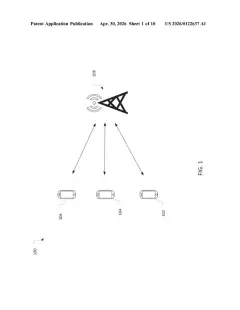
Apple
Apple Patents Scheduled 5G Upload Gaps to Sense How Close Your iPhone Is to Your Body
Qualcomm
Qualcomm Patents AI That Tells Networks Which Signals Work Best
Samsung
Samsung Patents an AI System That Cleans Up Wireless Signals Using Specialist Teams
Samsung
No comments yet