
Samsung Patents a Two-Frequency Radio Trick for Pinpointing Your Phone's Location
GPS is often good enough to find your street, but not your exact seat in a stadium or your lane on a highway. Samsung's new patent takes aim at that gap by making phones measure their position using radio wave timing data from two separate frequencies at once, then honestly reporting how uncertain those measurements are.
What Samsung's dual-frequency positioning actually does
Today's phones figure out where they are by measuring signals from cell towers or satellites, but a single radio frequency can only get you so far. Tiny electrical quirks inside the phone itself introduce errors that look identical to real movement, and there's no easy way to tell them apart.
Samsung's patent describes a phone that takes two separate measurements of the same signal, each at a different radio frequency, and uses the difference between them to detect and cancel out that internal noise. The phone then sends the cleaned-up result to the network, along with a confidence score so the network knows exactly how much to trust the location data.
The practical goal is centimeter-level positioning accuracy, the kind that lets a network know not just which building you're in but which corridor you're standing in. That matters for indoor navigation, emergency response, and anything that needs to know exactly where a device is, not just roughly.
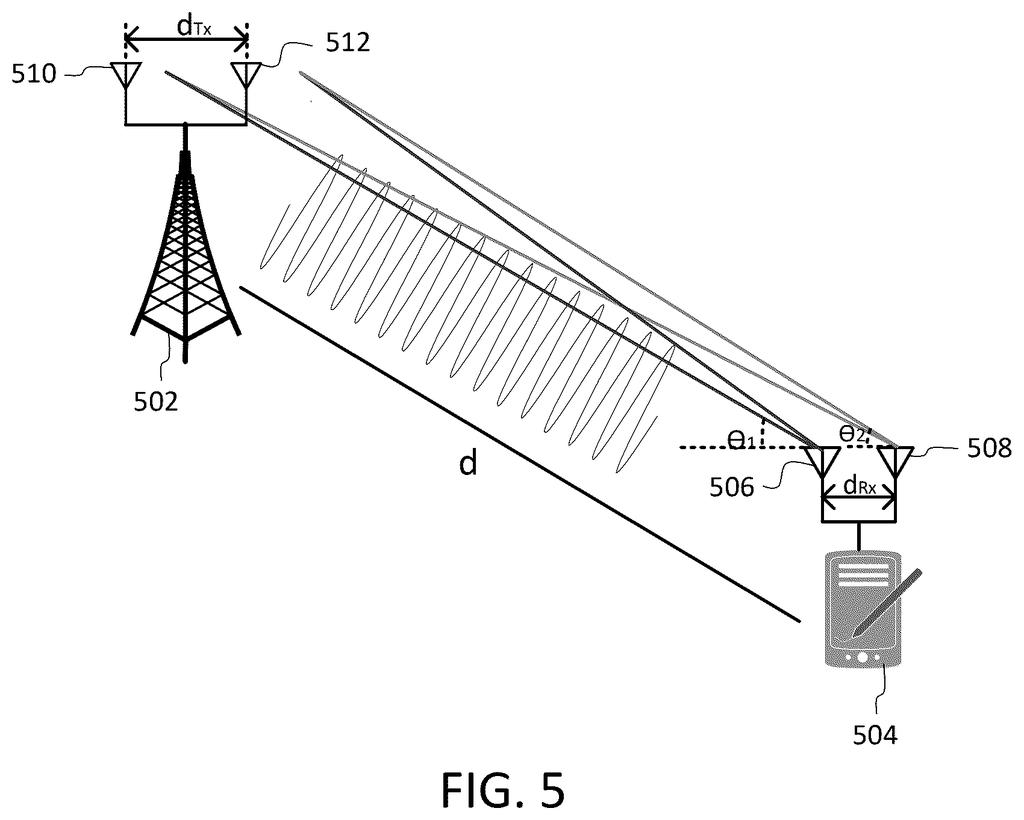
measuring, by a user equipment (UE) in a network, a first carrier phase of a reference signal at a first receive antenna and a second carrier phase of the reference signal at a second receive antenna; determining, by the UE, a phase offset associated with the first carrier phase and the second carrier phase …
Translation: Your phone uses two separate antennas to measure the signal timing and calculates the difference between them to fix errors.
How the UE calibrates phase offsets across two antennas
The patent centers on carrier-phase positioning, a technique that measures location by counting the peaks and troughs of a radio wave rather than just timing a signal's arrival. It is far more precise than ordinary GPS timing, but also far more sensitive to errors.
The core problem is a phase offset: the phone's two receive antennas each pick up the same signal at slightly different times due to tiny hardware imperfections inside the device. Those imperfections look to the network like the phone moved, even when it didn't. The patent's solution is to measure the signal at two different frequencies simultaneously. Because the offset behaves predictably across frequencies, the phone can calculate its size and subtract it out, a process the filing calls calibration.
After calibration, the phone doesn't just send the cleaned-up phase measurement to the Location Management Function (LMF) (the part of the 5G network responsible for computing a device's position). It also sends an uncertainty value that tells the LMF how confident the measurement is, factoring in whatever offset couldn't be fully removed.
That uncertainty report is meaningful. A network that knows a measurement is slightly noisy can weight it accordingly when combining it with other data points, producing a better final location estimate than one that treats all inputs as equally reliable.
… a user equipment (UE) in a network measures a first carrier phase based on a first reference signal at a first frequency, and a second carrier phase based on a second reference signal at a second frequency that is different from the first frequency.
Translation: The phone tracks two different radio frequencies at the same time to get a more precise location reading.
What this means for next-generation phone location accuracy
Location accuracy at the centimeter scale is one of the bigger unsolved problems in 5G. Emergency services need it to find people inside buildings, autonomous vehicles need it to stay in lanes, and industrial robots need it to work safely alongside humans. Current phone GPS is accurate to a few meters on a good day, which is nowhere close. The carrier-phase approach Samsung is patenting is already used in professional surveying equipment, but making it work on a mass-market smartphone, with all its thermal noise and cheap antenna hardware, is the hard part this filing addresses.
The uncertainty-reporting piece is also worth noting. It shifts the design philosophy from "give the network a number" to "give the network a number and tell it how much to trust that number," which is how professional measurement systems already work. Samsung's positioning work sits alongside a broader wave of new Big Tech patents targeting centimeter-level indoor and outdoor location for 5G and beyond.
Samsung's 1148th filing in our Samsung coverage since May adds to a run of phone ideas that includes a chat-aware keyboard and a three-panel folding phone.
When a 911 call comes from inside a large building, dispatchers often have no idea which floor, let alone which room. That gap costs lives, and closing it on ordinary consumer phones has been an unsolved problem for years.
Samsung's approach uses two radio frequencies instead of one, so the phone can detect and subtract its own internal measurement noise, the same way professional surveyors have worked for decades. The hard part is making that logic fit inside a phone's antenna stack, where heat and manufacturing variation make precision far more difficult to achieve.
The piece that may matter most to real-world deployment is the confidence reporting: rather than just outputting a location, the system tells the network how certain that location actually is. A dispatcher told "this reading is accurate within two centimeters" can act on that; a dispatcher handed a raw coordinate cannot.
Get our take in your Top Stories
Liked this breakdown? Add Patentlyze as a preferred source on Google, and our plain-English take shows up more often in your Top Stories the next time Samsung patent news breaks.
There are more where this came from
We read every patent application Big Tech publishes and send you the ones worth knowing. Plain English, free, every week.
The drawings
6 drawing sheets from US 2026/0255314 A1 · click any drawing to enlarge


Want this weekly breakdown for a company we don't cover? Patentlyze Pro →
Be the first to weigh in