
Samsung Patent Shows Three-Panel Phone That Automatically Rearranges Apps When Unfolded
Samsung is thinking carefully about one deceptively hard problem with foldable phones: what happens to your apps when you unfold the thing? A new patent describes a three-panel phone that uses each unfolding step as a cue to help you pick and arrange what you want on screen.
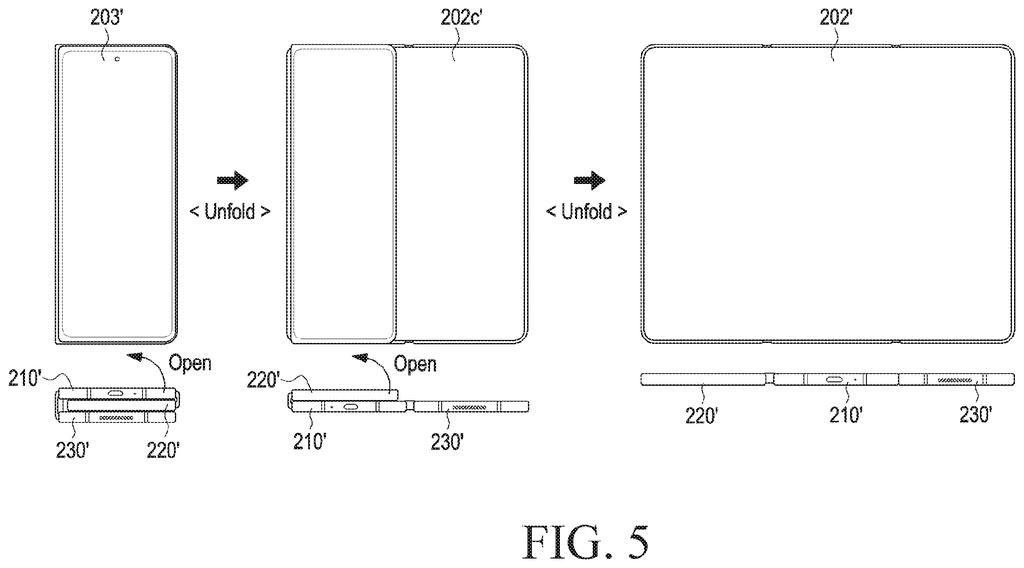
How Samsung's tri-fold app-switching idea actually works
You're watching a video on the outside screen of your folded phone, and you decide to open it up for a bigger view. Most phones today just shove whatever was on the small screen onto the big one, which can feel awkward.
Samsung's patent describes a different approach. When you start unfolding, the phone doesn't immediately expand your current app. Instead, it shows you a list of apps related to what you were already doing, so you can pick what you actually want on that bigger canvas. Maybe you were reading an article and you'd rather open a browser alongside a notes app.
Once you finish unfolding all the way into a three-panel tablet, the phone arranges whichever app or apps you chose across the entire inner display, in a layout that suits them. The whole sequence, from folded phone to fully open tablet, becomes a natural moment to reorganize your workspace rather than an interruption.
… display an application list ( 740 , 1010 , 1020 , 1110 , 1220 , 1620 , 1720 , 1820 , 1920 , 2020 , 2420 , 2520 , 2620 ) related to the first application through at least one area of the first display …
Translation: The phone shows a list of related apps on the main screen when opened.
How the device detects folds and assigns screen layouts
The patent covers a device with three housing panels connected by two hinges. There's a large flexible display that spans all three panels on the inside, and a smaller display on the outside (like today's Galaxy Z Fold cover screen). The device tracks its own physical state using a sensor module.
The system works in three distinct stages keyed to how open the device is:
- First state (fully folded): The user is running an app on the outer screen.
- Second state (partially open): The sensors detect that the user has started unfolding. The inner display activates and shows an application list related to the app that was running. The user picks what they want to open.
- Third state (fully unfolded): The chosen app or apps fill the entire inner display in a layout the system decides is appropriate for them, for example, a video player stretched wide, or two apps side by side.
The key engineering detail is that the transition between states is used as the trigger for the interface change, rather than a button press or a swipe. The sensor module (likely accelerometers or Hall-effect sensors that detect magnet positions in the hinges) tells the processor where the device is in its unfolding arc, and the software responds accordingly.
… display, based on detecting that a state of the electronic device is changed from the second state to a third state, an execution screen of at least one application on the entire area of the first display in a layout corresponding to the at least one application …
Translation: Opening the device fully launches the selected apps across the large screen in a custom layout.
What this means for tri-fold phones and multitasking
For anyone who has used a foldable phone, the moment of unfolding is already a small ritual. Samsung's idea is to make that ritual useful, turning a physical gesture into a multitasking shortcut instead of just a screen-size change. If it works well in practice, it could make the transition from phone mode to tablet mode feel much more intentional.
The catch is that this requires hardware that doesn't yet exist at mass-market scale: a three-panel foldable with two working hinges and a cover display. That's a longer production road than a pure software feature would be. Samsung has shown tri-fold prototypes, but shipping reliable dual-hinge hardware at consumer prices is a different challenge. This patent sits at the intersection of foldable hardware and Big Tech patent news around adaptive software interfaces, an area where several companies are building up IP before the hardware catches up.
Samsung's 63rd filing we've tracked since May on our Samsung foldable phone watchlist follows dual-fold camera layout and tiny cuts to stop cracks.
The physical act of unfolding a screen is already an intentional gesture, so using it to trigger a relevant app layout is smart design. It removes a step that would otherwise require conscious menu navigation after the screen opens.
Getting there requires new hardware that does not exist yet as a consumer product: two working hinges, a flexible screen that can crease across two fold lines without degrading, and a smaller cover screen that stays useful when the device is closed. Software that predicts which apps belong together is the easiest piece of this; everything underneath it is the hard part.
Samsung's ability to manufacture flexible screens puts them closer to this than most, but the patent describes a destination, not a schedule. The shortest path to a real product depends almost entirely on how long it takes the hardware to mature, and that timeline could be two years or considerably longer.
Get our take in your Top Stories
Liked this breakdown? Add Patentlyze as a preferred source on Google, and our plain-English take shows up more often in your Top Stories the next time Samsung patent news breaks.
There are more where this came from
We read every patent application Big Tech publishes and send you the ones worth knowing. Plain English, free, every week.
The drawings
30 drawing sheets from US 2026/0252296 A1 · click any drawing to enlarge


Want this weekly breakdown for a company we don't cover? Patentlyze Pro →
Be the first to weigh in