
Samsung
Samsung · AI / ML · Filed May 1, 2026 · USPTO published Nov 19, 2026 · This week's release
Samsung Patents a Sleep Tracker That Predicts Where Your Night Is Headed
Samsung's sleep tracking patent describes a model that labels the stage you're in right now and also guesses which stages come next. The idea is that knowing where a night is headed makes the live reading more accurate.
- Publication number
- US 2026/0363611 A1(US20260363611A1)
- Applicant
- Samsung Electronics Co., Ltd.
- Filed · Published
- May 1, 2026 · Nov 19, 2026
- Inventors
- Viswam Nathan, Keum San Chun, Varun Kumar Viswanath, Jilong Kuang
- Status when we published
- Waiting for an examiner
- Document
- 20 claims
- US classification
- 600/301
- Parent application
- Claims priority from a provisional application 63805100 (filed May 13, 2025)
What Samsung's sleep-stage predictor actually does
Most sleep trackers that tell you your stage in real time treat each short block of the night as a separate event, with no memory of what came before. The most accurate ones only work after the fact, once they have the whole night's data. Samsung's patent application tries to get the live answer without giving up that accuracy.
Sleep isn't random. You move through light sleep, deeper sleep and REM in a loose order, over several cycles, so what you're doing now says a lot about what's coming. The system looks at your heart rate, breathing and movement over the recent past, then reports two things: the stage you're in now and a guess at the next few stages.
Because the model is trained to guess ahead, it has to learn how sleep tends to flow from one stage to the next. That learned pattern is what should sharpen the live reading.
… generating, using the at least one processing device, real-time sleep stage predictions of the subject during the epochs using the trained machine learning model; …
Translation: AI processes live sleep data to guess what stage of rest you are in right now.
How the model learns the rhythm of a night
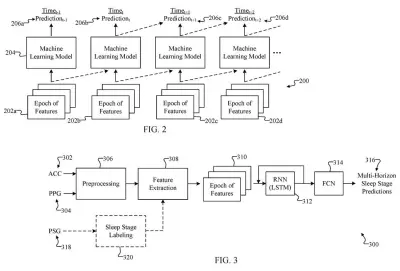
The device collects body signals from a wearable such as a smart watch or smart ring, or from a camera or smart home device that watches from across the room. The claims call this physiological information: heart rate, heart rate variability (the tiny shifts in timing between heartbeats), breathing rate and movement. The data is split into epochs, which are short repeating time blocks. The filing gives thirty seconds as an example.
Each block is boiled down into a compact set of numbers called features. A trained machine learning model then reads the features from the current block plus those from earlier blocks, which the filing calls a "long context" input. The example model is a recurrent neural network (an AI built for sequences, since it carries information forward from earlier steps), followed by a classifier that picks the stage. Other versions use LSTM or GRU designs, which are variations on the same memory idea.
The output is a multi-horizon prediction: the current sleep stage and one or more future stages, all produced at once. To train it, the company uses polysomnography data (the overnight lab sleep studies that record brain waves and more) as the answer key. The model makes guesses, measures its error against those labels, and adjusts until the error drops below a set threshold. The claims cover both using the model and training it.
The real-time sleep stage predictions for the at least one current epoch include a predicted sleep stage of the subject during the at least one current epoch and at least one predicted future sleep stage of the subject during one or more subsequent epochs.
Translation: The system predicts your current sleep stage and forecasts how you will sleep in the near future.
What this means for alarms and sleep scores
The practical payoff is in features you already see on a sleep app. The filing describes a wake-up alarm that sounds only when you are in light sleep and holds off during deep or REM sleep. It also describes a deep sleep boost that triggers sounds or vibrations from a watch once deep sleep is detected. Knowing what's likely coming next gives those features a head start on timing.
It could also feed your sleep score, the overnight chart of your stages, and health predictions or advice about improving your sleep. All of that depends on the stage labels being right, so a better live guess lifts everything built on top. The filing is short on accuracy numbers, so the size of the gain is still unknown.
That makes this Samsung's 35th filing we've tracked since June in our body-sensing wearables watchlist, joining work like the altitude misread fix and the ring stylus idea.
Source: US 2026/0363611 A1 at the USPTO (PDF). Full patent text and figures are in the official publication.
Get our take in your Top Stories
Liked this breakdown? Add Patentlyze as a preferred source on Google, and our plain-English take shows up more often in your Top Stories the next time Samsung patent news breaks.
Add Patentlyze on Google
One click.
There are more where this came from
We read every patent application Big Tech publishes and send you the ones worth knowing. Plain English, free, every week.
The drawings · 5 sheets
5 drawing sheets from US 2026/0363611 A1 · click any drawing to enlarge


More from Samsung
All 1,662 Samsung patents →
More in AI simulation
All 192 AI simulation patents →
Nvidia
Nvidia Patents AI That Generates Fake Medical Scan Images From Text Descriptions
Adobe
A New Adobe Patent Lets You Reshape 3D Models by Typing What You Want
Adobe
Adobe Files Patent for Rotating Objects in a Photo to Show Their Other Side
Sony
No comments yet