Get the newsletter
Samsung · Wearable · Filed Jun 11, 2026 · USPTO published Nov 12, 2026 · This week's release

Samsung Patents a Fix for Watches That Misread Altitude When You Flip Your Wrist

The waterproof gel that protects your watch's pressure sensor also weighs on it, so turning your wrist can shift an altitude reading by up to about 1.6 meters. Samsung's filing describes a way to cancel that weight out.
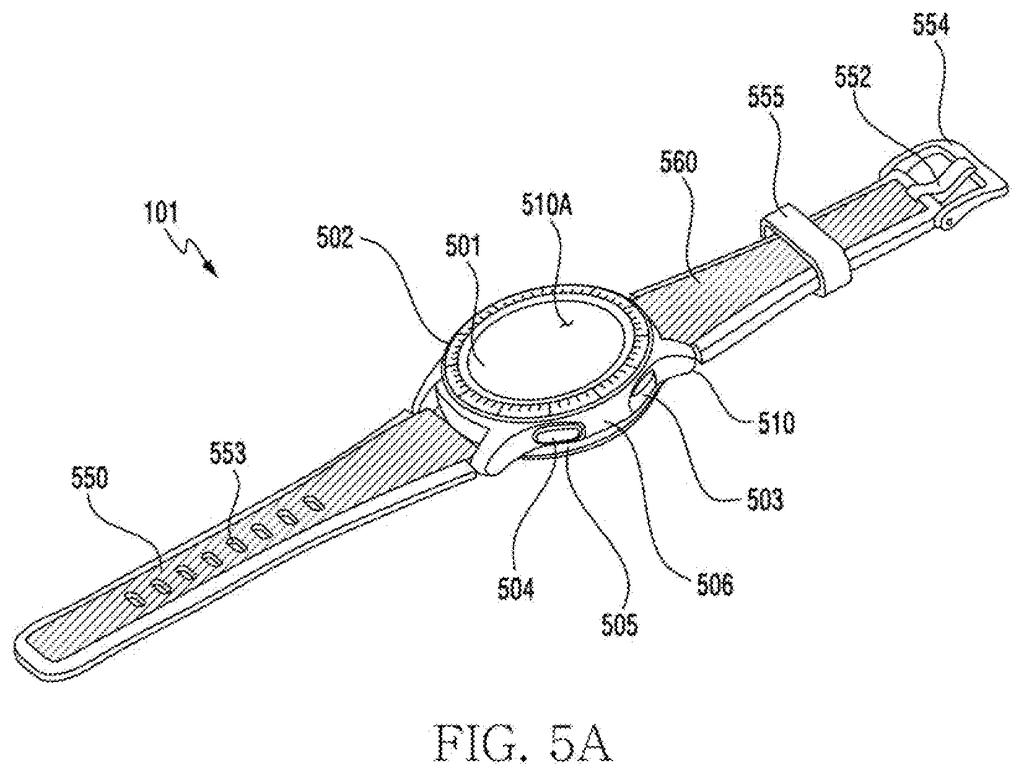
A smartwatch designed to monitor air pressure and elevation accurately as the wearer moves their arm. Drawing from patent filing US 2026/0358122 A1.
A smartwatch designed to monitor air pressure and elevation accurately as the wearer moves their arm.All 30 drawings ↓
Publication number
US 2026/0358122 A1(US20260358122A1)
Applicant
SAMSUNG ELECTRONICS CO., LTD.
Filed · Published
Jun 11, 2026 · Nov 12, 2026
Inventors
Hyungjin SON, Kihun EOM
Status when we published
Waiting for an examiner
Document
20 claims
US classification
73/493
Parent application
Continuation of PCT/KR2024/018428 (filed Nov 20, 2024)(PCTKR2024018428)

What Samsung's gel-corrected altitude patent does

Every time you turn your wrist, the blob of waterproofing gel inside your watch's air-pressure sensor leans on the sensor chip a little differently. Gravity does that. The filing says the resulting error, about 0.1 to 0.2 hectopascals (a unit of air pressure), can equal an altitude mistake of 80 to 160 centimeters.

Samsung's answer starts at the factory. Engineers record how far the gel skews the reading when the sensor faces the ground, sits sideways, and faces away from the ground, then store those numbers in the sensor itself. Later, your device's motion sensor works out which way the pressure sensor is tilted, and the device subtracts the matching error.

The filing even shows the problem in a drop test: a device that flips mid-fall reports pressure going down while the real pressure rises. The correction is meant to fix that, and it can run only when an app needs precise readings, to save battery.

From the filing · CLAIM 1
determine direction information of the barometric pressure sensor based on sensing data of the inertial sensor …

Translation: The watch uses motion sensors to figure out which way the air pressure sensor is facing.

How the watch cancels out the gel's weight

Samsung's filing covers a device with a waterproof air-pressure sensor plus a motion sensor. The pressure sensor is a tiny MEMS chip (a microscopic membrane that bends under pressure). The motion sensor combines an accelerometer and a gyroscope, which track tilt and rotation. In the main example, a gel covers the sensing element and its control chip (an ASIC, a small custom circuit). The gel's weight adds to the true pressure when the sensor faces the ground and subtracts from it when the sensor faces away.

The method has three steps:

  • Work out which way the pressure sensor faces, using the motion sensor and the known angle between the two chips.
  • Look up a correction. Offsets measured in advance for three directions (facing the ground, sideways, pointing away from the ground) are stored in the sensor's chip and fit into a quadratic polynomial (a simple curve) that gives a correction for any angle in between.
  • Add that correction to the raw reading and report altitude or water depth.

To trust the angle, the device first checks whether it is moving calmly. If acceleration varies less than a set threshold, it reads tilt directly. Otherwise it takes the last calm reading and adds the measured rotation since then. The result is filtered, because the motion sensor reports about ten times for every three pressure readings.

In one worked example, a 38 degree tilt yields a correction of roughly -0.00957 hPa.

From the filing · THE ABSTRACT
… determine a correction value in accordance with the direction information of the barometric pressure sensor, based on pressure offset data for the sensing element in a plurality of directions of the barometric pressure sensor …

Translation: It calculates an adjustment based on how wrist orientation changes pressure readings.

Why wrist-tilt errors matter for swimmers

If you wear a watch to track a swim, a night of sleep or a workout, your altitude and depth numbers come from tiny pressure readings. The filing says an error of 0.1 to 0.2 hectopascals can equal 80 to 160 centimeters of height, enough to throw off ball sports, fitness and Pilates tracking. The fix keeps the waterproof gel and adds a factory test plus some math.

The filing also describes a battery-saving twist. The correction can run only when a designated app is open, such as a health, sleep, swimming, fishing or emergency-call app, because constant motion sensing drains power. It names rings and headsets alongside watches, so the same idea could follow the sensor into smaller wearables.

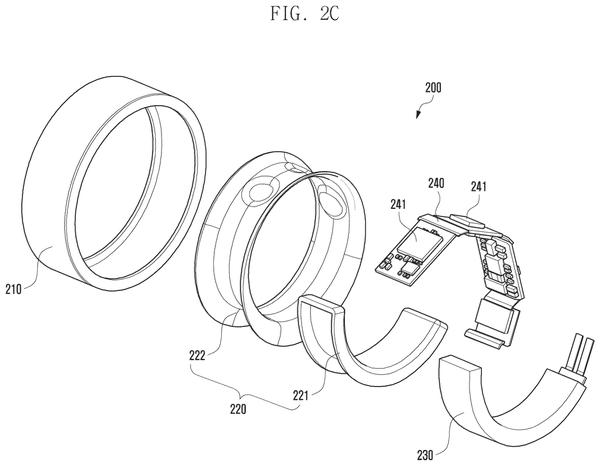
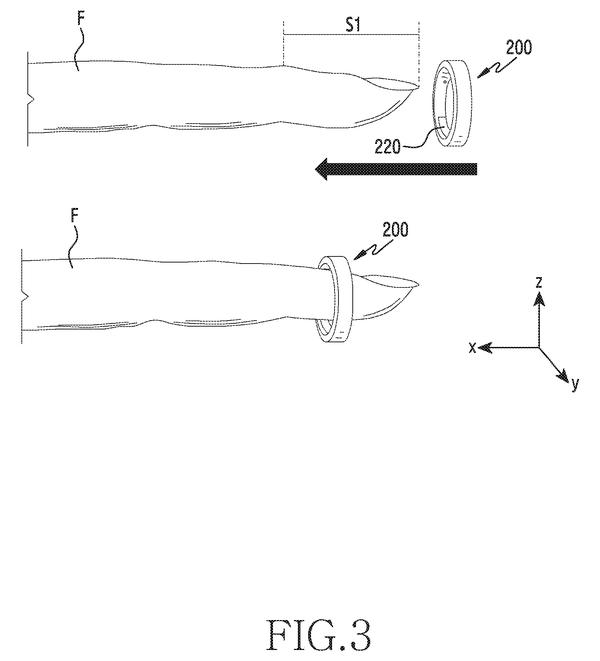
Samsung's 34th filing we've tracked since June in our wearables that read your body watchlist follows one turning rings into a stylus and one separating heartbeat from arm movement.

Source: US 2026/0358122 A1 at the USPTO (PDF). Full patent text and figures are in the official publication.

Get our take in your Top Stories

Liked this breakdown? Add Patentlyze as a preferred source on Google, and our plain-English take shows up more often in your Top Stories the next time Samsung patent news breaks.

There are more where this came from

We read every patent application Big Tech publishes and send you the ones worth knowing. Plain English, free, every week.

The drawings · 30 sheets

30 drawing sheets from US 2026/0358122 A1 · click any drawing to enlarge

Internal parts that manage sensors, memory, and wireless connections, drawing sheet 1 from US 2026/0358122 A1
Sheet 1 Internal parts that manage sensors, memory, and wireless connections
Wiring pressure and motion sensors to the watch chip, drawing sheet 2 from US 2026/0358122 A1
Sheet 2 Wiring pressure and motion sensors to the watch chip
Waterproof gel resting over the pressure sensor inside the watch, drawing sheet 3 from US 2026/0358122 A1
Sheet 3 Waterproof gel resting over the pressure sensor inside the watch
Gravity pulls on waterproof gel as the watch changes position, drawing sheet 4 from US 2026/0358122 A1
Sheet 4 Gravity pulls on waterproof gel as the watch changes position
Water pressure pushing on the protective gel when submerged, drawing sheet 5 from US 2026/0358122 A1
Sheet 5 Water pressure pushing on the protective gel when submerged
Adjusting altitude readings based on the angle of your wrist, drawing sheet 6 from US 2026/0358122 A1
Sheet 6 Adjusting altitude readings based on the angle of your wrist
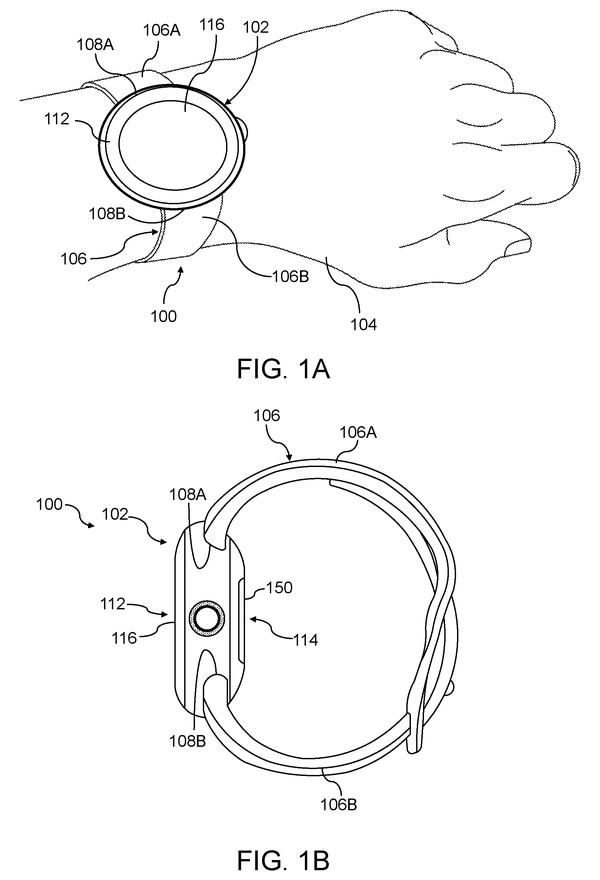
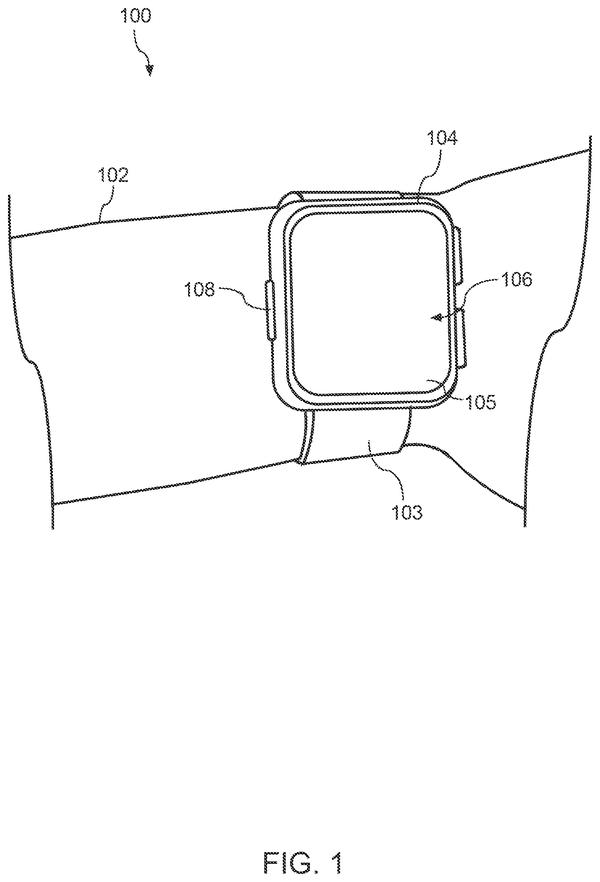
Outside controls and screen of a smartwatch housing the sensors, drawing sheet 7 from US 2026/0358122 A1
Sheet 7 Outside controls and screen of a smartwatch housing the sensors
Underside sensor cluster and vents that rest against your skin, drawing sheet 8 from US 2026/0358122 A1
Sheet 8 Underside sensor cluster and vents that rest against your skin
Show the other 22 sheets
Internal parts stacked inside the smartwatch case, drawing sheet 9 from US 2026/0358122 A1
Sheet 9 Internal parts stacked inside the smartwatch case
Where the pressure and motion sensors sit inside the watch, drawing sheet 10 from US 2026/0358122 A1
Sheet 10 Where the pressure and motion sensors sit inside the watch
Rising pressure as a flat watch drops to a surface, drawing sheet 11 from US 2026/0358122 A1
Sheet 11 Rising pressure as a flat watch drops to a surface
Flipping the watch upside down distorts the pressure curve, drawing sheet 12 from US 2026/0358122 A1
Sheet 12 Flipping the watch upside down distorts the pressure curve
Sudden pressure spikes caused by moving the sensor, drawing sheet 13 from US 2026/0358122 A1
Sheet 13 Sudden pressure spikes caused by moving the sensor
How sensor tilt angles throw off air pressure accuracy, drawing sheet 14 from US 2026/0358122 A1
Sheet 14 How sensor tilt angles throw off air pressure accuracy
Calculating correction numbers for every tilt angle, drawing sheet 15 from US 2026/0358122 A1
Sheet 15 Calculating correction numbers for every tilt angle
Test hardware used to measure waterproof sensor error, drawing sheet 16 from US 2026/0358122 A1
Sheet 16 Test hardware used to measure waterproof sensor error
Three watch orientations tested to measure sensor tilt, drawing sheet 17 from US 2026/0358122 A1
Sheet 17 Three watch orientations tested to measure sensor tilt
How waterproofing shifts pressure readings across watch angles, drawing sheet 18 from US 2026/0358122 A1
Sheet 18 How waterproofing shifts pressure readings across watch angles
Flipping your wrist shifts the angle of the watch, drawing sheet 19 from US 2026/0358122 A1
Sheet 19 Flipping your wrist shifts the angle of the watch
Finding the pressure sensor tilt using motion sensors, drawing sheet 20 from US 2026/0358122 A1
Sheet 20 Finding the pressure sensor tilt using motion sensors
Pressure measurement errors grow as the watch rotates, drawing sheet 21 from US 2026/0358122 A1
Sheet 21 Pressure measurement errors grow as the watch rotates
Checking whether the watch is still before calculating tilt, drawing sheet 22 from US 2026/0358122 A1
Sheet 22 Checking whether the watch is still before calculating tilt
Saving battery by correcting pressure only for certain apps, drawing sheet 23 from US 2026/0358122 A1
Sheet 23 Saving battery by correcting pressure only for certain apps
Corrected air pressure readings over time during wrist motion, drawing sheet 24 from US 2026/0358122 A1
Sheet 24 Corrected air pressure readings over time during wrist motion
Sensors placed on a smart ring to track elevation correctly, drawing sheet 25 from US 2026/0358122 A1
Sheet 25 Sensors placed on a smart ring to track elevation correctly
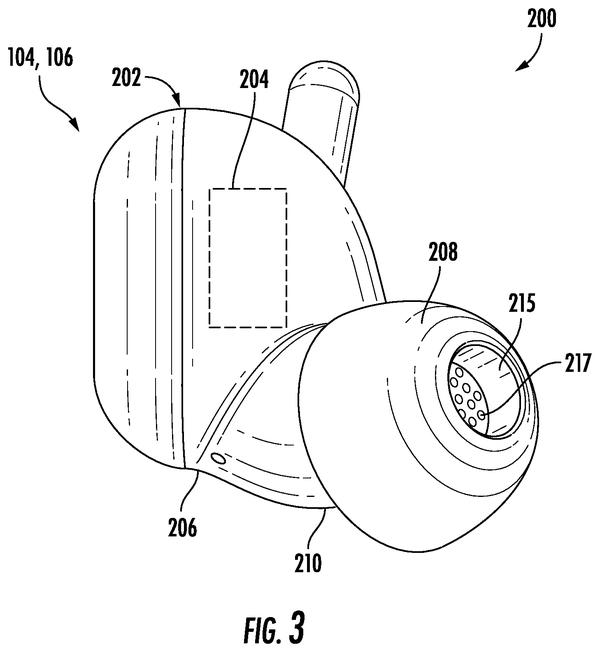
Motion sensors that adjust headset pressure as you look around, drawing sheet 26 from US 2026/0358122 A1
Sheet 26 Motion sensors that adjust headset pressure as you look around
Smart glasses designed to house orientation and pressure sensors, drawing sheet 27 from US 2026/0358122 A1
Sheet 27 Smart glasses designed to house orientation and pressure sensors
Internal layout of parts inside the frame of smart glasses, drawing sheet 28 from US 2026/0358122 A1
Sheet 28 Internal layout of parts inside the frame of smart glasses
Inside view of an XR headset facing the eyes, drawing sheet 29 from US 2026/0358122 A1
Sheet 29 Inside view of an XR headset facing the eyes
Headset visor equipped with outer cameras and sensors, drawing sheet 30 from US 2026/0358122 A1
Sheet 30 Headset visor equipped with outer cameras and sensors
Patent filing page

Watchlists this filing belongs to

All watchlists →
Reader comments

No comments yet

Start the discussion

Real name or a handle, either is fine. Comments are read by a person before they appear, so allow a little time. Keep it about the filing.