
Samsung Patents a Fix for Jarring Color and Brightness Jumps in Headset Video
A headset that shows you the real world through cameras can make a passing cloud feel like a sudden flash. Samsung's new patent application describes a way to ease those jumps in color and brightness.
What Samsung's headset color smoothing does
Every time you walk from a dim hallway into a bright room, your eyes take a moment to adjust. A headset that shows you the outside world through cameras gets no such grace period. Its video can lurch from dark to bright in a single frame, and that sudden jump is uncomfortable to look at.
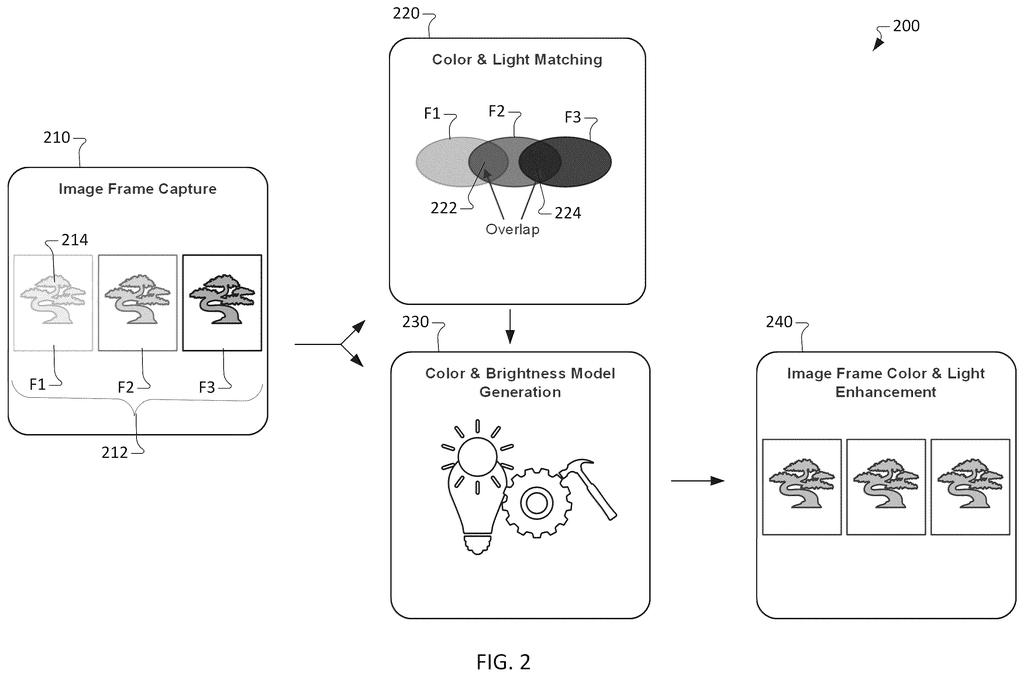
Samsung's patent application describes a fix. The headset compares each new video frame with the one before it, looking only at the parts of the picture that show the same spot in the room. It measures how much the color and the brightness changed there, then adjusts the new frame so the change happens gradually instead of all at once.
The lighting around you still changes, but the video eases into the new look, which should make wearing the headset easier on your eyes.
… determine one or more color differences and one or more luminance differences for each of one or more overlapping areas between at least one pair of consecutive image frames in the sequence; …
Translation: The system checks how much color and brightness change between overlapping parts of video frames.
How the headset compares one frame to the next
This is a frame-by-frame correction step for video see-through headsets (also called passthrough headsets), which show you your surroundings using their own cameras. The cameras can run at rates like 30, 60, 90 or 120 frames per second, and the filing says the method works with ordinary frames, so it does not need several exposures of the same moment.
For each new frame, the device first lines it up with the previous one (called registration, which uses head-movement data to find the same points in both pictures). That reveals the overlapping area: the part of the scene both frames captured. Inside that area it measures the difference in color (chrominance) and in brightness (luminance).
Those differences feed two small math models:
- Color matching model: uses a linear correction, which scales and shifts each frame's color values so the two frames agree.
- Luminance matching model: uses a gamma correction, a curve that changes brightness unevenly across dark and light areas.
A minimization algorithm (a method that finds the settings leaving the smallest total error across recent frames) then produces smoothing parameters, which are applied to the current frame. The parameters are saved in a frame registry for the next frame. The filing also describes skipping the whole process when neighboring frames already look alike, and converting frames into a format that keeps brightness on its own channel.
Why stable color matters for passthrough headsets
If you wear a passthrough headset, the most direct payoff is comfort. Walking past a window, flipping on a lamp, or looking from a shadow into sunlight could produce a gentle shift in the video instead of a jolt. The filing itself says abrupt color shifts make for an uncomfortable experience.
It also fits a practical constraint of these devices: the cameras usually give the headset one exposure per frame, so techniques that blend several exposures of the same moment are often off the table. Samsung's approach works on the frames the headset already has. That makes it a candidate for any headset or wearable that shows the real world through video, though the filing does not tie it to a specific product.
Samsung's 58th filing we've tracked in the AR glasses race since May builds on earlier applications like one on flattening display films and one on clearing graphics for focus.
Every fix has a price. Smoothing means the headset deliberately shows you a slightly wrong picture for a moment: if the lights snap on, the video eases toward the new brightness instead of jumping to match it. An early bad reading can also echo through later frames, since each correction builds on the ones before it.
The other cost is work. The headset runs this math up to 120 times per second while also bending the image to correct for the lenses and painting virtual objects on top of the real world.
That trade reads as worth it. A brief lag in catching a lighting change is far easier to live with than a flicker directly in front of your eyes, and the filing's shortcut of skipping the math when neighboring frames already look similar helps keep the power bill reasonable.
Get our take in your Top Stories
Liked this breakdown? Add Patentlyze as a preferred source on Google, and our plain-English take shows up more often in your Top Stories the next time Samsung patent news breaks.
There are more where this came from
We read every patent application Big Tech publishes and send you the ones worth knowing. Plain English, free, every week.
The drawings
11 drawing sheets from US 2026/0313065 A1 · click any drawing to enlarge


Show the other 3 sheets


Want this weekly breakdown for a company we don't cover? Patentlyze Pro →
Be the first to weigh in