
Samsung Files Patent for Screens With Holes That Keep Moisture Out
If your screen has a hole in it for a camera, the edge of that hole is an open door for damp air. Samsung's answer is to dig tiny moats with overhanging lips around it.
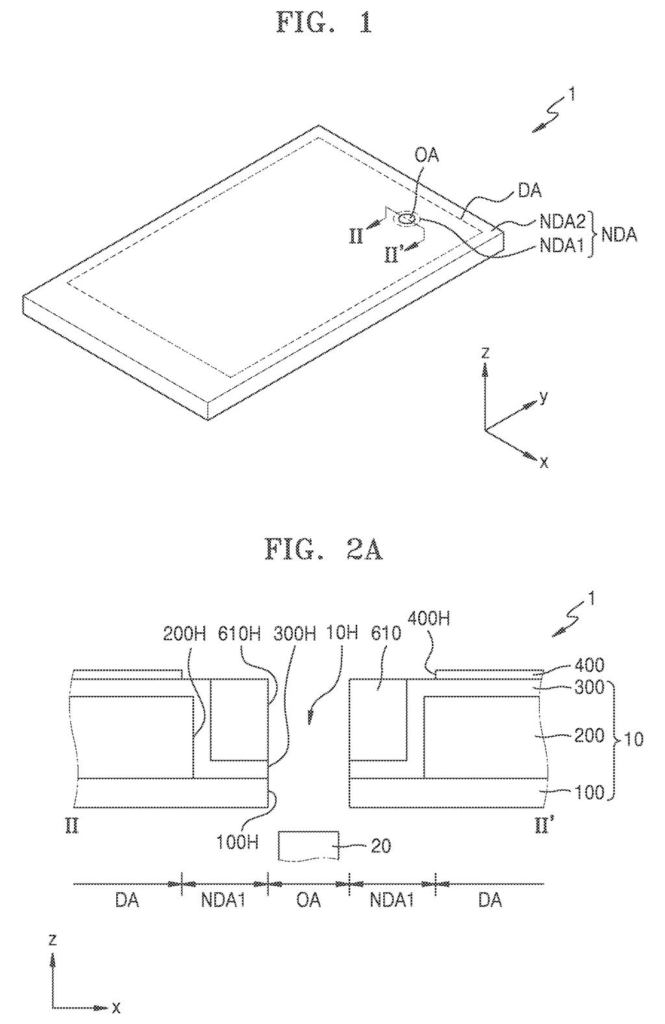
What Samsung's screen-hole trenches actually do
Every time your phone sits in a steamy bathroom or a damp pocket, moisture is looking for a way into the screen. A display with a hole in it, for a camera or sensor, gives that moisture an extra doorway along the hole's edge.
Samsung's new patent application describes a fix: dig narrow, ring-shaped trenches around the hole, each with an overhanging lip like the eaves of a roof. When the light-producing layers of the screen are laid down, they snap apart at those lips, so moisture has no unbroken path toward your pixels.
The same trenches help when the hole is cut out. A crack that starts at the cut runs out of road before it reaches the part of the screen you actually look at. Sealing layers then cover everything on top.
forming a groove in the first non-display area by etching a stacked structure of a first layer located in the first non-display area and a second layer directly on the first layer, wherein the second layer includes a tip protruding further toward the groove than a lateral surface of the first layer in a cross-sectional view …
Translation: Workers carve a tiny trench with an overhanging lip to block moisture from reaching the screen electronics.
How the overhanging lip splits the glowing layers
The claims cover a manufacturing method for a display panel with a hole (the "open area"), a ring of non-glowing border around it, and the glowing display area beyond. First, a groove is etched into that border through a stack of two layers: a lower one, and an upper one whose edge sticks out past it. That sticking-out edge is the tip, and it gives the groove an undercut shape, wider underneath than at the opening.
Next the screen's light-producing parts are built: a pixel electrode, an intermediate layer holding the light-emitting layer, and a top electrode. Because these organic layers are laid down as one sheet, the tip breaks them into separate pieces, so no unbroken organic path runs from the hole to the pixels. In the description, the tips stick out about 0.7 to 1.5 micrometers (far thinner than a hair), and the lower layer is a polymer resin.
Then comes encapsulation, a sealing coat against moisture:
- A first inorganic layer coats the grooves without breaking.
- An organic layer is made by applying a liquid plastic ingredient (a monomer) and hardening it, with a partition wall steering where the liquid flows.
- A second inorganic layer goes on top and touches the first.
One version adds a flattening layer at least about 5 micrometers thick over the grooves. Another uses a broken ring of conductive material as a wire, so a crack would show up as a lost signal.
… a thin-film encapsulation layer disposed on the display element layer, the thin-film encapsulation layer including a first inorganic encapsulation layer, an organic encapsulation layer, and a second inorganic encapsulation layer which are sequentially stacked …
Translation: Layers of organic and inorganic materials are stacked on top to seal the sensitive parts of the display.
Why Samsung's hole-punch screens need these moats
Holes in screens are getting used for more than selfie cameras. The filing lists infrared sensors, microphones, speakers, and even a clock hand on a smartwatch or a car's instrument panel. Every one of those holes is a weak spot where water vapor can sneak in and cracks can start. A design that blocks both could mean panels that keep their brightness longer and survive the cutting step in the factory.
You would never see any of this in a product photo. It is a factory-line detail, and the benefit shows up as fewer dead spots near the hole over time. This application is also the latest in a long chain of continuations that trace back to Korean filings from 2018, so the idea has been refined over years.
Samsung's 131st filing we've tracked in our display technology watchlist since May follows one on hover-vs-finger detection and one on self-crossing wiring.
Every moat costs something. Here the price is space and precision: the rings eat into the border around the hole, and each overhanging lip is only about a micrometer wide in the filing's examples. The factory has to hit that shape every time, with extra etching steps to get there.
The description also admits weak spots. Metal layers laid on top can come out thin or broken around the lips, and stray bits of hardened coating can end up inside a trench. Samsung's remedy is more covering layers, which adds even more steps to the build.
Still, the trade reads as worth it. A hole in a screen is a hole in its armor, and a few thin rings of extra border is a small price for pixels that stay bright and a panel that survives being cut. The risk sits in manufacturing yield, which this document cannot tell us anything about.
Get our take in your Top Stories
Liked this breakdown? Add Patentlyze as a preferred source on Google, and our plain-English take shows up more often in your Top Stories the next time Samsung patent news breaks.
There are more where this came from
We read every patent application Big Tech publishes and send you the ones worth knowing. Plain English, free, every week.
The drawings
50 drawing sheets from US 2026/0349551 A1 · click any drawing to enlarge


Show the other 42 sheets


Want this weekly breakdown for a company we don't cover? Patentlyze Pro →
Be the first to weigh in