
Samsung
Samsung · Robotics · Filed Jul 8, 2026 · USPTO published Nov 19, 2026 · This week's release
Samsung Patents a Robot Mop Dock With a Water Nozzle That Moves to Fit
Robot mops are good at cleaning floors but picky about parking, so Samsung's filing gives the dock a water nozzle that moves to meet the robot instead of waiting for a perfect fit.
- Publication number
- US 2026/0363517 A1(US20260363517A1)
- Applicant
- Samsung Electronics Co., Ltd.
- Filed · Published
- Jul 8, 2026 · Nov 19, 2026
- Inventors
- Donghyun LEE, Haekang LEE
- Status when we published
- Waiting for an examiner
- Document
- 14 claims
- US classification
- 15/320
- Parent application
- Continuation of PCT/KR2024/021566 (filed Dec 31, 2024)(PCTKR2024021566)
What Samsung's self-aligning mop dock does
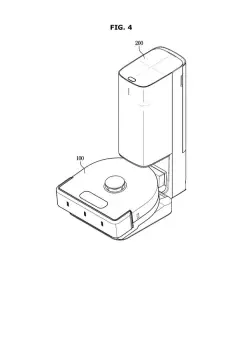
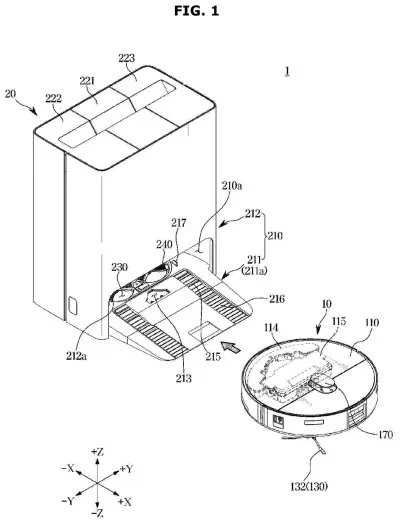
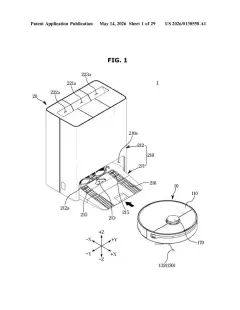
A robot mop rolls backward into its dock after a long run across the kitchen floor. To refill its water tank, a small opening on its back has to line up with a water nozzle on the dock. That sounds easy, but the robot climbs a little ramp and bumps over a ridge on the way in, so it can end up tilted or a bit off to one side.
Samsung's answer is a nozzle that moves to meet the robot. It rides on a spring, so if the robot nudges it backward during docking, it pushes forward again and presses against the opening. A rubber collar around the nozzle keeps water from leaking and steam from creeping into the dock.
For you, the goal is simple: fewer failed refills and fewer mornings spent wondering why your robot ran dry.
… a water filling portion configured to guide water to the water tank; and a station to which the robot cleaner is docked, wherein the station comprises: a water supply tank configured to store water; and a nozzle configured to supply the water in the water supply tank to the water tank while the robot cleaner is docked at the station …
Translation: The dock automatically fills the robot vacuum's onboard water tank while it is parked.
How the spring-backed nozzle finds the port
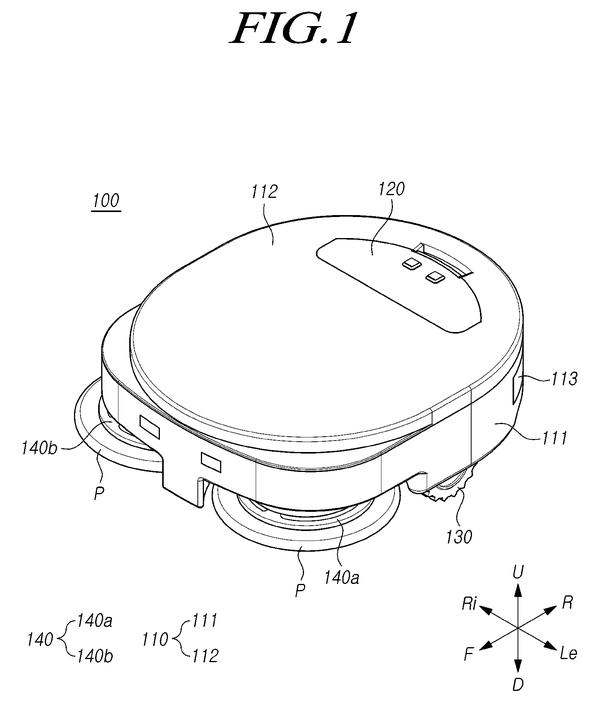
The filing covers a cleaning system with two parts: a robot cleaner with a water tank that feeds a removable wet mop, and a station it docks into. The station holds a clean-water tank and a nozzle that fills the robot's tank through a water filling portion (the opening on the robot's back) while it is docked.
What sets it apart is that the nozzle is not fixed in place. The claims describe a few ways it can move:
- A spring (the filing calls it an elastic member) pushes the nozzle toward the robot's opening.
- A mounting bracket lets the nozzle slide left and right.
- A guide piece lets it slide front to back, and the nozzle body is shorter than the slot holding it, leaving room to shift.
The filing explains what the moving nozzle is for. The dock has a ridge between two parking spots, and when the robot rolls over it, its body tilts up and down. That can spoil the connection at the spot where it refills. The opening on the robot is also shaped like a shallow bowl (an inwardly concave sloped surface), so a slightly misaligned nozzle slides toward the center.
A tube-shaped rubber seal wraps the tip of the nozzle, with a wider flange at each end. The front flange seals against the robot's opening to stop leaks. The rear flange covers the hole in the bracket so steam and water stay out of the dock's insides.
… the nozzle being movably provided to correspond to a position of the water filling portion.
Translation: The water nozzle shifts its position so it always lines up correctly with the robot.
Why docking errors matter for mopping robots
If you own a mopping robot with a self-service dock, the refill step is one of the places where things can go wrong. A nozzle that forgives a sloppy parking job could mean fewer missed refills, fewer drips around the dock, and less steam reaching parts of the station that were never meant to get wet.
The filing also describes a station that charges the robot, empties its dustbin, washes and dries the mop, and makes steam. The water connection is one link in that chain, and every chore the dock handles depends on the robot sitting in the right spot. Samsung's filing does not name a product, so treat it as a look at how the company thinks about the problem.
That makes this Samsung's 58th filing we've tracked in our home robots watchlist since May, adding to work like keeping wheels on course and a one-motor bending finger.
Source: US 2026/0363517 A1 at the USPTO (PDF). Full patent text and figures are in the official publication.
Get our take in your Top Stories
Liked this breakdown? Add Patentlyze as a preferred source on Google, and our plain-English take shows up more often in your Top Stories the next time Samsung patent news breaks.
Add Patentlyze on Google
One click.
There are more where this came from
We read every patent application Big Tech publishes and send you the ones worth knowing. Plain English, free, every week.
The drawings · 15 sheets
15 drawing sheets from US 2026/0363517 A1 · click any drawing to enlarge


Show the other 7 sheets


More from Samsung
All 1,662 Samsung patents →
More in Hardware
All 2,355 Hardware patents →
Samsung
Samsung Patents a Home Robot That Can Read and Control Your Screens
Samsung
Samsung Patents a Robot That Figures Out Whose Turn It Is to Be Looked At
Samsung
Samsung Patents a Robot That Picks Up Its Own Sensor to See Around Obstacles
Samsung
No comments yet