
Sony
Sony · AI / ML · Filed May 26, 2026 · USPTO published Nov 19, 2026 · This week's release
Sony Files Patent for an AI Ghost That Shows You How to Play
Sony's patent application describes a see-through AI character that plays a section of your game ahead of you, or finishes it while you watch. You choose whether it sticks to the story, the fights or the treasure hunting.
- Publication number
- US 2026/0364467 A1(US20260364467A1)
- Applicant
- Sony Interactive Entertainment LLC
- Filed · Published
- May 26, 2026 · Nov 19, 2026
- Inventors
- Bethany Tinklenberg, Angela Webb
- Status when we published
- Waiting for an examiner
- Document
- 20 claims
- US classification
- 463/31
- Parent application
- Continuation of 18/486,081 (filed Oct 12, 2023)(18486081)
What Sony's AI ghost player actually does
Every time you get stuck on a boss fight, you pause the game and hunt for a video of someone else beating it. Then you try to copy what you saw, which rarely lines up with the spot you are actually stuck on.
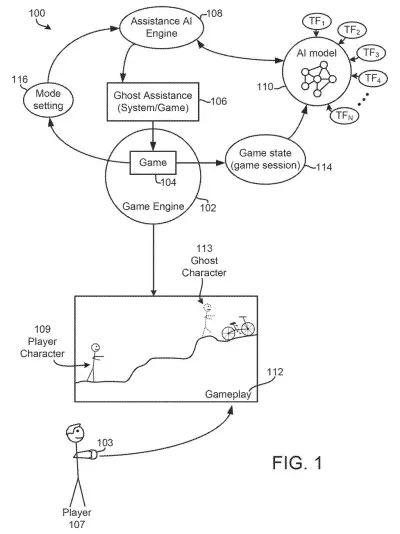
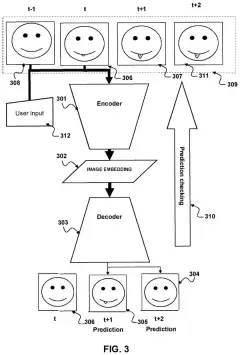
Sony's patent application describes a ghost character that does the showing for you, right inside your game. An AI watches what is happening in your session, recognizes the situation, and has the ghost act it out, like a see-through teammate demonstrating the move. It learns from recorded gameplay of that same game.
You pick how much help you want. The ghost might lead you through only the main story, only the fights, or only the places where items are hidden. In some versions it can even take over and finish a task while you watch.
selecting a particular ghost assistance mode for an AI engine, from among multiple ghost assistance modes are each associated with (i) an objective and (ii) an interactivity setting; and operating an AI engine according to the particular ghost assistance mode.
Translation: Players can pick different helper AI styles with specific goals and rules.
How the ghost's assistance modes are set up
The core of the claims is a menu of ghost assistance modes. Each mode is tied to two things: an objective (what the ghost is trying to get done) and an interactivity setting (whether the ghost's actions count in the real game). An AI engine then runs according to whichever mode is chosen, and the claims say the player can make that choice.
The objectives named in the claims are:
- Story: follow the ghost through only the essential story pieces to finish the storyline.
- Combat: follow the ghost through the fighting scenes.
- Exploration: follow the ghost to discover items.
- Full game: follow the ghost through the whole game in normal order.
On interactivity, one setting has the ghost's actions not advance your real progress, so it is purely a demonstration. The other lets the ghost's actions count. In the filing's football example, a ghost could score a touchdown that does not add to your score while you try to copy it.
The description explains where the AI gets its knowledge. It is trained on recorded gameplay of the specific game, pulled from sources such as gaming networks, streaming services and social media clips. It also reads the game's live state data (the running record of what is happening in your session) to spot a matching scenario. The ghost can speak, answer spoken questions like "how do I jump the river?", and turn from green to red as the help gets more urgent.
… rendering, during the game session, the ghost character performing interactive actions in the game. The interactive actions are generated responsive to control inputs generated by the assistance AI engine.
Translation: The game displays an AI character that physically plays through the level to show you how it is done.
Why a game helper that adapts could matter
If you have ever quit a game because one section would not budge, this is aimed at you. The filing says non-expert players often give up or struggle, and that searching for videos is slow and rarely matches the moment you are in. A helper that sees your situation and shows the move inside your own game could cut out that detour. The modes also let you choose a gentle nudge or a full handover, which helps if you want combat advice but prefer to explore on your own.
The filing says the help could be built into a single game, offered by a console's system software, or added through middleware (software that sits between a game and the system) so it could reach older games too. It is still a patent application, so nothing here says it will ship.
That makes this Sony's 175th filing we've tracked since May in our PlayStation hardware and software plans, a list that already includes an AI that plays for you and voice removal from clips.
Source: US 2026/0364467 A1 at the USPTO (PDF). Full patent text and figures are in the official publication.
Get our take in your Top Stories
Liked this breakdown? Add Patentlyze as a preferred source on Google, and our plain-English take shows up more often in your Top Stories the next time Sony patent news breaks.
Add Patentlyze on Google
One click.
There are more where this came from
We read every patent application Big Tech publishes and send you the ones worth knowing. Plain English, free, every week.
The drawings · 6 sheets
6 drawing sheets from US 2026/0364467 A1 · click any drawing to enlarge


More from Sony
All 722 Sony patents →
More in AI / ML
All 2,738 AI / ML patents →
Sony
Sony Patents an AI That Picks Your Game Settings From a Plain-English Request
Sony
Sony Patents an AI That Rewrites a Game's Video and Audio Mid-Session for Accessibility
Sony
Sony Patent Reveals How Deliberate AI Deception Makes Game Opponents Beatable
Sony
No comments yet