
Sony
Sony · AR / VR · Filed Sep 5, 2024 · USPTO published Aug 20, 2026 · Aug 20 release
Sony Patents a System for Storing Touch Sensations Inside 3D Media Files
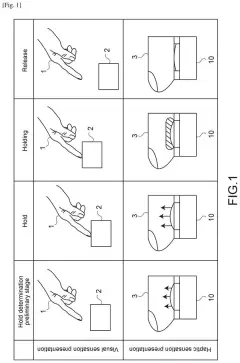
Sony is working on a way to embed touch sensations directly into 3D media files, so that when you watch or interact with a 3D scene, your device knows exactly when and how to vibrate or push back, without any extra syncing required.
- Publication number
- US 2026/0246970 A1(US20260246970A1)
- Applicant
- Sony Group Corporation
- Filed · Published
- Sep 5, 2024 · Aug 20, 2026
- Inventors
- Mitsuhiro HIRABAYASHI, Ryohei TAKAHASHI
- Status when we published
- Examiner raised objections; the company can respond
- Document
- 20 claims
- US classification
- 382/243
- Examiner
- SHAH, UTPAL D (Art Unit 2668)
- Parent application
- National Stage Entry of PCT/JP2023/010321 (filed Mar 16, 2023)(PCTJP2023010321)
How Sony wants to bundle touch feedback into 3D scenes
Have you ever watched a movie where the subtitles were slightly off from the dialogue? Now picture that same problem with touch feedback in a VR experience: the rumble in your controller fires a half-second late, or not at all, because the haptic data was stored separately and got out of sync.
Sony's patent tackles that by treating touch sensations like any other media track inside a 3D scene file. Instead of managing haptic data in a separate system, the file itself tells the device where to find the touch data, how to decode it, and when to play it back. Think of it like a video file that already has the audio baked in so you never have to match them manually.
Interactive content gets special handling too. The same file can carry descriptions of how touch should respond when you do something, not just when a pre-set moment in the scene triggers it. That means a 3D experience could respond to your actions with physical feedback that feels deliberate rather than canned.
an acquisition unit that acquires encoded data of dynamic haptics media associated with 3D data to be reproduced on the basis of a description of a scene description file; a decoding unit that decodes the encoded data based on the description of the scene description file and generates data of the haptics media; …
Translation: The system grabs and decodes compressed touch data linked to three dimensional scenes using a map file.
How the accessor ties haptic data to the scene description
The patent describes an information processing device built around a concept called a scene description file, which is essentially a master blueprint for a 3D experience. That file doesn't just describe what you see; it now also points to where haptic data lives and how it should be used.
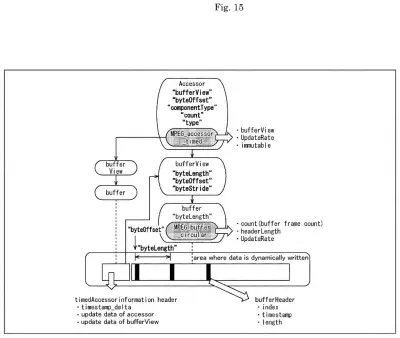
At the center of the system is something called an accessor, a pointer inside the scene description file that says "the touch data you need is stored right here, in this specific memory location." The device reads that pointer, fetches the encoded haptic data, decodes it, stores it in the designated spot in memory, and then reads it back out at the right moment to drive whatever output device delivers the physical sensation.
The patent also separates two types of haptic content:
- Dynamic haptics media: pre-authored touch sensations that are part of the 3D scene, like the rumble of an explosion or the texture of a virtual surface.
- Interactive media: touch responses triggered by what the user does, described separately in the scene file so the device can decode and apply them on the fly.
By keeping everything inside one structured file format rather than juggling separate haptic tracks, the system avoids timing errors and playback gaps that tend to occur when media components are loaded from different sources.
An accessor for storing dynamic haptics media associated with 3D data in a predetermined storage area is specified in a scene description file.
Translation: A special pointer in the scene file decides exactly where the touch sensation data gets saved.
What this means for touch feedback in VR and 3D content
For anyone using a VR headset, a haptics-enabled controller, or future AR glasses, the quality of touch feedback often depends on how well it stays in sync with what's on screen. A system that bakes the synchronization instructions directly into the 3D content file removes one of the most common failure points: the gap between when a scene event happens and when the haptic device reacts.
Sony has long made hardware, from PlayStation controllers to professional VR equipment, where haptic quality is a real selling point. This filing sits in a growing set of interesting tech patents around structured haptic media standards, suggesting the industry is moving toward treating touch data as a first-class media format rather than an afterthought bolted onto visual content.
Sony's 356th filing we've tracked in our Sony coverage since May adds to a camera-focused run that includes sound control via motion camera and noise reduction chip work.
Source: US 2026/0246970 A1 at the USPTO (PDF). Full patent text and figures are in the official publication.
Get our take in your Top Stories
Liked this breakdown? Add Patentlyze as a preferred source on Google, and our plain-English take shows up more often in your Top Stories the next time Sony patent news breaks.
Add Patentlyze on Google
One click.
There are more where this came from
We read the new patents from Big Tech, carmakers and more and send you the ones worth knowing. Plain English, free, every week.
The drawings · 35 sheets
35 drawing sheets from US 2026/0246970 A1 · click any drawing to enlarge


Show the other 27 sheets


More from Sony
All 722 Sony patents →
More in AR / VR
All 718 AR / VR patents →
Meta
Meta Patents Haptic Feedback System That Signals XR Event Urgency
Apple
Apple Patents a System That Adds Simulated Lighting to Media Apps When You Press Play
Qualcomm
Qualcomm Patents a System That Predicts What You're About to Touch in VR
Samsung