
Sony
Sony · Audio · Filed Jul 9, 2026 · USPTO published Nov 19, 2026 · This week's release
Sony Files Patent for Speakers That Fake a Full Surround Setup in Small Rooms
Sony describes a sound system that figures out where your speakers are and where you sit, then adjusts the audio so a few speakers in an awkward room sound like the full surround setup the movie was made for.
- Publication number
- US 2026/0371026 A1(US20260371026A1)
- Applicant
- SONY GROUP CORPORATION
- Filed · Published
- Jul 9, 2026 · Nov 19, 2026
- Inventors
- Toshiya KAIHOKO, Masashi HONDA, Tetsuo IKEDA, Yoshikazu OHURA, Yukiko UNNO, Yuki ANDOH
- Status when we published
- Waiting for an examiner
- Document
- 20 claims
- US classification
- 381/303
- Parent application
- Continuation of 18/292,517 (filed Jan 26, 2024)(18292517)
What Sony's virtual-speaker sound fix does
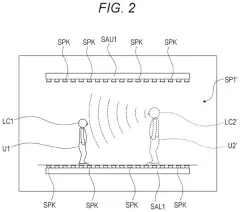
Four speakers sit in a living room, one wedged behind the couch because that is the only spot that fits. The movie you just started was mixed for a far bigger setup, with speakers all around you and even overhead. The sound you hear is a rough copy of what the filmmakers intended.
Sony's patent describes a control device that sorts this out on its own. It finds where each speaker sits, where you are sitting, and how high your ceiling is. It also learns what speaker layout the movie or song was made for. Then it adjusts the audio so it reaches your seat as if virtual speakers stood in all the ideal spots.
You would not need to place a microphone at your seat or run a setup routine. The device keeps re-checking, so if you shift a speaker while cleaning, it notices and adapts.
… corrects audio that is observed at the position of the listener, the audio included in the content emitted from a speaker located in the space, to audio based on the recommended environment on a basis of information measured by the measurement unit.
Translation: It alters the sound so that real speakers in a cramped room mimic the exact acoustic layout intended by the creators.
How Sony maps your room, seat and speakers
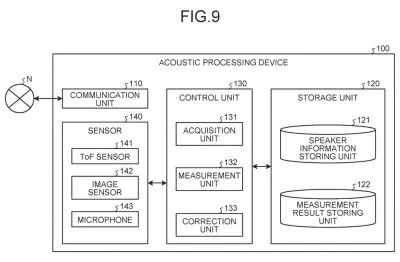
The patent covers a control device with three jobs. First, it gets the recommended environment for whatever you are playing: the ideal speaker layout the content was made for, which can be read from information bundled with the movie or music file. Second, it measures your real room. Third, it corrects the audio so what reaches your seat matches what a perfectly placed set of virtual speakers would deliver.
The filing describes several ways to measure:
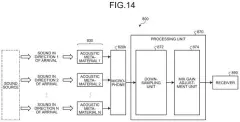
- Radio signals between the device and the speakers. Several antennas compare tiny timing offsets (phase differences) in the signal to work out the direction of each speaker.
- Cameras or depth sensors (time-of-flight, which times how long light takes to bounce back) to spot you and the speakers.
- Your smartphone or smartwatch, used as a stand-in for where you are sitting.
- Sound bounced off the ceiling and timed on its return, to estimate how high the ceiling is.
For the correction itself, the filing describes combining the output of several real speakers, including sound reflected off the ceiling by upward-facing speaker units. The sound waves add up to something that seems to come from a spot where no speaker exists. Measurement repeats over time, and you can fine-tune the results in a phone app.
The filing also describes learning your habits with AI and folding in open-style headphones or a neck speaker, using your head-related transfer function (how your head and ears shape sound).
… measures a position of a listener located in the space, the number and arrangement of the speakers, and a space shape …
Translation: The system scans where you are sitting, how many speakers you have, and the dimensions of the room.
Why Sony's fix matters for cramped living rooms
If you have ever bought a soundbar or a few speakers and wondered why movies do not sound like the demo at the store, this is the gap Sony is aiming at. 3D audio formats assume speakers all around and above you, and most living rooms cannot hold them. Software that measures the room and compensates could make a modest setup sound closer to the intended mix.
The design also takes work off you. The filing describes automatic re-measuring, so moving the couch or nudging a speaker does not mean redoing a calibration. It also lets you correct the device's guesses from your phone, and it can read the intended layout straight from the content. That would suit a home speaker system sold as a package, where the company controls the speakers, the sensors and the software.
That makes this Sony's 27th filing we've tracked in our Audio patent coverage since May, a series that includes applications like headphones that pause for your singing and brain-wave music tuning.
Source: US 2026/0371026 A1 at the USPTO (PDF). Full patent text and figures are in the official publication.
Get our take in your Top Stories
Liked this breakdown? Add Patentlyze as a preferred source on Google, and our plain-English take shows up more often in your Top Stories the next time Sony patent news breaks.
Add Patentlyze on Google
One click.
There are more where this came from
We read every patent application Big Tech publishes and send you the ones worth knowing. Plain English, free, every week.
The drawings · 13 sheets
13 drawing sheets from US 2026/0371026 A1 · click any drawing to enlarge


Show the other 5 sheets


More from Sony
All 722 Sony patents →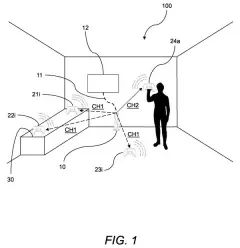
More in Audio
All 97 Audio patents →
Samsung
Samsung Patents a System That Auto-Corrects Uneven Dual Speakers
Google
Google Patents a System That Keeps 3D Surround Sound Smooth When Your Wireless Connection Struggles
Apple
Apple Patents a Faster, Leaner Method for Delivering Immersive Surround Sound
Samsung
No comments yet