
Sony Patents a Pen-Shaped Device That Tugs Your Fingertip to Fake Weight in VR
Sony has designed a pen with a tiny sliding bump that drags sideways across your fingertip, tricking your brain into feeling weight that isn't there. The trick is a motor that twists a bundle of wires like a rubber band.
What Sony's fingertip-tugging pen actually does
Making a handheld gadget feel like it is holding something heavy usually takes a bulky mechanism. To fake weight, a device has to drag the skin of your fingertip sideways, and that takes real force. The belt-winding method that does this in a small package is hard to fit into slim shapes like a pen or a mouse.
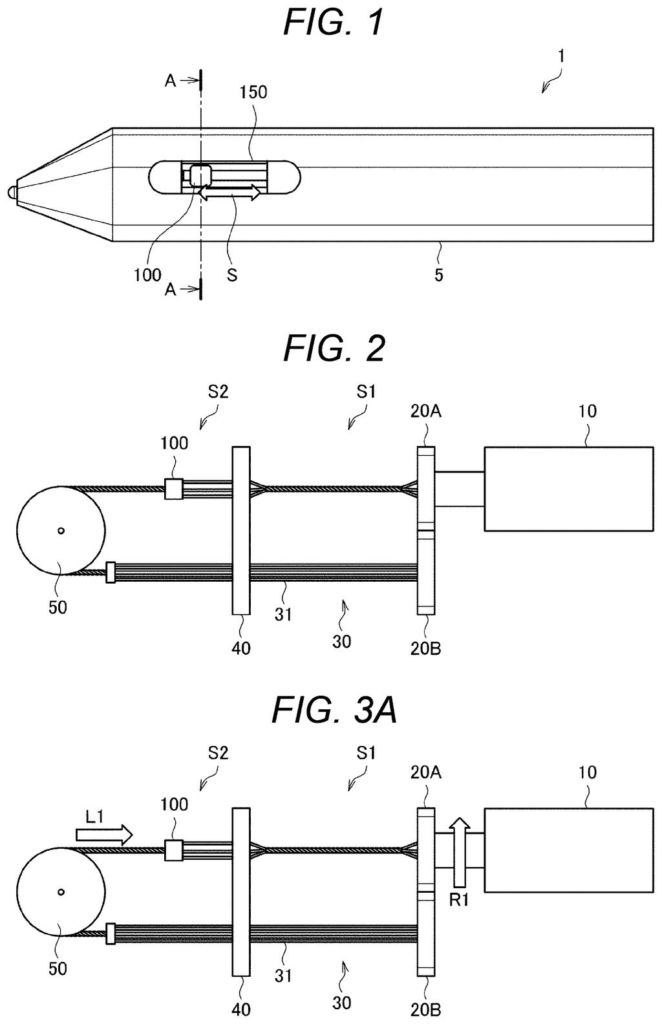
Sony's patent application describes a pen with a small bump poking out of its side. You rest your index finger on the bump, and a motor slides it forward or back, tugging your skin. Your brain reads that sideways tug as weight, so in a VR game the pen could feel like it is lifting a virtual object.
The trick is a bundle of twisted wires, a bit like a wound-up rubber band, that lets one small motor move the bump in both directions.
A tactile sensation by a shear force is presented to a user by a linear motion by a TSA.
Translation: The device creates a dragging feeling on your skin by pulling a wire straight back and forth.
How twisted wires slide a bump under your finger
At the core is a twisted string actuator, or TSA. When you twist a bundle of wires, it gets shorter and pulls on whatever is attached, a bit like winding a rubber band. It is small and light with plenty of pulling power, but it only pulls one way.
Sony splits the wire bundle at a divider called a separator. On the motor side, the wires twist and untwist as the motor runs. Past the separator, the twist stays fixed, and that section carries the effector, a sliding part with a bump that pokes out of the pen. A main gear meshes with a sub gear that spins the other way, so one side tightens while the other loosens. Reverse the motor and the bump slides back.
The filing adds several supporting pieces:
- A pulley folds the wires into a U shape, so one motor does the job.
- A groove with a sloped edge lets your finger touch both the moving bump and the fixed body, which is what makes a tug felt.
- A grippy surface (silicone or rubber) and a guide that keeps the bump from being pushed inward.
- An optional vibration motor, combined with the tug.
Infrared LEDs and a motion sensor track the pen, so a virtual pointer touching a virtual object can trigger the tug.
… an effector including a protrusion protruding outward from the tactile presentation device and movable in a linear direction by the driving force of the motor is provided.
Translation: A tiny button or tip pushes against your finger and moves in a straight line using motorized force.
Why a pen could make VR objects feel heavy
VR controllers can show you a ball, but they struggle to make it feel like it has any heft. A skin-tug approach like this aims to add that missing sense of weight, and the pen shape in the filing puts it in something you hold like a pen or a mouse, shapes the company says are hard for other approaches to fit.
For you, it could mean a future VR gadget that tells your fingertip when you have grabbed, lifted or bumped something. The filing also sketches wristbands, rings and headsets, where the same bump could suggest direction, acceleration or wind on your forehead. It is a patent application, with no product attached.
Sony's 27th filing in our input and haptics coverage we've tracked since May adds to a run that includes a self-positioning thumbstick and remappable controller buttons.
Nothing here arrives as a software update. Every piece is physical: a motor, two gears, a bundle of six or so wires, a pulley and a rubbery bump. The parts count stays low, which is the whole selling point for a device slim enough to be a pen.
The shortest route to a product is a pen-style VR controller. The filing already pairs the pen with position sensors and a virtual pointer that triggers the tug on contact, and that tracking half exists in modern VR gear. What has to be built is the tug itself, tuned so a few millimeters of bump travel feels like a heavy cup.
The filing gives no force numbers, no durability testing and no battery details, so how long twisted wires last under daily use is an open question. That puts it a few engineering rounds from a shippable gadget.
Get our take in your Top Stories
Liked this breakdown? Add Patentlyze as a preferred source on Google, and our plain-English take shows up more often in your Top Stories the next time Sony patent news breaks.
There are more where this came from
We read every patent application Big Tech publishes and send you the ones worth knowing. Plain English, free, every week.
The drawings
2 drawing sheets from US 2026/0349515 A1 · click any drawing to enlarge


Want this weekly breakdown for a company we don't cover? Patentlyze Pro →
Be the first to weigh in