Get the newsletter
Sony · Software · Filed May 23, 2025 · USPTO published Nov 12, 2026 · This week's release

Sony Files Patent for Cheaper, Realistic Game Audio Behind Walls and Obstacles

Ever noticed how game audio suddenly goes dull when you duck behind a wall? Sony has filed a patent application for simulating how sound really bends around edges, with a shortcut that keeps the math light enough to run live.
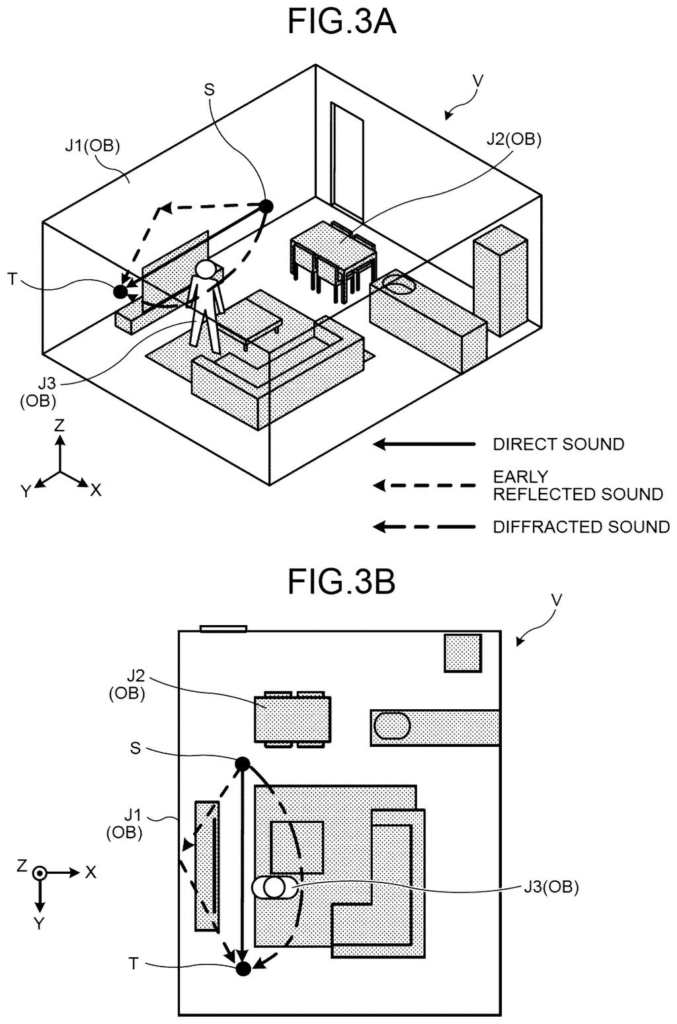
Sound waves bend around walls and furniture in a virtual room so game audio matches what players see on screen. Drawing from patent filing US 2026/0362078 A1.
Sound waves bend around walls and furniture in a virtual room so game audio matches what players see on screen.All 35 drawings ↓
Publication number
US 2026/0362078 A1(US20260362078A1)
Applicant
Sony Group Corporation
Filed · Published
May 23, 2025 · Nov 12, 2026
Inventors
Koya Sato, Kazuki Sakai, Naoki Shinmen, Natsuko Maeda
Status when we published
Waiting for an examiner
Document
22 claims
US classification
381/303
Examiner
FAULK, DEVONA E (Art Unit 2618)
Parent application
National Stage Entry of PCT/JP2023/041352 (filed Nov 16, 2023)(PCTJP2023041352)

What Sony's muffled-sound simulation actually does

Imagine you're crouched behind a concrete pillar in a video game while a teammate shouts from the other side. In real life, that voice wouldn't just get quieter. It would bend around the pillar's edge and pick up a slightly hollow, muffled character that your ears recognize instantly.

Most games fake this with a simple dial that turns down the treble, which is why the sound can jump abruptly when your character steps behind something. Sony's filing describes a more physically accurate approach: actually simulating how sound waves wrap around an edge, but only for a short slice of time and a small patch of space, so a game console can keep up.

The big idea is to stop the heavy calculation the moment the bent sound has arrived, instead of working out the echo of the entire room.

From the filing · CLAIM 1
searching a diffraction path from a sound source to a sound receiving point; and generating a diffracted sound acquired at the sound receiving point on a basis of a wave acoustic simulation with a simulation time constrained according to a distance of the diffraction path.

Translation: The system traces how sound bends around obstacles and calculates the resulting audio based on how far it has to travel.

How Sony shortens the sound-wave math

The method has two steps. First, the computer searches for the route sound takes from a source (say, a shouting teammate) to the listening point (your character's ears) when something blocks the straight line. Sound that bends around the edge of an obstacle is called diffracted sound.

Second, it generates that sound with a wave acoustic simulation (a physics calculation that treats sound as a wave rather than a beam), but cuts it short. The program works out when the bent sound first arrives by dividing the path length by the speed of sound. It then simulates only 1 to 5 times that arrival time. The description suggests about 2 times, preferably 3 or fewer, which is enough to catch the fine scattering at the edge.

The filing also describes shrinking the space. Instead of the whole virtual world, the simulation runs in a small subspace around the obstacle's edge, sized to what a machine can compute in one video frame (about 16 milliseconds at 60 frames per second). One worked example gives a sphere with a radius of about 1.36 meters.

The output is an impulse response (a sound fingerprint of that path) that gets blended with the original audio. A trained AI model or a pre-computed lookup table can stand in for the full simulation, and the work can be offloaded to a cloud server.

Why game worlds could sound less fake behind walls

If you play games or explore virtual worlds with headphones, the practical payoff is sound that behaves more like the real thing. The filing says the usual game audio tools fake obstacles with a simple filter that dulls high pitches, and that this can cause sudden, jarring changes as you move. A physics-based version could smooth that out.

The catch it is trying to solve is cost. Wave simulation gives better results but is normally too heavy to run while you play. By trimming the time and space it covers, and by offering shortcuts like lookup tables, a trained model or cloud processing, the filing aims to make realistic sound affordable on a game machine, tablet or PC. Sound designers could also adjust the results for dramatic effect.

Sony's 699th filing in our Sony coverage since May adds to a run that includes a voice-panic game helper and a shape-shifting digital ball.

Source: US 2026/0362078 A1 at the USPTO (PDF). Full patent text and figures are in the official publication.

Get our take in your Top Stories

Liked this breakdown? Add Patentlyze as a preferred source on Google, and our plain-English take shows up more often in your Top Stories the next time Sony patent news breaks.

There are more where this came from

We read every patent application Big Tech publishes and send you the ones worth knowing. Plain English, free, every week.

The drawings · 35 sheets

35 drawing sheets from US 2026/0362078 A1 · click any drawing to enlarge

Combining direct and reflected audio in a 3D scene, drawing sheet 1 from US 2026/0362078 A1
Sheet 1 Combining direct and reflected audio in a 3D scene
Steps for turning room geometry into realistic game audio, drawing sheet 2 from US 2026/0362078 A1
Sheet 2 Steps for turning room geometry into realistic game audio
Tracking sound paths around furniture and walls, drawing sheet 3 from US 2026/0362078 A1
Sheet 3 Tracking sound paths around furniture and walls
Calculating how sound bounces off room boundaries, drawing sheet 4 from US 2026/0362078 A1
Sheet 4 Calculating how sound bounces off room boundaries
An impulse response blending direct sound and late echoes, drawing sheet 5 from US 2026/0362078 A1
Sheet 5 An impulse response blending direct sound and late echoes
Repeating calculations for sounds that bend or pass through, drawing sheet 6 from US 2026/0362078 A1
Sheet 6 Repeating calculations for sounds that bend or pass through
Why low pitches bend around obstacles better than highs, drawing sheet 7 from US 2026/0362078 A1
Sheet 7 Why low pitches bend around obstacles better than highs
Conventional filter settings and a room diffraction path, drawing sheet 8 from US 2026/0362078 A1
Sheet 8 Conventional filter settings and a room diffraction path
Show the other 27 sheets
Frequency patterns of sound bending around an obstacle, drawing sheet 9 from US 2026/0362078 A1
Sheet 9 Frequency patterns of sound bending around an obstacle
Internal parts of a device that simulates game audio, drawing sheet 10 from US 2026/0362078 A1
Sheet 10 Internal parts of a device that simulates game audio
How the system looks up sound patterns around corners, drawing sheet 11 from US 2026/0362078 A1
Sheet 11 How the system looks up sound patterns around corners
Using AI to predict realistic sound around barriers, drawing sheet 12 from US 2026/0362078 A1
Sheet 12 Using AI to predict realistic sound around barriers
Offloading sound calculations to cloud servers, drawing sheet 13 from US 2026/0362078 A1
Sheet 13 Offloading sound calculations to cloud servers
Limiting sound simulation to small zones around obstacles, drawing sheet 14 from US 2026/0362078 A1
Sheet 14 Limiting sound simulation to small zones around obstacles
Steps for calculating sound within a restricted space, drawing sheet 15 from US 2026/0362078 A1
Sheet 15 Steps for calculating sound within a restricted space
Handling distant audio by placing a stand-in sound source, drawing sheet 16 from US 2026/0362078 A1
Sheet 16 Handling distant audio by placing a stand-in sound source
Steps for tailoring sound delay and loudness around an obstacle, drawing sheet 17 from US 2026/0362078 A1
Sheet 17 Steps for tailoring sound delay and loudness around an obstacle
How the system chooses full simulation or quick sound adjustments, drawing sheet 18 from US 2026/0362078 A1
Sheet 18 How the system chooses full simulation or quick sound adjustments
Placing virtual sound markers along boundaries to save computing power, drawing sheet 19 from US 2026/0362078 A1
Sheet 19 Placing virtual sound markers along boundaries to save computing power
Enclosing multiple jagged obstacle edges inside one simulation zone, drawing sheet 20 from US 2026/0362078 A1
Sheet 20 Enclosing multiple jagged obstacle edges inside one simulation zone
Breaking a sound path across multiple barriers into smaller steps, drawing sheet 21 from US 2026/0362078 A1
Sheet 21 Breaking a sound path across multiple barriers into smaller steps
Checking sound direction and source size to skip useless calculations, drawing sheet 22 from US 2026/0362078 A1
Sheet 22 Checking sound direction and source size to skip useless calculations
Handling sound squeezing through a gap between two obstacles, drawing sheet 23 from US 2026/0362078 A1
Sheet 23 Handling sound squeezing through a gap between two obstacles
Flattening obstacle corners into slices to speed up audio processing, drawing sheet 24 from US 2026/0362078 A1
Sheet 24 Flattening obstacle corners into slices to speed up audio processing
How audio fades over distance across two and three dimensions, drawing sheet 25 from US 2026/0362078 A1
Sheet 25 How audio fades over distance across two and three dimensions
Mixing sounds that bend around wall edges, drawing sheet 26 from US 2026/0362078 A1
Sheet 26 Mixing sounds that bend around wall edges
Mapping three separate sound paths around a single obstacle, drawing sheet 27 from US 2026/0362078 A1
Sheet 27 Mapping three separate sound paths around a single obstacle
Splitting a complex room position into simpler flat sound views, drawing sheet 28 from US 2026/0362078 A1
Sheet 28 Splitting a complex room position into simpler flat sound views
Calculating sound bending past the side edge of a barrier, drawing sheet 29 from US 2026/0362078 A1
Sheet 29 Calculating sound bending past the side edge of a barrier
Adjusting timing and volume for side-bent audio, drawing sheet 30 from US 2026/0362078 A1
Sheet 30 Adjusting timing and volume for side-bent audio
Recreating sound waves bending over a wall, drawing sheet 31 from US 2026/0362078 A1
Sheet 31 Recreating sound waves bending over a wall
Fine-tuning volume and delay for sound passing over an obstacle, drawing sheet 32 from US 2026/0362078 A1
Sheet 32 Fine-tuning volume and delay for sound passing over an obstacle
Combining audio signals from different paths around an obstacle, drawing sheet 33 from US 2026/0362078 A1
Sheet 33 Combining audio signals from different paths around an obstacle
Angling a calculation plane to follow sound over obstacles, drawing sheet 34 from US 2026/0362078 A1
Sheet 34 Angling a calculation plane to follow sound over obstacles
Hardware running AI to predict sound responses, drawing sheet 35 from US 2026/0362078 A1
Sheet 35 Hardware running AI to predict sound responses
Patent filing page

Reader comments

No comments yet

Start the discussion

Real name or a handle, either is fine. Comments are read by a person before they appear, so allow a little time. Keep it about the filing.