
Unitree
Unitree · AR / VR · Filed Mar 3, 2025 · USPTO published Nov 19, 2026 · This week's release
Unitree Patents a Support Frame That Takes the Weight of VR Headsets Off Your Face
Wear a VR headset for an hour and your neck usually lets you know about it. This Unitree patent application hangs the headset from a frame on your back or a nearby chair, so something other than your head carries the load.
- Publication number
- US 2026/0367412 A1(US20260367412A1)
- Applicant
- HangZhou YuShu TECHNOLOGY CO.,LTD.
- Filed · Published
- Mar 3, 2025 · Nov 19, 2026
- Inventors
- Xingxing WANG
- Status when we published
- Examiner raised objections; the company can respond
- Document
- 10 claims
- US classification
- 345/8
- Examiner
- SITTA, GRANT (Art Unit 2622)
- Parent application
- National Stage Entry of PCT/CN2024/080950 (filed Mar 11, 2024)(PCTCN2024080950)
What Unitree's VR headset support frame does
A man sits down for a long VR session with a heavy headset strapped to his face. An hour in, his nose is sore and his neck aches from holding up a weight that sits mostly out in front of his eyes.
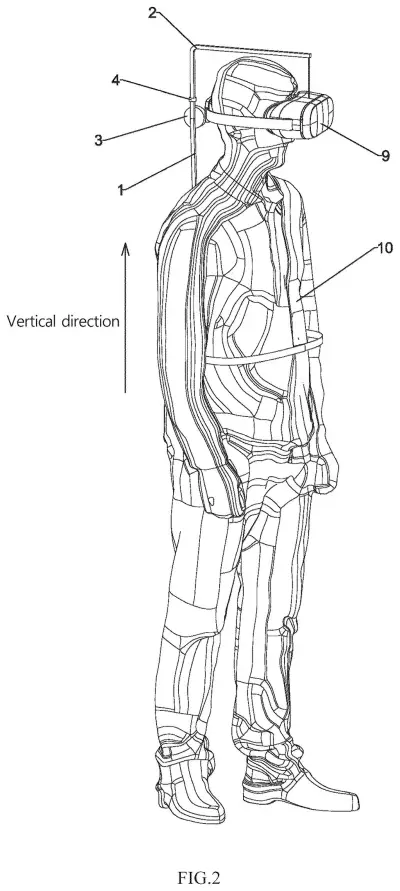
Unitree's filing describes a fix: let something other than your head hold the headset up. A rod straps to your back, and an arm curves over your head to the headset. A rope runs from the arm to the headset, so the weight travels down the rope and the rod into your torso.
The frame is built to move with you. Look up or down and a small motor feeds out or reels in the rope. Turn your head and the arm swivels along with you. The filing also describes versions that clamp to a chair or a table, so your body carries none of the weight.
… a gravity-overcoming support force for the head-mounted smart device; a drive unit provided between the first support member and the second support member or provided on the second support member, and configured to, in cooperation with rotation of the head of the user in a vertical direction, provide a driving force for the head-mounted smart device in the vertical direction; …
Translation: A motorized mechanism helps lift the weight of the headset as you look up and down.
How the rope and motor follow your head
The filing describes a gravity compensation mechanism (a support that cancels some or all of a headset's weight), filed by HangZhou YuShu Technology, the company behind Unitree. It has two main parts. A first support member fixes to your body or to something near you, like a chair or table. A second support member connects to it with a movable joint and holds up the headset.
The filing describes several versions:
- Worn on the body: a vertical rod strapped to your back, joined to an L-shaped or arc-shaped rod that goes around your head.
- Rope and reel: a drive unit (a motor, or a spring-like elastic mechanism) winds a rope attached to the headset, with pulleys or slots guiding it.
- Swivel joint: a horizontal rotating shaft lets the arm turn when you turn your head.
- Furniture mounted: the base rod attaches to a chair, table or other fixed object.
In the main worked example, the motor senses a change in the rope as you raise or lower your head, then winds or unwinds it, so the headset is supported in real time. A simpler variation swaps the motor for a joint with built-in resistance (a damped universal joint). The rods can also be telescoping, to fit different heights and headset weights.
… alleviating poor use experience such as head and face discomfort and neck soreness that is caused by long-time wearing of the head-mounted smart device, thereby improving the use experience of the user for the head-mounted smart device …
Translation: The design aims to stop the face pain and neck strain caused by wearing a headset for too long.
What this means for heavy VR headsets
The practical payoff is comfort. The filing says most headsets are heavy and weighted toward the front, which causes face discomfort and neck soreness over long sessions, and it calls the problem a barrier to wider use of these devices. It also points out that an earlier lever-style fix only gave limited relief and added pressure to the top of the head.
The approach here is an accessory frame, and it could work with a headset from any maker rather than needing a redesigned one. The examiner's first review rejected the claims as filed, which is routine at this stage and usually followed by amendments. Nothing in the filing says this is headed for a product.
Source: US 2026/0367412 A1 at the USPTO (PDF). Full patent text and figures are in the official publication.
Get our take in your Top Stories
Liked this breakdown? Add Patentlyze as a preferred source on Google, and our plain-English take shows up more often in your Top Stories the next time Unitree patent news breaks.
Add Patentlyze on Google
One click.
There are more where this came from
We read the new patents from Big Tech, carmakers and more and send you the ones worth knowing. Plain English, free, every week.
The drawings · 9 sheets
9 drawing sheets from US 2026/0367412 A1 · click any drawing to enlarge


Show sheet 9

More from Unitree
All 2 Unitree patents →More in AR / VR
All 718 AR / VR patents →
Apple
Apple Files Patent for Headset Labels That Turn to Face You as You Walk
Microsoft
Microsoft Files Patent for Turning One Selfie Into a 3-D Face Model
Samsung
Samsung Patents a VR Headset That Pauses the Game When You Step Out of Bounds
Apple
No comments yet