
Waymo Patents Using Two Radars to Tell Where Cars and Pedestrians Are Heading
A single car radar can tell how fast something is approaching, but it barely notices when that something is moving sideways. Waymo's patent application adds a second radar to fill in the missing half.
What Waymo's two-radar setup actually does
Ever watched a car far down the road and wondered whether it's heading straight for you or sliding across your lane? A car's radar has the same problem. It can tell how fast something is closing in or pulling away, but it is nearly blind to sideways motion.
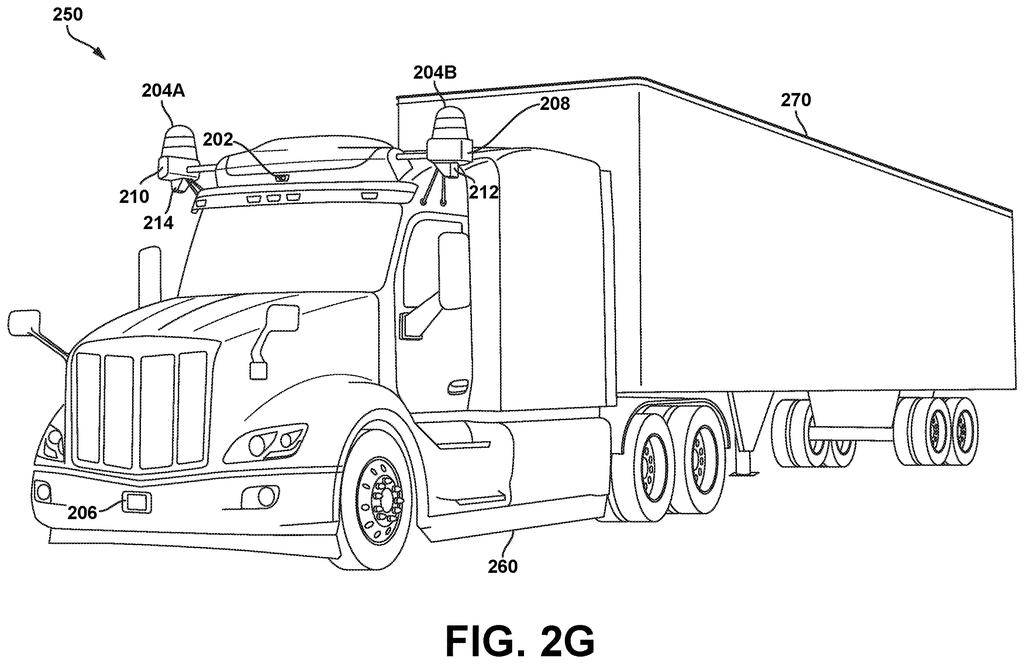
Waymo's patent application covers a fix. Put two radars at different spots on the vehicle, such as near the headlights, and let each one measure the same object from its own angle. Two angles on the same moving thing are enough to work out its real direction and speed.
That richer motion data then goes to an AI model that spots objects and estimates what they are and what they might do next, such as a pedestrian about to cross. The car's driving decisions follow from that output.
… determining a first radial speed for an object in the environment based on the first radar data and a second radial speed for the object based on the second radar data; estimating a velocity vector for the object relative to the vehicle by determining an intersection point based on the first radial speed and the second radial speed; …
Translation: The system combines speed readings from two different radars to figure out which way a nearby car or pedestrian is moving.
How two radar readings become one direction
Each radar bounces radio waves off an object and reads the Doppler shift (the change in the returning wave's frequency caused by motion) to get a radial speed: how fast the object moves straight toward or away from that radar. One radar misses the sideways part of the motion entirely.
With two radars at different spots on the vehicle, the system turns each reading into an arrow in the car's own coordinate frame. It then draws a line at a right angle to each arrow and finds where the two lines cross. That crossing point gives the object's full velocity vector (speed and direction) relative to the car, found by solving a small two-by-two set of equations. A third radar mounted elsewhere, for example higher up, lets the same idea work in three dimensions using three planes and a three-by-three set of equations.
- Each pixel of the radar image carries two velocity channels (x and y) instead of a single radial speed.
- The radar images are lined up into one shared frame, and the per-pixel speeds are merged before the neural network (the AI model) looks for objects.
- One dependent claim has the network detect objects without a Kalman filter (older tracking math that follows an object after it has already been found).
The description also covers giving the radars different waveforms and pulse rates, so their signals can be told apart and speed readings that wrap around can be sorted out. Camera images or lidar data can be fed into the same network as extra inputs.
A vehicle radar system receives radar first radar data from a first radar and second radar data from a second radar, which are coupled at different locations on a vehicle traveling in an environment.
Translation: Two radars mounted in different spots on the car collect movement data at the same time.
Why sideways motion matters for robotaxis
The practical payoff is a car that reads crossing traffic better: a pedestrian stepping off a curb, a car cutting across a lane, or a stalled vehicle that a single radar could mistake for scenery. The filing says that kind of motion data helps the system guess where an object is going, not only where it is right now.
Radar also keeps working in rain, fog and snow, when cameras struggle. If the approach holds up, it could sharpen the all-weather part of a car's senses. The filing describes uses in both fully self-driving vehicles and driver-assist systems, so the idea is not limited to robotaxis.
Google's 65th filing we've tracked since May joins earlier work like turn signals versus actual movement and predicting what comes next in our robotaxi sensing filings.
The problem is real. A car that only knows how fast something is closing in on it has to guess about everything crossing its path, and crossing paths are where many collisions begin. Pedestrians stepping off a curb and cars cutting across lanes both live in that blind spot.
The fix matches the size of the problem. It adds a second radar and some geometry rather than a whole new type of sensor, and it hands the result to the AI early, before the car decides what it is looking at.
The filing gives no accuracy figures and no test results, so how much it helps stays unknown. Until numbers appear, treat it as a sound idea on paper that targets a well-known gap.
Get our take in your Top Stories
Liked this breakdown? Add Patentlyze as a preferred source on Google, and our plain-English take shows up more often in your Top Stories the next time Google patent news breaks.
There are more where this came from
We read every patent application Big Tech publishes and send you the ones worth knowing. Plain English, free, every week.
The drawings
19 drawing sheets from US 2026/0309857 A1 · click any drawing to enlarge


Show the other 11 sheets


Want this weekly breakdown for a company we don't cover? Patentlyze Pro →
Be the first to weigh in